Mercedes Benz Places Binghatti City: Are Cities Being Built or Logos?

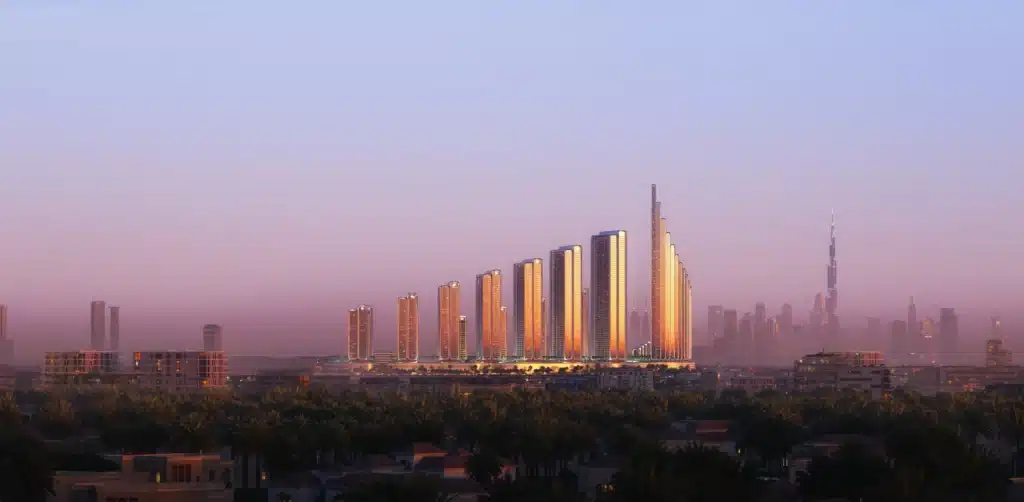
Mercedes Benz Places Binghatti City represents a shift in Dubai’s real estate trajectory. It is the first integrated masterplan developed by Binghatti Developers in partnership with a non-hotel global industrial brand. The project expands the concept of branded architecture beyond a single tower among buildings and structures, forming a coordinated urban district. It reflects how corporate identity now shapes entire urban systems in rapidly transforming cities.

Design Concept
The masterplan uses a mixed-use urban model. Residential, commercial, cultural, and leisure functions coexist within a walkable radius. Instead of a closed compound, it creates layered zones of privacy and public access. Multiple buildings generate active ground-level spaces like boulevards and plazas. This counters the region’s trend of isolated developments. Pedestrian continuity and spatial sequencing draw from automotive design logic.

Materials & Construction
The design follows Mercedes-Benz’s Sensual Purity philosophy. Expect fluid façades, clear horizontal lines, and precise metallic details. Specific building materials are undisclosed. But geometric clarity suggests engineered glass, precast concrete, and finished metals. Active podiums link interior design with public paths without decorative branding. Engineering likely addresses Dubai’s heat, though full construction methods remain unreleased.
Sustainability
Detailed environmental data is not public. Yet the scale of Mercedes Benz Places Binghatti City demands clear sustainability measures. Anticipated features include high performance façades, water efficient landscaping, and energy conscious systems. If integrated, these would make sustainability part of the project’s identity. This aligns with findings in global research.
Urban Impact
The project sits in Meydan, a zone undergoing rapid densification. It includes mobility hubs and reduces car dominance through multi-level circulation. Parking is hidden in podiums or underground. This frees the pedestrian level for social use. But success depends on real public activity not just curated aesthetics. As branded developments rise, this scheme tests if commercial identity can support civic cities frameworks. Will Mercedes-Benz Places Binghatti City redefine urban integration or just repackage branding as placemaking?
architectural Snapshot: A branded masterplan in Meydan translating automotive design language into layered public space, graduated skyline, and mixed use urbanism.
✦ ArchUp Editorial Insight
Mercedes Benz Places Binghatti City reframes branded architecture as an urban proposition rather than a singular icon, embedding automotive design logic into zoning, podium activation, and pedestrian sequencing. Yet the translation of Sensual Purity into civic space risks conflating corporate aesthetics with public value. The project avoids overt ornamentation, which is commendable, but its narrative still hinges on brand aura over spatial democracy. Should such models proliferate without robust public oversight, Dubai’s urban fabric may become a catalog of logos rather than a city.