

Murano Glass Stools at Bottega Veneta: Where Traditional Craft Meets Contemporary Designi

In the world of fashion runways, where all eyes are on fabric and textile details, Bottega Veneta’s Summer 2026 show in Milan redefined the concept of scenography. It transformed stools from mere functional props into central artistic masterpieces, telling the collection’s story through a silent yet powerfully impactful visual language.
A Series of Murano Glass Stools: The Beating Heart of the Scenography
A series of stools made from transparent, hand-blown Murano glass formed the main visual axis of the show. These pieces were not just seating; they were luminous sculptures mimicking the gaze into the sea. Designed specifically for the show by studio 6:AM, they created a visual dialogue with the collection’s colors and textures, indirectly translating the brand’s famous “intrecciato” technique through the interplay of light, color, and transparency.
A Nature-Inspired Color Palette: Ten Shades of the Italian Coast
The design relied on a custom color palette of ten natural shades, ranging from aquatic greens and warm amber to stony grays. No single color dominated; instead, they harmonized in a chromatic symphony reminiscent of a coastal landscape. This gradient was not random but served to guide the audience’s gaze along the runway, with each stool forming an independent yet complementary visual station.
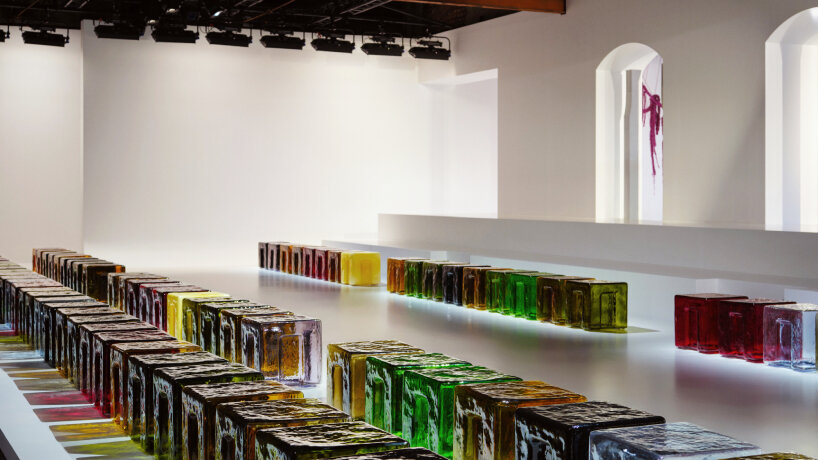
A Dialogue of Material and Light: Simulating the Calm and Turmoil of the Sea
The design’s mastery was evident in how the pieces interacted with light. The smooth external surfaces, with natural marks from the blowing process, gently diffused light, creating a glow similar to sunlight on water. When viewed from above, the slightly flattened top surface revealed calm reflections, while the transparent, hollow interior revealed a magical depth, trapping and releasing light in a gradient, mimicking the ocean depths where light turns to darkness. This visual play transformed the static objects into dynamic entities that changed with the viewing angle and light intensity.
Functional Essence: Between Art and Practical Use
Despite their artistic nature, the stools maintained their functional core. The cubic form with equal dimensions and the flattened top confirmed their potential use as a stool, seat, or even a low side table. This blend of overt aesthetics and latent utility is the core of Bottega Veneta’s design philosophy, where beauty is inseparable from function.
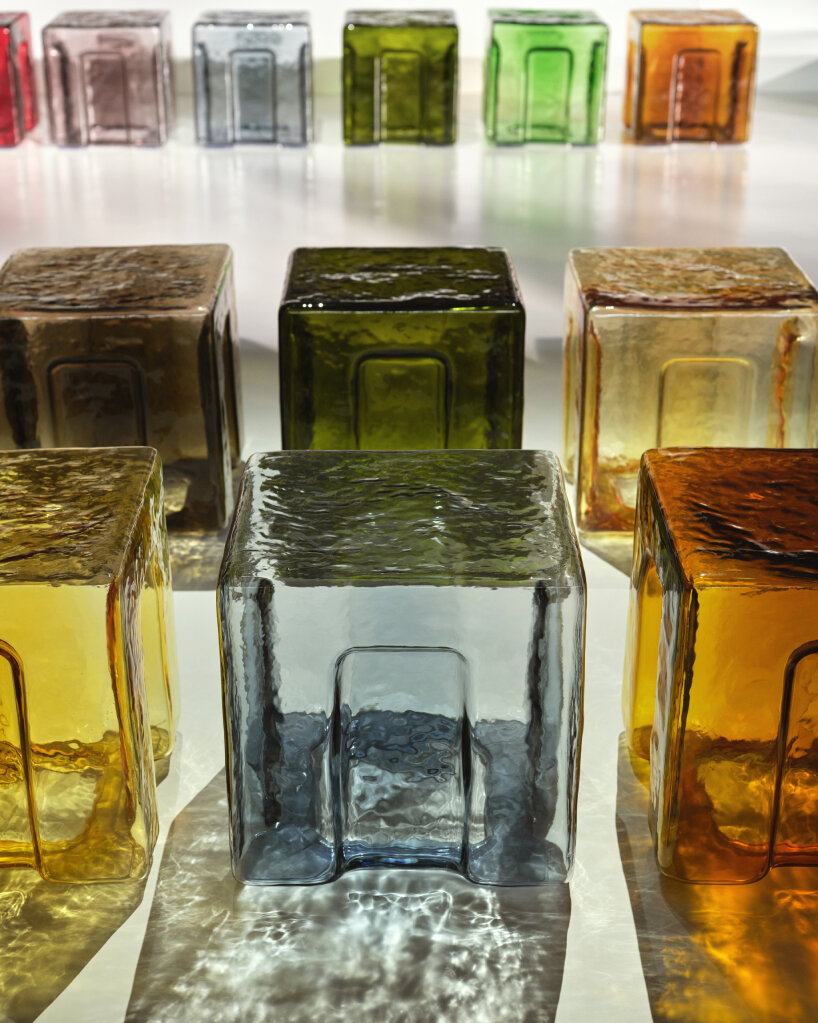
Murano Craft: Centuries of History in a Contemporary Mold
The beauty of these pieces is inseparable from their artisanal history. Crafted on the island of Murano near Venice, the stools utilized blown-glass techniques developed and passed down over centuries. For this project, studio 6:AM worked closely with local glassmakers, who used traditional kilns and exercised precise control over temperature and molten glass movement to achieve the desired cubic form and unique optical properties. Each stool is a testament to a living, breathing craft that refuses to fade in the face of mass production.
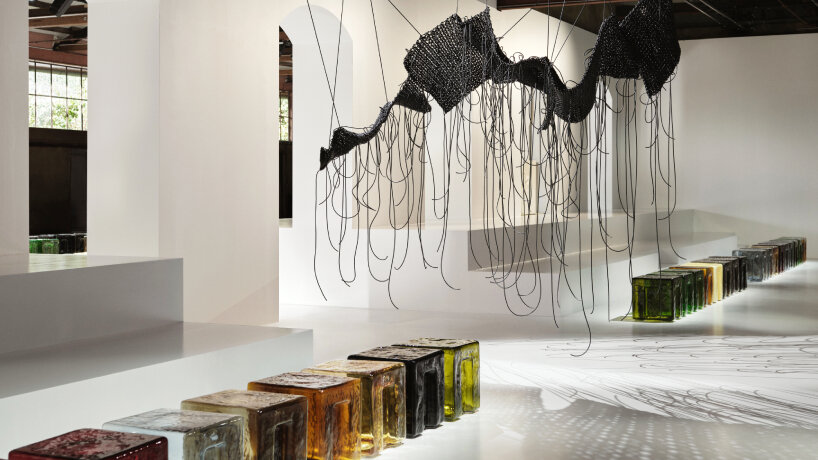
The Holistic Sensory Experience: When Sound Becomes a Fabric
The visual experience was not the only sensory element. To deepen the audience’s immersion, Bottega Veneta presented a unique soundscape produced by the Oscar-winning British artist and director Steve McQueen. McQueen created an auditory piece titled “’66 – ’76,” which reworked and recorded the song “Wild Is the Wind” by both Nina Simone and David Bowie. The two versions were edited to overlap and function as a sonic vortex, with the artist describing his work as an “auditory intrecciato,” a clever and direct reference to the woven leather pattern that is a cornerstone of the brand’s identity. In this way, the show was not merely a fashion presentation but a comprehensive art installation stimulating all the senses.
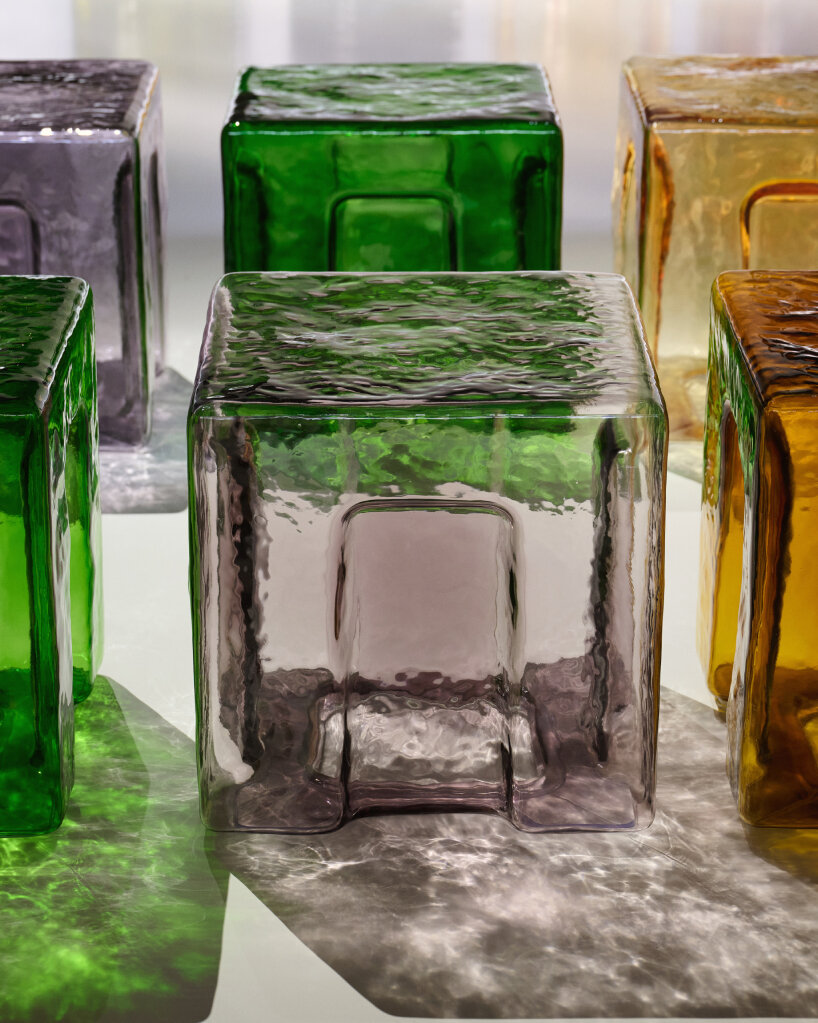
Through this masterful integration of historic Murano craft, contemporary design, and an immersive sensory experience, the Bottega Veneta show presented a complete scenographic environment. The glass stools were not mere decor; they were a visual matrix linking past and present, craft and design, art and function, confirming that true creativity lies as much in the details surrounding the clothes as in the clothes themselves.
✦ ArchUp Editorial insight
The article examines the transformation of a fundamental functional element in fashion shows—stools—into central artistic pieces that form the entire scenography. Through an architectural reading of the pieces, it is noted that the reliance on a strict cubic form with equal dimensions conflicts with the organic narrative derived from the sea and waves, creating a contradiction between the flexibility of the visual reference and the rigidity of its physical embodiment. The design depends entirely on transparency and light reflections to create aesthetic value, yet this characteristic makes the piece highly sensitive to its surrounding context, as it may lose its impact under uncontrolled lighting conditions or non-uniform backgrounds. Furthermore, the purely artisanal nature of production, while valuable, presents challenges related to scalability and achieving consistency if the concept were to be applied in a broader architectural context. However, the piece demonstrates a notable efficiency in utilizing the unique optical properties of the material to create a dynamic dialogue with the surrounding space, activating the void by breaking harsh light, redistributing it, and imparting a changing visual depth that adds vitality to a static space.
Brought to you by the ArchUp Editorial Team
Inspiration starts here. Dive deeper into Architecture, Interior Design, Research, Cities, Design, and cutting-edge Projectson ArchUp.


