Nang House: Architectural Design Exploring the Interaction Between Contemporary Architecture and Heritage Nature

Preserving Heritage in the Suburbs of Hanoi
In the outskirts of Hanoi, where the urban sprawl encroaches upon traditional rural life, Trung Tran Studio presents the Nang House project as an example of balancing modernity with local identity. The residence spans 270 square meters and accommodates three generations, quietly nestled among existing homes and buildings and mature trees. What distinguishes this project is the preservation of every element of the surrounding landscape rather than its removal, reflecting respect for the local environment and the history of the site. The project was completed in 2025, at a time when traditional rural heritage faces pressures from rapid urban development.
Brick as an Expressive Element
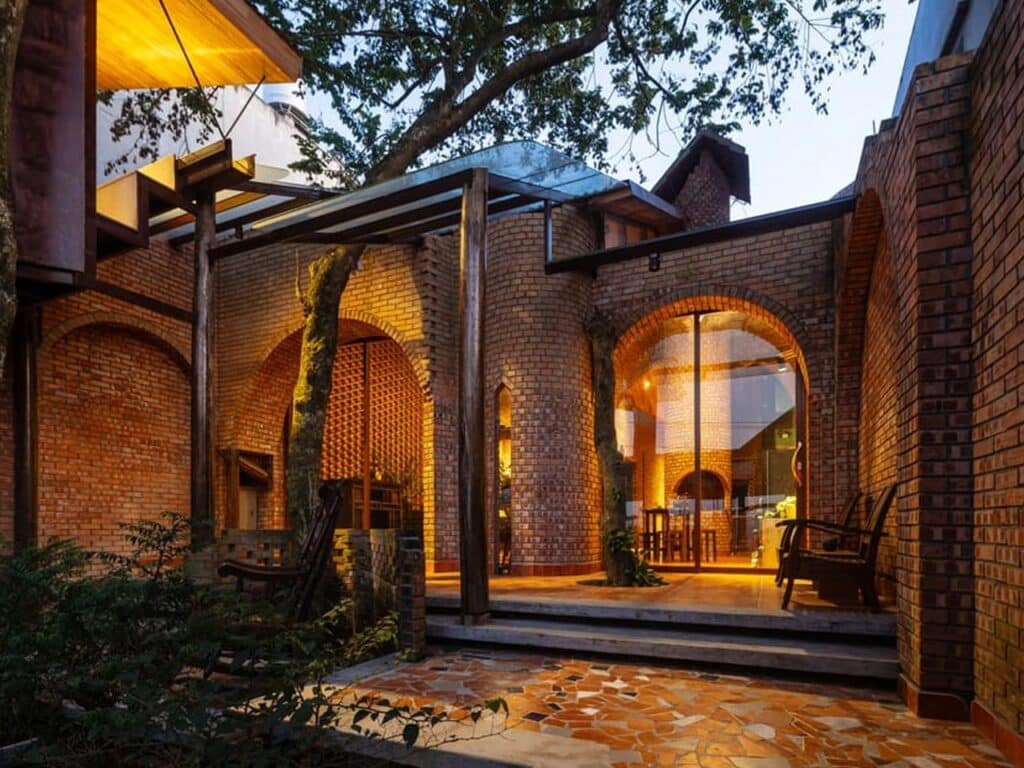
The architecture of this residence speaks through brick, the primary building material, reimagined in contemporary forms. Patterned walls rise with modular designs, capturing light in different ways throughout the day. Arches and circular openings punctuate the structure, acting as gateways that guide movement within the house and frame views toward the surrounding gardens.
Balancing Rigour and Warmth
The choice of materials in the house represents a balance between practicality and poetic expression; it anchors the residence in local building traditions while advancing a coherent and clear modernity. The high wooden ceilings and curved details emphasize the geometric corners of the brickwork, creating a harmony between structural rigor and organic warmth, making the sensory experience of the space rich and comforting.

An Integrated Relationship with Nature
The Nang House project is distinguished by its close relationship with the site itself. Trees that have stood for decades remain rooted in their original positions, as the openings in the rooflines were carefully designed to accommodate their trunks without removing any of them. The tree canopy extends over the central courtyard, blurring the boundaries between interior and exterior spaces and turning the garden into the vibrant heart of the home. Here, sunlight filters through the leaves, and multiple generations gather together, enhancing a sense of family cohesion.
Flow Between Indoor and Outdoor Spaces
The design allows for a seamless flow between indoor and outdoor areas, where spaces naturally converge, and the house benefits from natural ventilation flowing through the porous brick façade. This open connection with the external environment enriches daily living experiences and ensures that every corner of the house is linked to the surrounding garden.
Floor Plans and Natural Light
The floor plans unfold as a series of sequential rooms around a central void. Living areas, dining rooms, and the prayer room occupy the heart of the home, forming a continuous zone for family life. Light penetrates through narrow clerestory windows installed in the sloping roofs, creating shifting patterns across the brick surfaces. The result is a delicate visual effect, where the walls appear alive with the daily movement of the sun.
Integration of Natural Materials
Inside, the patterned brick walls converge with wooden elements at precise, well-defined intersections, highlighting the balance between geometric rigor and organic warmth. This combination gives the house a distinctive character that blends authenticity with modernity, making it a notable reference in architectural research on integrating traditional materials in contemporary architecture.


Bedroom Design and Interaction with the Environment
The Nang House spans two floors and contains five bedrooms, four of which extend toward the rear of the property. Each room is modest in size, yet exudes warmth through wooden ceilings and brick walls, creating intimate and comfortable spaces for daily living. Windows with framed views of the garden connect each room to the surrounding landscape, maintaining visual continuity throughout the home.
The bedrooms are interspersed with three distinct gardens, each serving a specific function suitable for a multigenerational family. This carefully considered layout allows for privacy when needed, while simultaneously encouraging social interaction in shared areas, making the home adaptable to the varied rhythms of family life.
Contemporary Architecture and Context Preservation
Trung Tran Studio’s approach goes beyond the conventional rapid-rural development model, which often entails clearing everything and starting from scratch. Instead, Nang House demonstrates how contemporary architecture can work with existing conditions, preserving what is already present while creating entirely new spaces.
Balancing Heritage and Progress
This architecture reflects a deep understanding of the local context without indulging in nostalgia. In a rapidly expanding urban environment that could erase everything in its path, Nang House proves that progress can coexist with nature and heritage. Ancient trees and new walls harmonize, affirming that innovation does not always mean erasure.


✦ ArchUp Editorial Insight
Nang House can be seen as a model reflecting an attempt to integrate contemporary architecture with the natural and heritage context, representing a positive example of respecting the surrounding environment and preserving the site’s original elements. The attention to landscaping and open spaces allows for a living experience more connected to nature, providing an example of how sites with heritage value can be approached without resorting to complete clearance.
However, some potential limitations can be observed when attempting to generalize this model. The design relies heavily on open spaces and surrounding gardens, which may be less feasible in densely urban locations or on smaller plots, where opportunities to preserve natural elements fully are limited. Additionally, the sequential layouts around a central void create visual balance, but may restrict flexibility in adapting interior functions in the future to meet changing family needs.
Moreover, traditional materials such as brick and wood may require ongoing maintenance to ensure long-term performance, a factor that must be considered in similar projects. Nonetheless, the project offers valuable opportunities for architects to explore strategies for integrating heritage with modernity and to experiment with innovative ways of connecting interior spaces to the natural environment. This can inspire more adaptable design solutions in the future, particularly when dealing with historic sites or semi-urban areas under pressure from rapid urban development.