New Port (Nowy Port) in Bydgoszcz

Shaping a Contemporary Urban Quarter
New Port (Nowy Port) is a residential development located on a former industrial site in the central area of Bydgoszcz. The site carries a layered urban context shaped by the city’s historic fabric and the presence of the Brda River. The project addresses a long-unused area and proposes its transformation into a mixed residential quarter integrated into the existing city structure. Alongside housing, the development introduces public spaces including a city avenue, pedestrian passages, pocket squares, and a riverside promenade.
The first phase of the project has recently been completed, marking the initial step in a larger, multi-stage urban intervention.
Industrial heritage and site memory
The site occupies a historically significant area whose industrial activity dates back to the late nineteenth century. Located near today’s Marcinkowskiego and Obrońców Bydgoszczy streets, the area once hosted production facilities that later evolved into a shipbuilding complex. Although ownership and functions shifted over time, traces of this industrial past remain embedded in the site’s identity, including several nineteenth-century factory buildings that have been retained and restored.
After more than a decade of inactivity, the post-industrial area is now being reintroduced into the city as an urban block rather than an isolated residential enclave. The project attempts to reconnect the site to its surroundings through permeability, public access, and a mix of uses. Rather than treating redevelopment as a purely commercial exercise, the scheme positions itself as an experiment in urban repair, though its long-term success will depend on how these spaces are inhabited over time.
A riverside urban structure
The development is structured around two dominant contextual forces: the historic perimeter-block fabric of central Bydgoszcz and the linear presence of the Brda River. The proposed urban form reinforces this relationship through a compact block arrangement that aligns with surrounding streets while opening toward the river.
The spatial composition is organized in three layers. The first consists of preserved historic buildings, including former factory structures and a tenement, restored under heritage supervision. The second layer introduces new perimeter blocks that follow the scale and proportions of the nineteenth-century city center. The third layer is defined by a group of eleven-storey towers positioned deeper within the site, establishing a vertical counterpoint to the lower historic fabric.
These towers are intended to articulate the riverfront skyline and create a visual threshold along the water. Their impact, however, remains subject to interpretation, as the balance between density, height, and context will only fully emerge once subsequent phases are realized.
Public space and urban life
The project is divided into four inner-city blocks connected by a newly introduced north–south avenue and an intersecting east–west pedestrian route. These axes organize movement and frame a sequence of public spaces, including two landscaped squares. Ground floors along primary public routes are designated for retail and services, reinforcing street activity and continuity.
The riverside promenade extends public access to the water and integrates recreational and commercial uses within both new and adapted buildings. Greenery is incorporated throughout the scheme, appearing in streets, courtyards, and open spaces, contributing to environmental comfort rather than serving as a purely decorative element.
Architectural language and material restraint
Most new buildings rise to four storeys, with additional recessed levels in selected sections. The taller towers are visually distinguished through slender proportions and a repetitive loggia grid, contrasting with the heavier, more solid block edges. Façades are intentionally restrained, relying on rhythm, proportion, and surface articulation rather than expressive form.
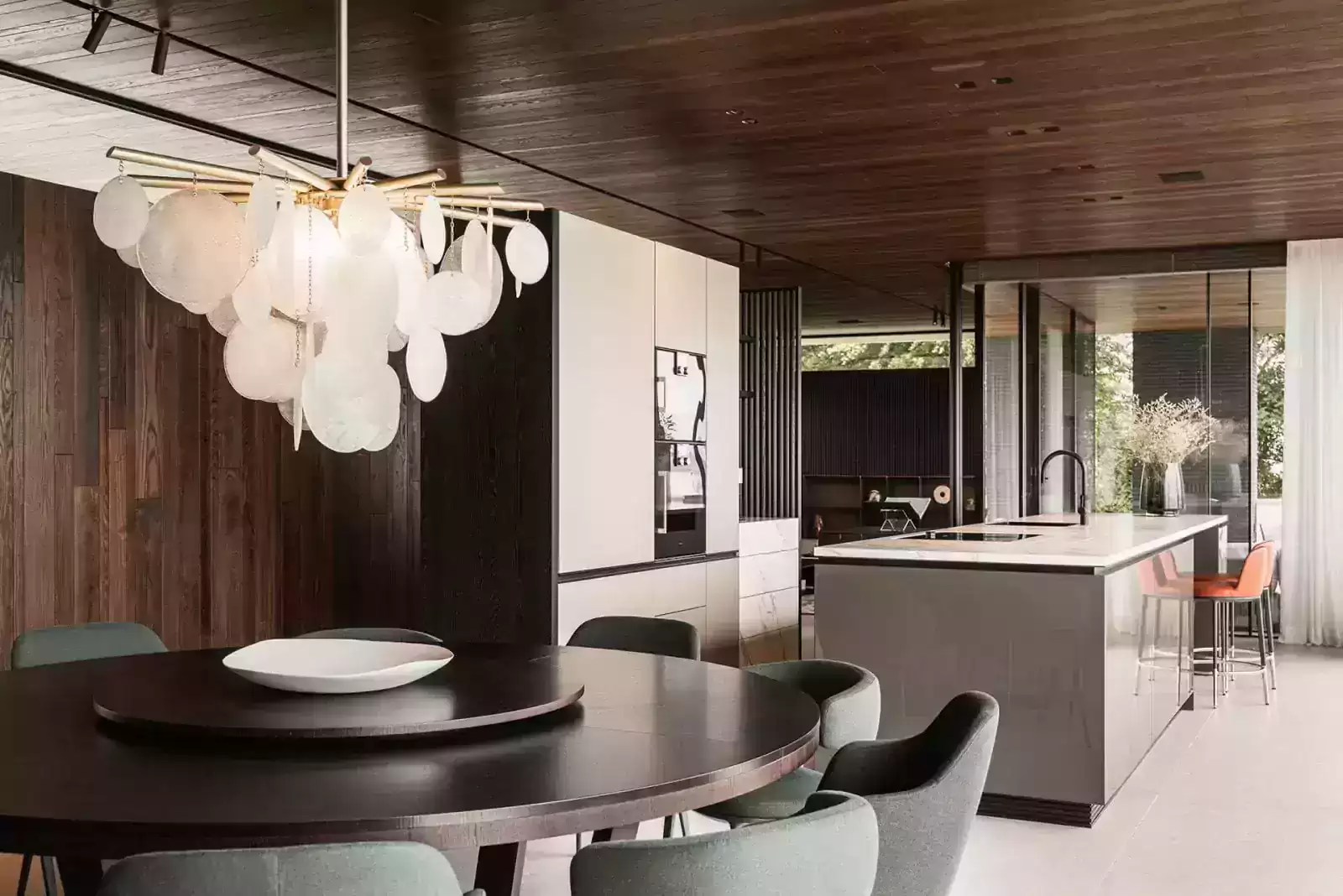
Material choices remain subdued and consistent, including light stone cladding, architectural concrete, granite accents, and timber window frames. River-facing apartments are provided with deep terraces and large glazing, emphasizing views while reinforcing the relationship between interior living spaces and the surrounding landscape.
The completed phase includes seven new buildings accommodating 177 residential units alongside commercial and office spaces. As the first of four planned stages, this phase establishes the project’s spatial and architectural framework, though its broader urban ambitions will ultimately be judged through the continuity and execution of future phases.


Project Credits
Architectural design: BBGK Architekci
Client: AWZ Deweloper
Location: Bydgoszcz, Poland
Design period: 2018–2021
Construction period: 2024–2025
Explore the Latest Architecture Exhibitions & Conferences
ArchUp offers daily updates on top global architectural exhibitions, design conferences, and professional art and design forums.
Follow key architecture competitions, check official results, and stay informed through the latest architectural news worldwide.
ArchUp is your encyclopedic hub for discovering events and design-driven opportunities across the globe.
Brought to you by the ArchUp Editorial Team
Inspiration starts here. Dive deeper into Architecture, Interior Design, Research, Cities, Design, and cutting-edge Projects on ArchUp