
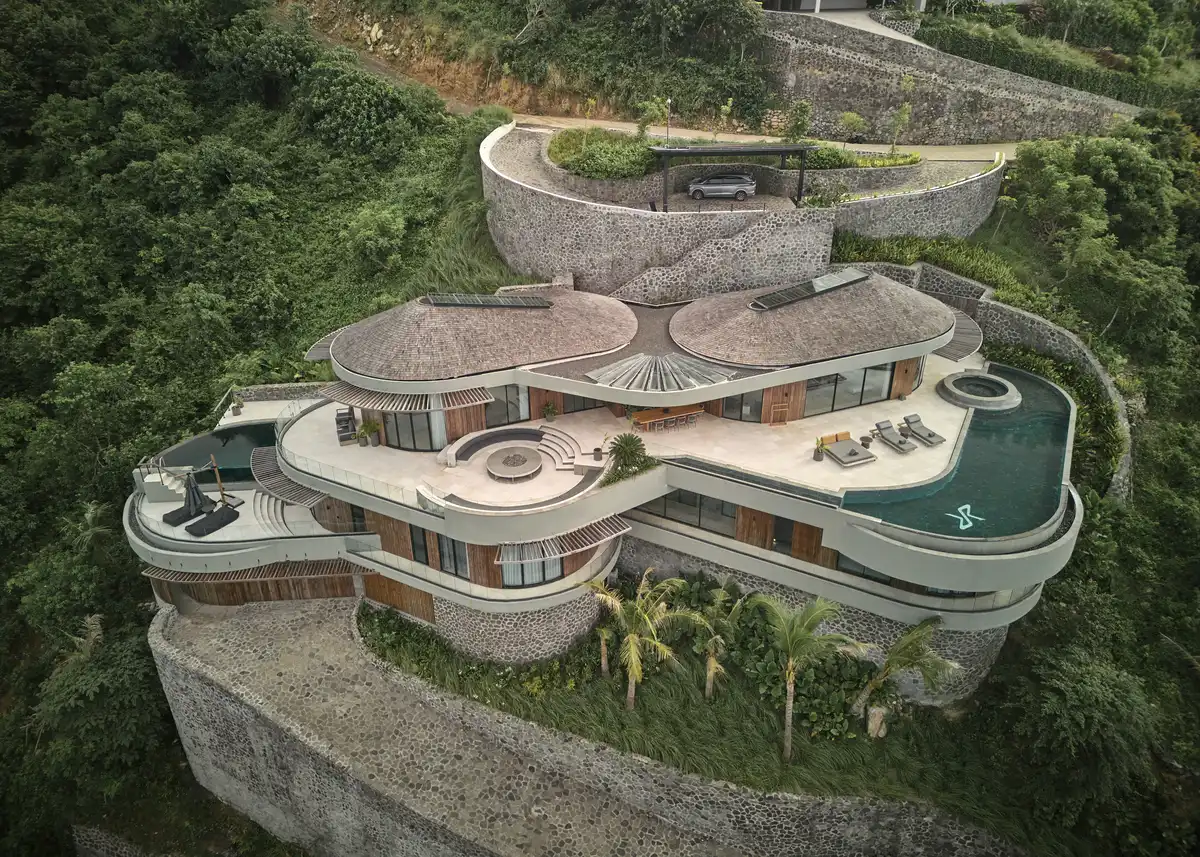
Nyrenstone Estate Lombok: Circular Geometry on Lombok’s Steep Slope

Nyrenstone Estate Lombok responds to steep topography through interlocking circular volumes that step down the hillside, anchors its logic in geometry rather than convention, favors intuitive circulation over rigid grids, and centers shared spaces while private wings branch outward to balance collective and individual needs.

Design Concept
The villa sits on one of Tampah Hills’ steepest slopes in South Lombok. It uses circles and tangents to shape both plan and experience. Communal areas lounges, dining zones, fireplaces form the social core for two families. Private wings extend from this nucleus. A circular yoga platform caps the highest point with panoramic bay views. The layout mirrors the coastline’s curve, creating dialogue between building and landform. This approach aligns with principles found in architectural design. Unlike typical hillside buildings, it avoids vertical stacking. Instead, it unfolds horizontally across terraces, appearing to grow from the slope.

Materials & Construction
Materials are deliberately neutral. Teak ceilings, off white plaster walls, and pale Palimanan stone floors blend with the landscape. The structure uses reinforced concrete frames adapted to steep grading. Minimal steel appears only in roof overhangs and cantilevers. Locally sourced stone and reclaimed teak reduce transport emissions. These choices reflect practices documented in studies on building materials. Interior transitions are flush and unadorned. This supports spatial continuity, a key concern in contemporary interior design.

Sustainability
The design relies on passive strategies. Open circular cores enable cross ventilation without mechanical systems. Deep roof overhangs shade glazed areas, cutting cooling loads in Lombok’s tropical climate. Rainwater drains through terraced channels into subsurface storage for irrigation. These methods echo techniques used in sensitive construction projects across Southeast Asia. Though not LEED certified, the villa embodies principles covered in ArchUp’s sustainability section prioritizing site response over tech add-ons.

Urban/City Impact
The estate is privately owned and isolated within the Tampah Hills masterplan. Yet it influences broader debates about hillside development in fragile zones. It avoids leveling the slope a common practice in luxury cities villas. Instead, it accepts topography as a design driver. This offers a model for Indonesia’s urbanizing peripheries. It joins other regionally grounded works in the archive. Unlike promotional developments, it speaks through spatial decisions, not marketing. Future phases of the masterplan may replicate its forms without its rigor a risk worth noting.
As landslide risks grow with climate change, could geometric responsiveness become a standard rather than a choice?
Architectural Snapshot: A circular, terraced villa on Lombok’s steep slope uses local materials and view framed geometry to integrate with topography without leveling the site.

ArchUp Editorial Insight
Nyrenstone Estate Lombok presents a geometric response to steep terrain through interlocking circles and tangents, framed as an organic dialogue with topography. The narrative avoids overt branding yet echoes John Lautner’s view framing risking aesthetic borrowing over contextual innovation. While its material restraint and terraced unfolding sidestep tropical clichés, the yoga platform and dual family layout reveal subtle luxury coding beneath neutral prose. One credit: the refusal to flatten the slope is a rare ethical stance in hillside development. Still, geometric purity may age faster than the stone floors it celebrates.


