Office Building in Mima City Reflects Spatial Efficiency and Local Context

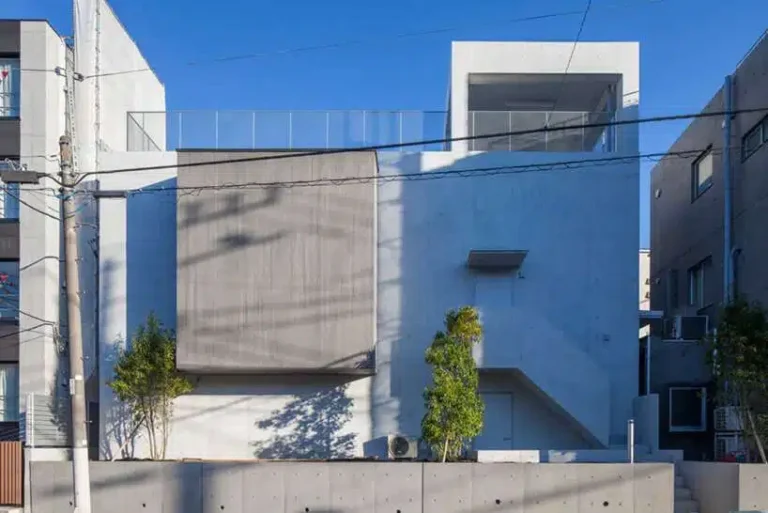
Wataru Architects established a modern office building in Mima City, Japan. Finished in 2025, the project hosts the Kitaoka Group focusing on the functional spatial organization and the integration with its urban surroundings. Simplicity, transparency, and flexibility were the main ideas that ran through the design. The result was a workspace that could cater to both the business sectors and the local environment.

Design Concept
The building takes on an a fight between openness and privacy. The given reception and public areas of collaboration are linked visually, whereas the private areas of the offices are set up in a way that focuses on the quietness. Big glass windows allow natural light, letting in less artificial light. Furthermore, the people using the space are made aware of the outside environment. The arrangement of the areas shows circulation and interaction among the employees in the office being taken into account.

Materiality and Construction
Making use of local materials was a way to highlight the region’s character. The building’s outer layer is made up of concrete and wood that provide a rough and warm look but still, give less maintenance needs. Besides, the walls are finished with natural wood, light colors, and discreet detailing that highlight the construction parts. The construction method adopted for the building was accuracy and flexibility, where materials were expressed, both in the case of defining function as well as the aesthetic clarity.

Architectural Research and Typology
The development presents a small-scale office typologies in the suburban areas of Japan case study. By investigating the relationship between the interior space layout and the exterior form, it is thus contributing to the architectural research of workplace design on a broader scale. The office building of the Kitaoka Group is a testimony to the role of architecture in the triad of operational effectiveness, visual comfort, and environmental responsiveness.

Critical Interpretation
The building is a revolution in the field of office typologies. Rather than strictly zoning the entire building, it has the ultimate goal of human experience. The circulation paths draw people through the building, making informal visits happen. Communication can take place without being in the thereby creating a common space around the separation of areas. The transparency and choice of materials augment the perception of space and daylight, which together with the compactness of the footprint creates an openness feeling. The design demonstrates that even minimal interventions can bring about considerable changes in behavior, interaction, and productivity in a professional environment.

Lessons for Architects and Designers
- Plan circulation in a way that interaction will not be strongly hindered and that privacy will be respected.
- Employ local and sustainable materials as a means of creating place.
- Daylight and visual connections should be integrated in such a way that they will create the best possible user experience.
- View smaller office typologies as inspirations for adaptable workplace designs.
- It’s worth noting how simplicity in detailing can elevate both the aesthetic and functional aspects of the design.

✦ ArchUp Editorial Insight
The Kitaoka Group Office in Mima City is an example of the delicate balancing act between a requirement for spatial efficiency and a demand for context-sensitive design. Given its location, large windows and open areas for the public to gather not only provide excellent daylight penetration and visual connection but also the sound from the quiet private offices is kept very low. The timber and concrete that together form the modest material palette work as positive elements in terms of evoking warmth and silence, as well as being a decisive factor in establishing a sense of place. Even though the design promotes informal interaction and openness well, its tightness might lead to limiting flexibility for future growth. However, the tactics like choices about materials, circulation and interior layouts that are not so evident may still be very powerful; thus, the whole scenario is indicative of small office architecture that fosters productivity and occupant well-being and it also serves as a reference of great value.

Conclusion
The Kitaoka Group Office is an example of the architectural design that not only takes but also gives back its context. It is an office building where the interrelation of space and materials has determined the quality of work environments. It is an architectural reference for modern offices that provide effective-functioning spaces, local identity, and environment-friendly systems, thus giving inspirations and the like to future buildings.
The photography is by Keita Yamamoto.
Explore the Latest Architecture Exhibitions & Conferences
ArchUp offers daily updates on top global architectural exhibitions, design conferences, and professional art and design forums.
Follow key architecture competitions, check official results, and stay informed through the latest architectural news worldwide.
ArchUp is your encyclopedic hub for discovering events and design-driven opportunities across the globe.
Brought to you by the ArchUp Editorial Team
Inspiration starts here. Dive deeper into Architecture, Interior Design, Research, Cities, Design, and cutting-edge projects on ArchUp.