Okrokana Residence: Redefining the Relationship Between Urban Enclosure and Interior Space

Interior Design as a Strategy for Privacy
This individual residence in Okrokana reflects an attempt to reinterpret the suburban urban fabric of Tbilisi, where the area is dominated by houses enclosed by fences. By adopting an inward-focused design, the house transforms into a protected space that provides a sense of privacy and security.
Light and Spatial Amplitude
The design highlights how interior spaces can generate a sense of light and openness, rather than relying on external expansion. This approach demonstrates the role of interior planning in enhancing comfort and privacy without requiring significant changes to the surrounding urban structure.


Spatial Challenges of the Project
The project is located in a residential area on hilly slopes in the city outskirts, and the plot within this neighborhood is characterized by narrow streets and small lots, enclosed by high fences. These urban features limit openness to the surrounding environment and amplify the sense of spatial confinement.
Impact of Location on Design
Although the neighborhood enjoys a prestigious position due to its elevated view over Tbilisi, the spatial nature of the area is often defined more by enclosure than openness. The plot was surrounded on three sides by neighboring walls and constrained by the street on the fourth side, resulting in almost no external views and limited daylight penetration. These conditions pose a major architecture challenge, highlighting the importance of architectural strategies to generate a sense of light and space from within.

Leveraging Enclosure as a Design Opportunity
Instead of attempting to open the house to the limited surrounding environment, the project treated these conditions as an opportunity to present an alternative residential model.
The Concept of the “Inverted House”
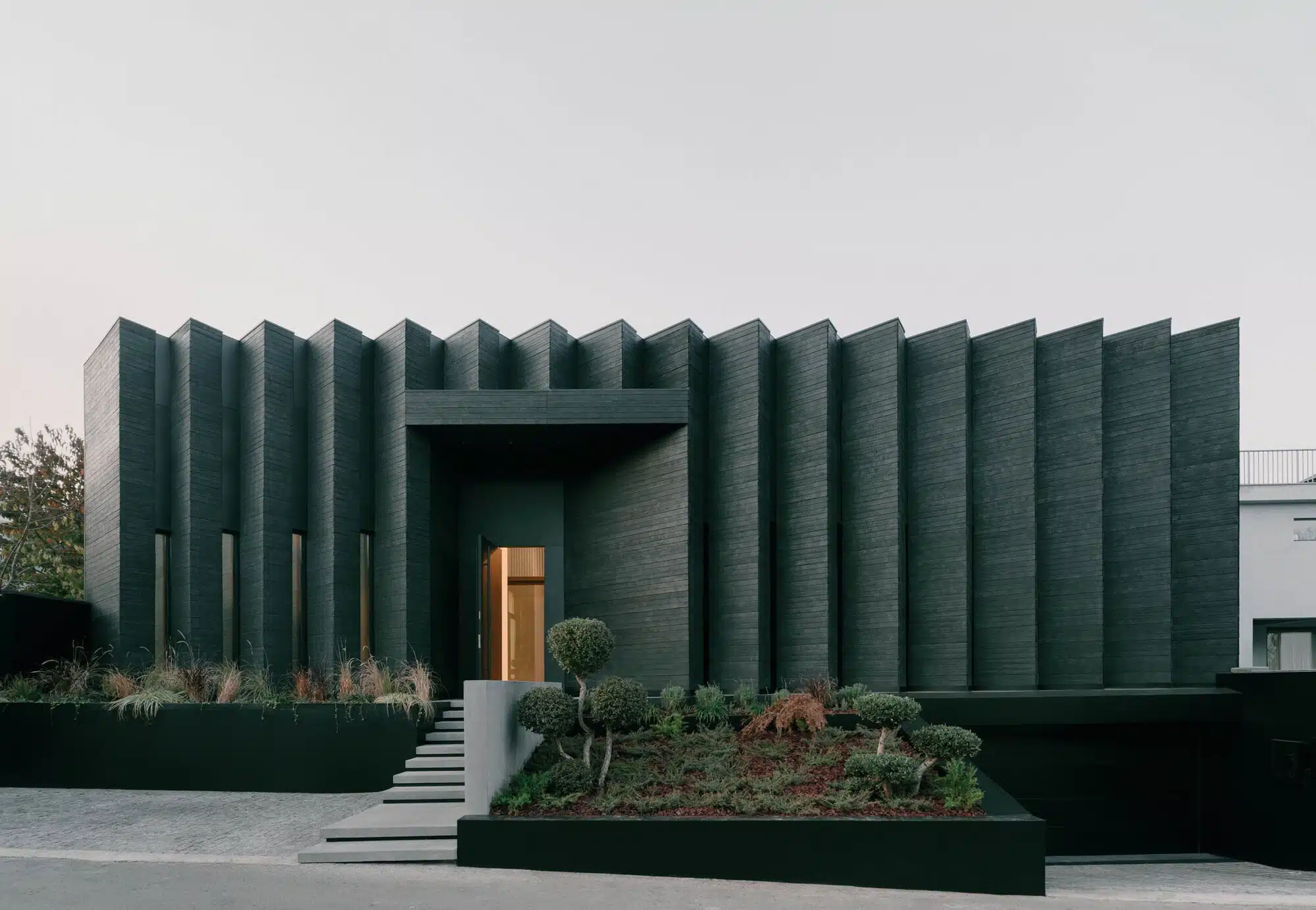
The house was designed according to a concept known as the “Inverted House,” which reverses the traditional relationship between dwelling and enclosure. In this model, the design does not rely solely on the external fence; the architecture itself becomes a perimeter that envelops the plot. The house wraps around its site, creating primary spaces oriented inward, enhancing privacy and generating a brighter, more expansive interior environment.


Interaction Between Public and Private Spaces
Along the street, the building is set slightly inward, a design decision that reduces the need for a separate fence. This strategy softens the boundary between public and private space, allowing for a smoother connection between the house and its surrounding environment.
Organizing Spaces Around Gardens
The design organizes spaces around two main gardens: the first is an internal courtyard that forms the true heart of the house, enhancing privacy and comfort; the second is an external garden that facilitates interaction with the street and provides a sense of openness without compromising privacy. This arrangement demonstrates how green spaces can play a pivotal role in structuring the relationship between interior and exterior in compact residential environments. More on building materials can influence spatial perception.

The Internal Courtyard as the Heart of Living Spaces
The main living areas, the entrance hall, living room, and kitchen, are oriented toward the internal courtyard, transforming it into a central open-air space. This orientation reflects a design strategy that combines natural light and ventilation while enhancing visual connectivity between different areas of the house.
Integrating Indoor and Outdoor Spaces
A suspended swimming pool extends across the courtyard, creating a covered outdoor space beneath it while visually connecting the upper levels of the house. This solution demonstrates how architectural design can use multifunctional elements to enhance openness and a sense of spatial expansion within compact areas.
Longitudinal Gradation and Varied Heights
In the longitudinal section, the building rises to three stories at the rear while appearing as a single-story volume toward the street. These variations allow for a double-height living area and the inclusion of intermediate mezzanine levels, generating a gradual and seamless spatial sequence. This strategy highlights how height variation can create a dynamic living experience that balances privacy and openness simultaneously.

Materials as a Core Element in the “Inverted House” Concept
The materials used reflect the logic of the inverted house concept, playing a crucial role in expressing the relationship between interior and exterior, as well as privacy. For more on building materials, see related Material Datasheets.
Exterior Envelope and Dwelling Protection
The street-facing façade is clad in charred wood, a traditional technique historically used to protect timber from weathering. In this context, the charred wood functions as a dense, protective envelope, creating a sense of security and enclosure toward the external environment. This approach is highlighted in various Architecture case studies.
Internal Courtyard and Spatial Intimacy
Within the courtyard, the wood transitions to natural, untreated timber, providing warmth, texture, and tactility. This shift from a dense exterior envelope to natural interior materials enhances the interior design and creates a more comfortable atmosphere oriented toward the heart of the house.
Color, Light, and Space
Interior spaces are finished in white, allowing natural light, proportions, and spatial relationships to define the overall atmosphere. This gradual transition, from charred wood to natural timber to pure white, creates a spatial sequence that directs both visual and functional movement from the exterior toward the internal core, reinforcing the projects’ design philosophy centered on inward-focused enclosure while maintaining a sense of openness and spaciousness.

Redefining Boundaries in Suburban Architecture
The project redefines the role of the traditional fence, transforming it from an external barrier into a habitable architectural element. This approach proposes a new residential model suitable for dense suburban environments, where spatial constraints become a design tool rather than an obstacle.
Turning Enclosure into a Spatial Asset
Instead of resisting the limitations imposed on the plot, the house embraces them internally, transforming enclosure into a spatial asset. Internal orientation of spaces, layered organization of levels, and gradual material transitions create a protected living environment that is visually and functionally rich.
Generating Interior Richness Through Design
Through these strategies, the project crafts a residential world that emphasizes internal richness, where privacy, spaciousness, and tactility generate a complete living experience despite limited external space. This model demonstrates how architecture can turn suburban constraints into opportunities for a carefully considered and intentional living experience.

✦ ArchUp Editorial Insight
It can be noted that the Okrokana Residence project offers several smart solutions to address the constraints of the suburban environment, such as orienting spaces inward and using the courtyard as the heart of the dwelling, enhancing privacy and creating a sense of interior spaciousness. However, the project raises a number of questions regarding the application of these strategies on a broader scale. For instance, the focus on internal enclosure may reduce interaction with the surrounding environment and limit the sense of suburban community, while the intensive use of layered organization and material transitions may complicate maintenance or replication in other projects without additional costs.
Moreover, an excessive focus on privacy and internal intimacy can lead to limited external spaces, reducing opportunities for diverse use of the house and flexibility under different architectural conditions. Nevertheless, the project presents an architectural vision worth studying, as architects and researchers can benefit from the “Inverted House” principle as a case study to evaluate the balance between internal enclosure and integration with the urban context, and to develop solutions that address small plot constraints and high residential density in a more adaptive and flexible manner. Related Archive examples provide further insights.