Operating Room Design: How Architecture Shapes Life-Saving Environments

An operating room is not just a space in a hospital—it’s a critical environment where design, technology, and precision converge to save lives. In such a setting, architecture becomes more than a visual expression; it becomes an essential tool for enhancing medical performance, minimizing errors, and ensuring patient safety.
Architecture as a Pillar of Modern Healthcare
When a patient is wheeled into an operating room, they’re placing full trust in the medical team. What often goes unnoticed, however, is how a thoughtfully designed space supports that team—from how light is positioned to how air flows and how every piece of equipment is within arm’s reach. A well-planned operating room helps surgeons focus, shortens procedures, and lowers infection risks.
Strategic Placement Inside the Hospital
Locating an OR within a hospital requires careful coordination to optimize medical workflow:
| Design Factor | Why It Matters |
|---|---|
| Proximity to ICU and emergency department | Quick access during critical emergencies |
| Direct access to central sterilization | Ensures clean surgical tools are always ready |
| Separate clean and contaminated paths | Prevents infection spread and cross-contamination |
This spatial logic improves staff mobility and reduces delays during emergencies.
Technical and Architectural Requirements
An operating room demands far more than four walls—it must meet rigorous spatial and environmental criteria:

- Minimum ceiling height of 3.5 meters for optimal airflow and lighting distribution.
- Seamless, antibacterial finishes on walls and floors to allow for deep cleaning.
- Hermetically sealed automatic doors to maintain sterile conditions.
- Shadow-free, adjustable LED lighting for precise visibility during surgery.
Airflow and Environmental Control
Clean air is one of the most important safety factors in any OR. Key metrics include:
| Feature | Standard |
|---|---|
| Ventilation type | Laminar Flow System |
| Air changes per hour (ACH) | 20–25 ACH |
| Temperature | 20–23°C |
| Humidity | 30–60% |
| Room pressure | Positive, to push out contaminated air |
These measures ensure a sterile, controlled environment at all times.
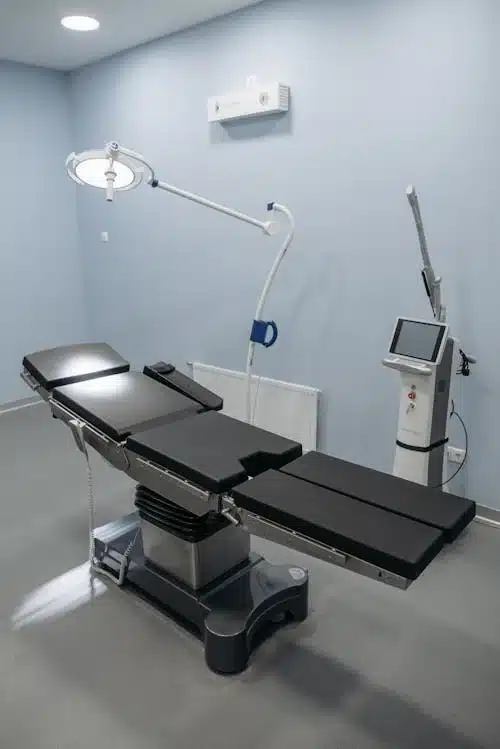
Medical Equipment & Interior Design Integration
The OR layout must support seamless interaction with advanced medical technology:
- Flexible surgical tables and imaging equipment
- Wall-integrated control panels for gases and power supply
- Ceiling-mounted units to save floor space and reduce clutter
- Real-time vital signs monitors connected to smart systems
A well-integrated design allows medical teams to respond swiftly and accurately during procedures.
Types of Operating Rooms
Different surgical specialties call for distinct OR setups:
| OR Type | Purpose |
|---|---|
| General OR | Used for a wide range of procedures |
| Specialized OR | Tailored for specific surgeries (cardiac, neuro, oncology) |
| Hybrid OR | Combines surgery with real-time imaging (CT, MRI, etc.) |
Hybrid ORs, in particular, require more space, more precise airflow, and complex wiring systems.
Global Codes and Standards
Operating rooms are designed according to international and local standards that ensure safety and efficiency:

- FGI Guidelines: Defines core design parameters for healthcare facilities.
- ASHRAE 170: Covers hospital HVAC systems and ventilation requirements.
- NFPA 99: Focuses on electrical and gas safety in healthcare environments.
- Local building codes also shape design based on geography and regulation.
Emerging Trends: Where Design Meets Innovation
As surgical methods advance, so do OR design strategies. Key trends include:
- Smart Operating Rooms with integrated digital systems
- AI-powered tracking systems for tools and workflow optimization
- Sustainable materials and energy-efficient systems for long-term impact
These innovations aim not only to improve outcomes, but also to redefine what a surgical space can be.
Final Thoughts: Architecture as a Life-Saving Asset
Success in surgery isn’t just about medical skill—it’s also about the environment that supports it. Every detail in the operating room—from ventilation to lighting to spatial layout—can impact patient outcomes.
Architects, therefore, are not just designing rooms; they are building environments where lives are saved and futures are shaped.
✦ ArchUp Editorial Insight
This article provides a precise overview of architectural strategies in operating room design, highlighting spatial planning and environmental control as key surgical performance factors. The descriptive cues evoke a tightly regulated space defined by antibacterial surfaces and high ceilings enabling laminar airflow systems.
However, while international standards like FGI and ASHRAE are discussed, the article offers limited insight into local contextual adaptations. Could it further explore how cultural or climatic variables inform such medical environments?
Still, the article delivers valuable technical depth and stands as a solid reference for architects designing high-performance healthcare infrastructure.
Explore the Latest Architecture Exhibitions & Conferences
ArchUp offers daily updates on top global architectural exhibitions, design conferences, and professional art and design forums.
Follow key architecture competitions, check official results, and stay informed through the latest architectural news worldwide.
ArchUp is your encyclopedic hub for discovering events and design-driven opportunities across the globe.