

Jazan International Airport An Architectural Gateway Redefining Infrastructure and Place

Introduction
The Jazan International Airport has reached nearly 87% completion, signaling the approach of one of the most significant architectural achievements in southern Saudi Arabia. More than a transport hub, the project represents a conceptual shift in infrastructure design, merging functional performance with architectural expression to redefine the airport as an experiential space rather than a mere point of transit.
The design of Jazan International Airport reflects a contemporary architectural vision that emphasizes the dialogue between local environment and urban identity, establishing a model of sustainable architecture integrated within its surrounding fabric.

Design Concept and Architectural Vision
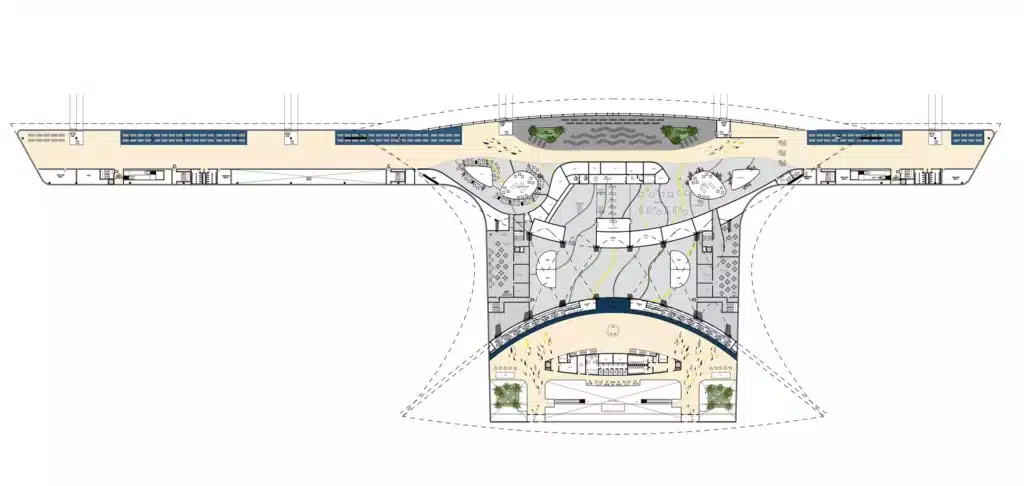
The architectural narrative treats the airport as a fluid spatial system a place shaped by movement, light, and air. The design rejects the notion of static infrastructure, instead crafting a living structure that breathes with its users. Expansive glass façades connect interior and exterior views, allowing travelers to remain visually engaged with the surrounding landscape of Jazan.
This design language is guided by visual openness, enabling a seamless relationship between built form and environment. The result is an airport that feels less like an enclosure and more like a natural extension of the coastal landscape, where space and light work together to form a continuous architectural rhythm.

Spatial Identity and Cultural Context
The airport’s aesthetic language draws deeply from Jazan’s local geography and culture, reinterpreting traditional motifs through a modern lens. Sand inspired hues and subtle shades of blue dominate the façades, bridging the visual dialogue between earth and sky. The softly layered rooflines diffuse natural light, producing a tranquil yet expansive atmosphere throughout the terminal.
Each architectural element performs a dual role functional and expressive. Circulation paths are generous and legible, ensuring fluid movement, while waiting zones are conceived as restful visual environments, fostering a sense of comfort within a contemporary architectural framework.
Sustainability as a Core Design Principle
Sustainability in Jazan International Airport is not an afterthought but a foundational design principle. Building orientation, material selection, and daylight optimization were all conceived as interdependent design decisions that reduce energy demand and enhance user comfort.
The interiors capitalize on natural ventilation and daylight, channeled through carefully positioned skylights and air corridors that minimize reliance on artificial systems. Sea breezes are guided into the building’s heart, ensuring a naturally cooled and comfortable microclimate.
This integration of technology and ecology transforms the airport into a self-regulating architectural ecosystem, illustrating how sustainable design can coexist with the functional rigor of major infrastructure.
Material Language and Visual Texture
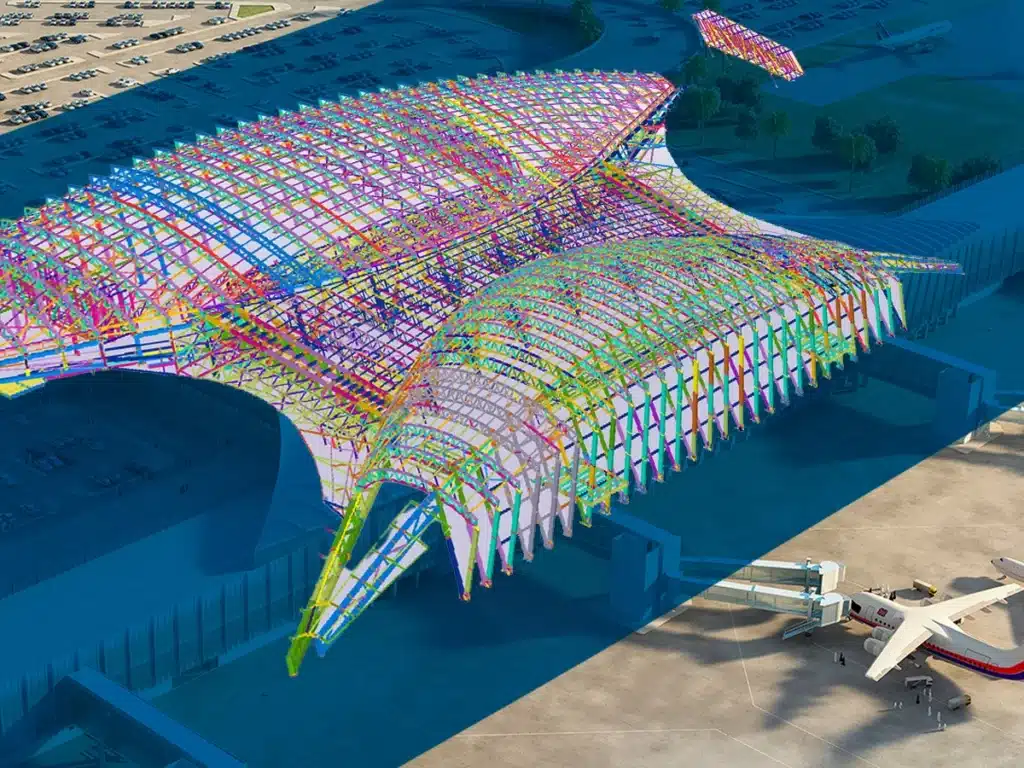
Material selection was guided by the pursuit of clarity, durability, and sensory depth. Polished concrete and treated glass establish a balance between solidity and transparency, while the play of shadows across the façades generates a dynamic visual rhythm throughout the day.
The reflective flooring enhances the sense of motion, mirroring the travelers’ flow and amplifying natural light. Curved metal ceilings express aerodynamics and movement, while landscaped interior courtyards punctuate the circulation paths, introducing moments of pause and visual relief.

Integration with the Urban Fabric
Jazan International Airport is envisioned as an urban extension rather than an isolated transport node. Its planning integrates open spaces, landscaped buffers, and road networks that reorganize the city’s spatial structure.
This urban integration approach transforms the airport into a developmental catalyst, linking the coastal and economic zones of the region. The project reimagines how airports can serve as architectural and civic infrastructures simultaneously embedded within the life of the city instead of existing at its periphery.
Architectural Reflection
Ultimately, Jazan International Airport stands as a redefinition of the airport typology an environment of transition elevated to a human and spatial experience. It reconciles technology with emotion, structure with environment, and the local with the global.
Through this balance, the project asserts itself as an architectural document within Saudi Arabia’s broader urban transformation, proving that infrastructure can embody thought, aesthetics, and place.
Summary Table
| Element | Description |
|---|---|
| Project Name | Jazan International Airport |
| Approximate Completion | 87% |
| Architectural Type | Contemporary international airport |
| Design Concept | Visual openness and environmental integration |
| Aesthetic Identity | Coastal-inspired palette reflecting Jazan’s natural context |
| Sustainability Principle | Integrated passive design using natural light and ventilation |
| Urban Role | A catalyst for urban and regional connectivity |
| Architectural Value | Blending infrastructure with human experience and spatial culture |
✦ ArchUp Editorial Insight
Jazan International Airport stands out for its visual design, balancing openness and solidity, where expansive glass façades harmonize with the gently curved ceilings and circulation paths, creating a sense of fluid movement. Coastal inspired color gradations provide travelers with a cohesive visual experience, while natural materials and light manipulation produce dynamic spatial layers. Critically, the design approach effectively integrates sustainability with aesthetic appeal, though public interaction zones beyond the airport footprint remain limited. Nevertheless, the project offers clear architectural value as an urban landmark, reflecting local identity and enhancing the city’s spatial character.
Architecture professionals can follow ArchUp’s events section for verified updates on exhibitions, conferences, competitions, and results.




🟥 Editor’s Notice:
The article on Jazan International Airport presents a technically sound overview but lacks the architectural imagination expected from a civic gateway project. The visual material and design language lean heavily toward engineering precision rather than spatial innovation, making the work feel more infrastructural than architectural. To strengthen its analytical and comparative value, the piece should examine how regional airports can integrate cultural identity, material expression, and passenger experience beyond functional planning.
(Related reference: a similar exploration of airport design depth and identity can be found in the review of JFK International Airport’s New Terminal 1 — https://archup.net/jfk-international-airports-new-terminal-1/
— which better illustrates how infrastructure and architecture can merge into a unified vision.)