
Puerta de Europa: A Critical Study of Inclined Geometry, Functional Integration, and Environmental Performance


Introduction to the Structure and Objectives of Architectural Study
The Puerta de Europa, designed by Philip Johnson and John Burgee, serves as a prominent landmark on the Madrid skyline. It features a constant 15° tilt from the vertical axis. This architectural study aims to analyze this daring inclination, examining it not merely as a visual feat but as an engineering test that challenges traditional building stability. We will assess how the structural system and materials manage the lateral forces caused by the tilt. Furthermore, we will analyze the impact of this shape on the building’s functional and environmental performance. Thus, this analysis provides a deep, critical reading of Inclined Architectural Engineering and its effect on urban planning.
Historical and Engineering Context of the Building
Puerta de Europa was constructed between 1990 and 1996. Its primary goal was to establish a distinctive architectural marker at the northern gateway to Madrid (Plaza de Castilla). The design emerged as an answer to the need for innovative forms during the Postmodern era, where architecture sought to break free from strict straight lines. From an engineering perspective, the building represents a masterpiece in managing stress. The 15° tilt demanded an unconventional structural system to ensure stability against gravity and wind, pushing engineers to develop unique structural solutions. Consequently, the building was the tallest in Spain upon completion, confirming its engineering leadership at that time.
General Planning and Space Distribution
The structure consists of two identical towers facing each other, with each tower containing 26 above-ground floors. The lateral tilt created significant challenges for the internal distribution of office space; every floor has a usable area that constantly changes its angles and size. Therefore, the service core (elevators and stairs) is concentrated in the least inclined section to simplify vertical circulation. Large glass façades are used to compensate for the asymmetry of the inner spaces by maximizing natural light. As a result, these arrangements led to high space efficiency despite the inherent geometric complexity.
Structural System and Primary Materials
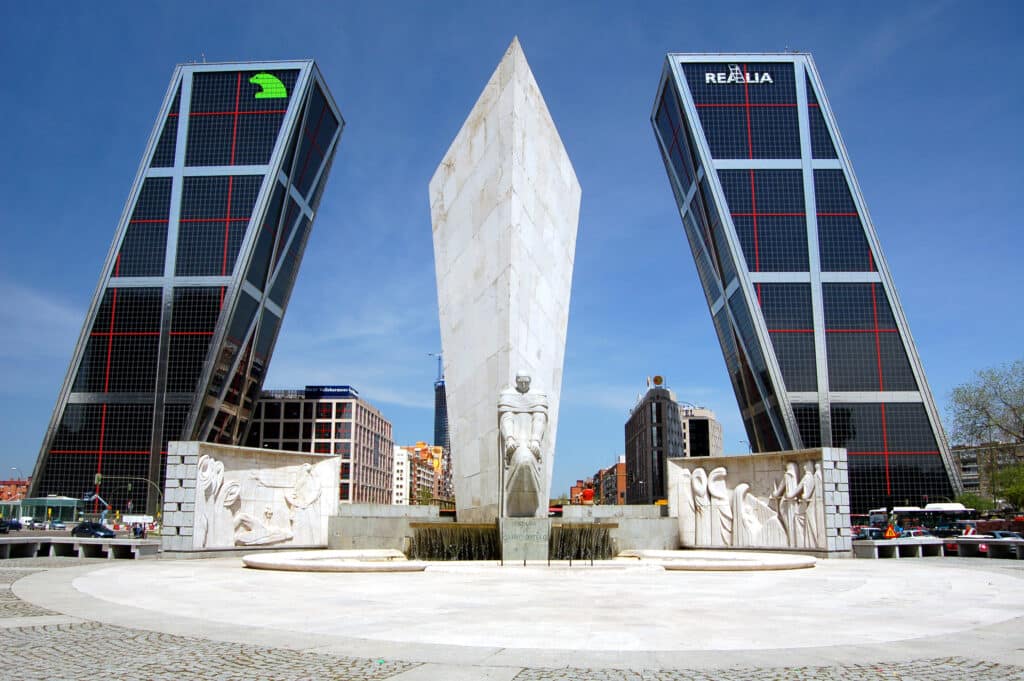
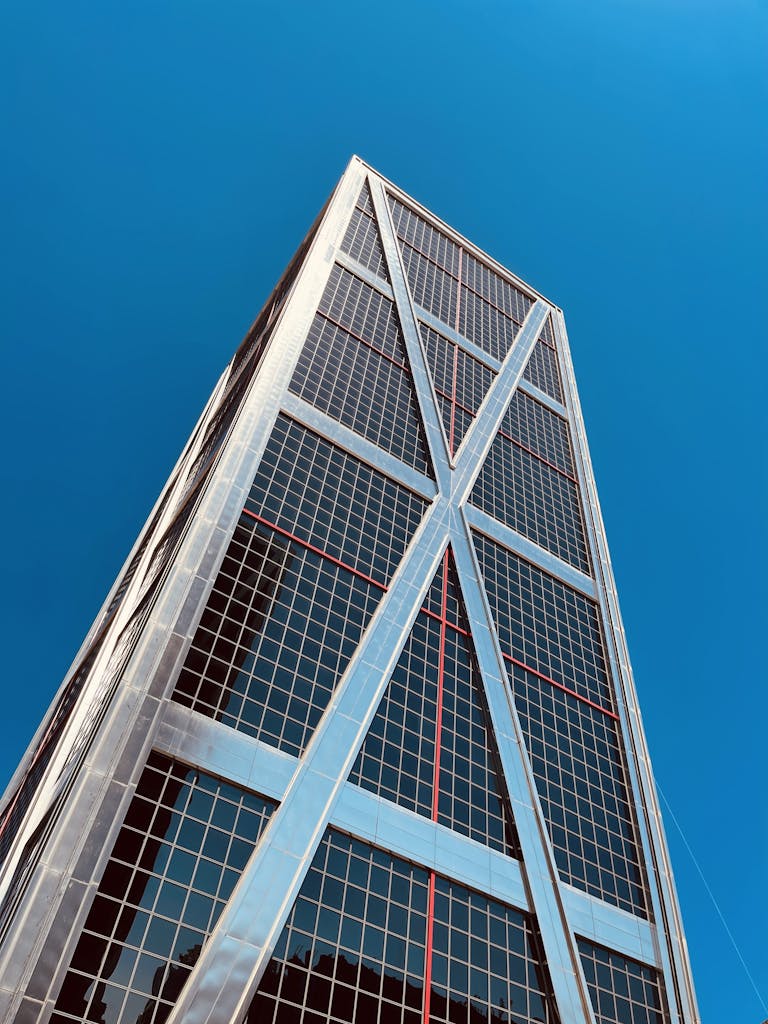
The building’s structural system is its most important aspect. The stability relies on a central concrete core which provides the main rigidity for the inclined section. In addition, the building utilizes massive, slanted steel braces on the rear façade to transfer the lateral tilting forces directly to the foundations. These steel braces act as external columns, anchored by massive counterweights buried underground. Primary materials include reinforced concrete for the core and the main structure. Conversely, the external envelope is characterized by alternating glass panels and prominent red-painted stainless steel.
Form, Façades, and Architectural Expression
The building’s architectural form directly results from the complex inclined structure, which visually defies gravity. The two towers are defined by large glass and blue panels alternating with bright red steel, which exposes the massive, slanted structural supports. This bold expression of the external structure is a defining feature of Postmodern architecture. Furthermore, the building acts as a visual symbol for the city’s entrance. The extensive use of glass helps reflect the surroundings, giving the structure a dynamic and changing appearance that serves the iconic intent of the design.
Natural Lighting and Ventilation
Despite its inclined shape, the building was designed to maximize the benefit of natural light. The large glass façades allow maximum daylight penetration deep into the office areas. However, the angle of the tilt created challenges related to direct sun exposure (Solar Gain). Thus, insulated panels and small internal courtyards were incorporated to allow for partial ventilation. Generally, the building relies heavily on mechanical systems for internal climate control, with attempts to integrate natural lighting and ventilation elements into the planning.
Interaction with the Context and Urban Environment
The building functions as a pivotal point in its urban context. The two towers were specifically designed to act as a visual “gateway” to the city at the intersection of Paseo de la Castellana. This visual interaction creates a sense of motion and dynamism, despite the structure’s fixed nature. Functionally, the location offers excellent access to public transport (metro and train stations), reducing reliance on private vehicles. However, the structure’s footprint occupies a considerable amount of space, slightly limiting open public areas compared to newer high-rises.
Sustainability and Environmental Performance
The Puerta de Europa is categorized as a classic megastructure from the early 1990s. At that time, modern, advanced sustainability standards (like LEED or BREEAM) were not the primary drivers of the design. Therefore, the building’s environmental performance focuses mainly on energy efficiency in internal operations. Nevertheless, the reflective glass façades helped partially control solar heat gain. Currently, the building requires ongoing efforts and upgrades to align it with contemporary environmental standards for Sustainable Building.
Functional Performance and Operational Processes
The building primarily serves administrative and commercial office functions. Functional performance is characterized by the central core’s effectiveness in serving the inclined floors, despite the challenges posed by the geometry. Operational processes demand precise planning; specifically, maintenance of the inclined glass façades requires highly specialized and complex equipment, unlike the standard cable systems used on vertical towers. This operational complexity increases the cost of routine building maintenance. However, the quality of the original construction has proven its resilience.
Mechanical, Electrical, and Plumbing (MEP) in the Architectural Context
The Mechanical, Electrical, and Plumbing (MEP) systems were designed to be concealed and integrated within the concrete core. These systems are essential for controlling the internal climate, given the façades’ varying sun exposure. These systems require continuous modifications to accommodate the asymmetrical distribution of spaces on each floor. For instance, the HVAC systems must ensure equal heat or cooling distribution despite the varying floor slopes. Overall, these systems function effectively to support the modern office environment.
Design and Structural Statistics for Puerta de Europa
| Structural Feature | Value / Detail | Engineering Significance |
| Angle of Inclination | 15° from Vertical | Provides the iconic shape and structural defiance. |
| Height per Tower | 114 meters (26 floors) | Makes it a prominent landmark in North Madrid. |
| Primary Structural System | Central Concrete Core & Slanted Steel Braces | Ensures structure stability against shear and gravity forces. |
| Counterweights | 600 tons per tower | Used to anchor the inclined braces against the direction of the tilt. |
| Location | Plaza de Castilla, Madrid | Defines the city’s northern “gateway.” |
Technical Considerations for Maintenance and Upgrading
The maintenance of the inclined façades poses an ongoing technical challenge. Cleaning and repair require specialized elevating platforms that move along integrated tracks, rather than the standard suspended cradle systems used on vertical towers. Regarding upgrading, the building has undergone internal modernization of its MEP systems to meet current energy efficiency standards. These essential upgrades aim to prolong the building’s lifespan and maintain a high-quality internal work environment, as detailed in specialized Architectural Reports.
Potential for Future Adaptation and Modification
Given the complex structural nature of the building and its inclined form, the potential for major future modifications or structural adaptation is limited. Any significant structural alteration could compromise the building’s stability. Nevertheless, the internal office spaces are moderately flexible due to the centralized core. Future adjustments will likely focus on updating internal technology, such as improving Building Management Systems (BMS) and replacing older HVAC and lighting systems with more energy-efficient models.
Design Approaches from Architectural Concept to Engineering Test
The Puerta de Europa design represents a bold approach where the architectural vision overcame engineering complexity. The design began with a simple architectural idea (the15° tilt) which then became a difficult engineering test. Engineers had to turn the expressive concept into a safe, tangible reality using innovative structural solutions like foundation counterweights and slanted steel supports. Consequently, the building demonstrates that the relationship between architecture and engineering is not always linear; rather, it can be a mutual challenge leading to unprecedented solutions in Architectural Projects.

Conclusion
The Puerta de Europa remains a definitive architectural and engineering icon of late 20th-century architecture. The designers successfully created a visually defiant landmark. Structurally, the building serves as a definitive case study in structural stability. Functionally, its office spaces have proven effective despite the shape’s challenges. In conclusion, this analysis confirms that the building is a unique blend of daring architectural expression and pioneering engineering solutions, making it a critical reference point in the study of Modern Architecture.
✦ ArchUp Editorial Insight
The Puerta de Europa towers in Madrid stand as a classic example of Postmodernism challenging gravity through a constant degree of inclination. The core Structural Innovation lies in its complex system, which combines a rigid central concrete core to handle the primary load with massive, slanted steel braces on the rear facade. These braces transfer the lateral forces caused by the tilt to heavy, subterranean counterweights, ensuring absolute Structural Stability. However, architectural criticism focuses on the operational cost stemming from this visual Architectural Ambition. The inclination creates internal Functional Challenges due to the asymmetrical distribution of office spaces on every floor and demands costly maintenance of the slanted glass facades using specialized lifting mechanisms, raising a question about the functional and environmental return compared to the achieved engineering complexity. Nevertheless, the towers remain a unique Urban Landmark, embodying engineering’s capacity to translate the boldest visual concepts into tangible reality.
A deeper Architectural Discussion within modern Architecture explores how innovative Design and advanced Construction methods reshape global Projects in the pursuit of sustainability and human-centered environments.





ArchUp Editorial Management
The article provides a comprehensive analysis of the technical and structural dimensions of the Puerta de Europa Towers, with exceptional focus on the 15-degree inclination challenge and its impact on structural performance. To enhance its archival value, we would like to add the following technical and structural data:
We would like to add that:
· Structural Data: 1.2-meter thick central concrete core with 50 MPa compressive strength, and 18 inclined steel supports with 40 cm thickness, featuring 600-ton counterweights per tower
· Facade Systems: 4,800 heat-treated double-paned glass panels, with Grade 316 steel structure weighing 850 tons per tower
· Advanced Materials: Low-E glass with 1.8 W/m²·K thermal transmittance and 25% light reflection coefficient, featuring zinc-epoxy protective coating at 120 microns thickness
· Environmental Performance: Achieving 25% energy savings compared to Madrid office buildings, with HVAC systems consuming 35% of total energy due to thermal challenges of inclined facades
Related Link:
Please review for a comparison of tower techniques:
https://archup.net/the-shard-engineering-structural-innovations-in-skyscrapers/