Rebuilding with Roots: James Baldwin Media Library and Refugee House by Associer


In the heart of Paris’ 19th arrondissement, the French architecture studio Associer has reimagined a defunct 1970s secondary school into a dual-purpose cultural and humanitarian hub. The newly established James Baldwin Media Library and Refugee House stands as a striking testament to architectural frugality, blending reuse, sustainability, and social engagement into a cohesive and responsive urban form.
The project is as much about preservation as it is about transformation. Rather than demolishing the concrete-framed former Jean Quarré secondary school, Associer surgically carved into the structure, reconfiguring its interior and upcycling its removed components. The resulting compound, comprising a five-storey media library and a two-storey Refugee House, is knitted together by a delicate extension made of latticed timber and poured earth — materials that symbolize low-impact design and renewed purpose.
Through the clever reallocation of spatial functions and the poetic use of raw, bio-based materials, the studio fosters both intellectual and emotional openness: a place where knowledge, shelter, and community intersect.

Spatial Composition and Design Highlights
A Library Reborn Within a Concrete Frame
Housed within the tallest volume of the old school, the James Baldwin Media Library is a five-storey block centered around a verdant courtyard. New cut-outs in the concrete floors and walls allow for layered spatial views, enhancing transparency and inviting natural light. Public and private zones — including booths, reading stacks, and collaborative desks — are elegantly stacked across the vertical space.
The Refugee House: Empowerment Through Architecture
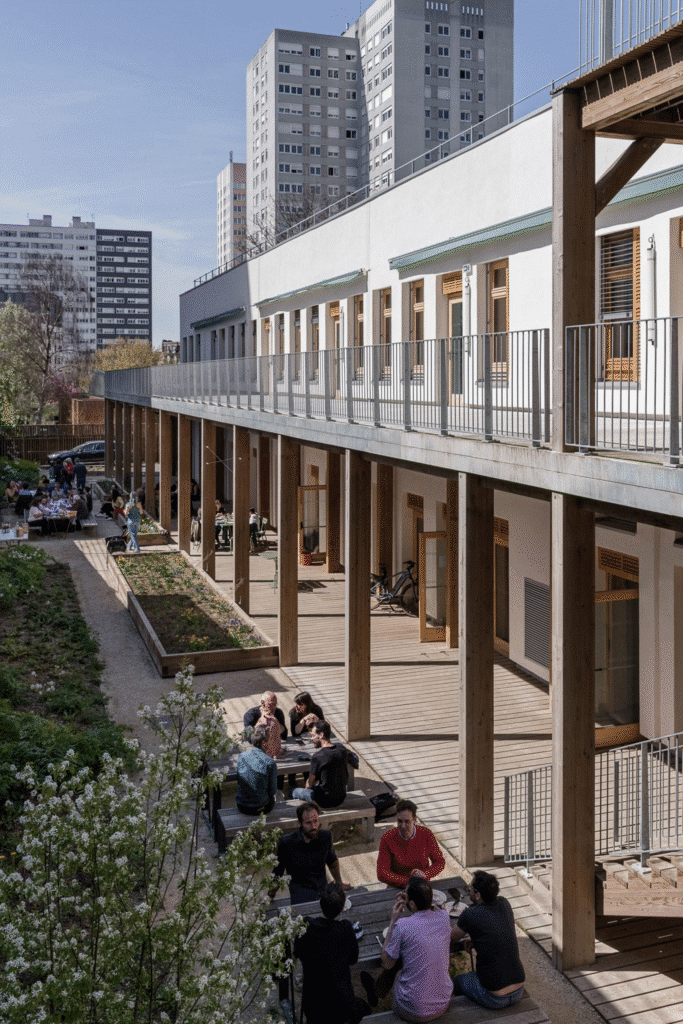
Parallel to the library lies a two-storey linear structure — the Refugee House — home to classrooms, kitchens, workout areas, and legal aid offices. Facing south, a verandah-style walkway offers access to a communal garden, integrating nature and healing into daily routines.
The Link: A Shared Spine of Light and Earth
Connecting the two blocks is a new timber and earth corridor called “the link”. This unheated zone functions as circulation, social space, and connective tissue, allowing for shared use of event halls and co-working rooms. Clad in a breathable shell of latticed wood, the structure captures filtered light while remaining ecologically light-footed.
A Public Square Made from Its Own Bones
At the site’s threshold lies a public plaza, paved with 135 repurposed concrete slabs from the old building. Timber benches and planters animate the space, transforming the once-enclosed site into an open civic ground.

Architectural Analysis
The guiding design logic of Associer’s intervention lies in adaptive reuse and architectural frugality. Instead of treating the existing school as obsolete, the studio considered it a resource — both structurally and symbolically. Removing parts of the concrete frame allowed Associer to bring in light and vertical fluidity, while recycling those removed elements for new use minimized waste and energy.
Material selection underscores this vision: timber, earth, and reclaimed components were chosen not only for their environmental performance but also for their tactile and visual warmth. The use of poured earth walls, particularly in the central link, evokes groundedness and temporality, contrasting yet harmonizing with the brutalist concrete.
In its urban context, the project challenges common narratives of erasure and replacement. Instead, it operates as a palimpsest, allowing old and new to co-exist — an approach rarely seen in Paris’ dense urban tissue. By avoiding total demolition, Associer retains memory while injecting new programs that reflect the city’s evolving demographics and needs.

Project Importance
This project is a pedagogical example of how architecture can respond to social, ecological, and spatial urgency simultaneously. It teaches architects the value of working with the existing fabric, not as a limitation but as a starting point. The integration of a refugee center alongside a public library promotes dialogue and coexistence — an architectural reflection of inclusive urban citizenship.
Moreover, the project expands the typology of cultural institutions, proving they can be porous, adaptable, and multi-use. Instead of isolated monuments, this architecture speaks to community activation. The minimal energy footprint and the decision to not pour new concrete redefine what “sustainability” means in practice, positioning this project as a forward-thinking case study in urban reuse.
✦ ArchUp Editorial Insight
The James Baldwin Media Library and Refugee House presents a multi-layered spatial narrative of renewal. The juxtaposition of cold concrete with latticed timber and warm earth tones creates a tactile dialogue between past and present. Spaces like the open verandah and central courtyard show thoughtful attention to light, air, and movement.
Critically, the project provokes an important question: can architecture facilitate integration, not just functionally but emotionally? While the duality of uses — library and refuge — is bold, their spatial separation could be softened further to foster deeper interaction. Nonetheless, Associer’s refusal to demolish symbolizes a hopeful ethic in architectural practice.
This is a building that remembers, reuses, and reinvents — a rare model for future urban adaptations.

Conclusion
The transformation of the Jean Quarré school into the James Baldwin Media Library and Refugee House by Associer exemplifies a sensitive, intelligent, and ethically conscious approach to architecture. It challenges the assumption that innovation requires new construction, instead proving that reclaiming the old can be both poetic and powerful.
Through smart programming, material restraint, and spatial generosity, the project meets the demands of modern urban life — from literacy to legal aid — in a manner that is both low-tech and high-impact. It offers architects a template for how to build communities, not just buildings. In an age of displacement, demolition, and disconnection, this project chooses continuity, context, and care.

Explore the Latest Architecture Exhibitions & Conferences
ArchUp offers daily updates on top global architectural exhibitions, design conferences, and professional art and design forums.
Follow key architecture competitions, check official results, and stay informed through the latest architectural news worldwide.
ArchUp is your encyclopedic hub for discovering events and design-driven opportunities across the globe.