The ‘Krashi Steel’ Project: Redefining the Industrial Warehouse and Its Relationship with Environment and Space

Reimagining the Industrial Warehouse
The “Krashi Steel” project reconsiders the conventional industrial warehouse, transforming the building from merely a storage space into an element that reflects the essence of steel manufacturing.
Design Challenges
From an architectural perspective, the challenge was not limited to renovating the building but also included redefining how the surrounding industrial environment is perceived. This environment is typically characterized by high noise, smoke, and dust, requiring innovative thinking about spatial design and user experience within the space.
Observational Design Approach
Adopting an observational approach as a design method helped architects understand the intricate details of industrial processes and interact with them in a way that enhances the industrial space experience without overlooking its primary function.


The Wavy Facade and Spatial Structure
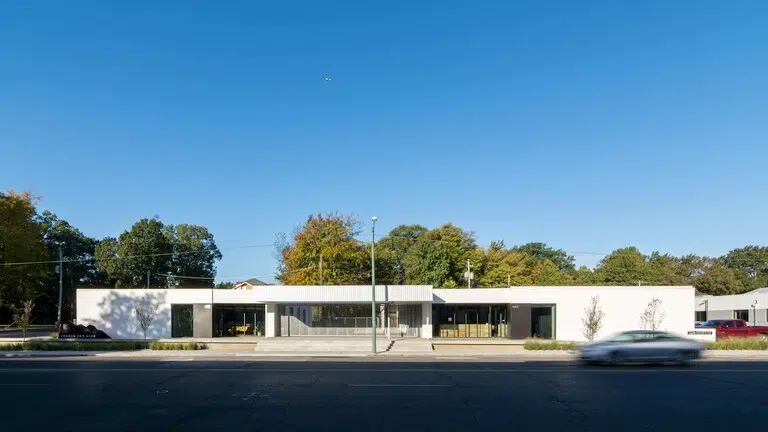
The building features a wavy facade and a spatial structure around the entrance, transforming the area into a prominent and visually striking lobby. This design became a central element in the architectural language of the renovated building, creating a dynamic interplay of light and shadow while emphasizing the strength of steel as a fundamental architectural component.
Light and Shadow Dynamics
The multi-dimensional proportions and the hovering over existing gray volumes impart a sense of movement within the space, making the user experience not merely about observing steel production but understanding the spatial context of a complex industrial process.
From Chaos to Harmony
The woodworking details and spatial engineering in the entrance lobby integrate functionality with visual appeal, providing a seamless transition from the noisy, dust-filled industrial environment to a harmonious and visually comfortable workspace.

Integrating Nature into the Industrial Environment
Carefully designed green spaces contribute to enhancing the aesthetic appeal and harmony of the workspace within the steel warehouse. In the “Krashi Steel” project, these spaces played a vital role in mitigating the visual clutter and noise associated with industrial activities.
Green Pockets as Buffer Spaces
Pockets of greenery were introduced within repurposed containers equipped with large windows that allow natural daylight to enter. These spaces act as internal dividers, subtly guiding attention and defining pathways, thereby improving the user experience and making the environment more comfortable.
Continuity Between Interior and Exterior
In addition to visual contrast, these green areas provide seamless continuity between the exterior and interior environments, softening the industrial character of the site and making the building more accessible and pleasant to use.

Designing Open Workspaces
The interior office spaces were reimagined as open, vibrant, and well-lit areas, creating an inspiring environment that encourages creativity and collaboration. This design contrasts with traditional corporate settings, focusing on enhancing employee experience and fostering interaction among staff. More details on interior design can be found on ArchUp.
Strengthening a Shared Identity
The project also implemented strategic programmatic moves, such as relocating the existing mosque to unify employees and workers while maintaining separate access for each group, supporting communication and a shared identity within the building.
Architectural Transformation for Resilience and Innovation
As a result of these efforts, the warehouse ages gracefully, celebrating the materiality of steel. Traditional industrial constraints were transformed into an architectural language that reflects resilience and innovation, giving the building a distinctive character that balances functionality with beauty.
✦ ArchUp Editorial Insight
It can be noted that the “Krashi Steel” project presents several notable positive elements, such as the integration of natural light and green spaces within a noisy and dusty industrial environment, providing a more comfortable spatial experience for employees and visitors. Additionally, the use of the spatial structure and wavy facade contributes to creating a visual dynamism that could serve as a model for reimagining industrial space.
However, the project still faces several clear challenges from an analytical architectural perspective. Expanding open workspaces may not always align with the demands of intensive industrial functions, and achieving a balance between practical use and operational efficiency can be difficult. Likewise, integrating green areas and large openings requires careful study regarding their impact on the building’s climate, ventilation, and industrial safety considerations. Moreover, implementing programmatic solutions, such as relocating the mosque to unify staff, needs long-term evaluation to assess its effect on internal organization and operational privacy.
From an architectural learning perspective, the project can be considered an example showcasing the potential for reinterpreting industrial warehouses and introducing innovative environmental and structural elements. However, applying it to other industrial projects may require careful adaptation to suit the specific characteristics of each site and actual operational conditions. More case studies are available in the archive section.