A Residential Design Exploring Integration with Nature in the Laurentians

Location and Natural Context
The residence is situated in the Laurentian region, an area renowned for its serene natural beauty and diverse green landscapes. This location is ideal for a family seeking a space that offers respite from the demands and constant pressures of daily life.
Design Approach
The architects adopted a minimalist architectural style that conveys calmness and harmony, designing the building to appear as a natural extension of its surrounding environment.
Through a balance between form and function, the design aims to provide a holistic living experience that combines physical comfort with mental clarity.
Integration with Nature
Furthermore, the natural character of the site is emphasized in every detail of the design, from the materials chosen to the orientation of openings and the lighting strategy.
The goal was not to create a building separate from nature, but rather a home that interacts seamlessly with it, reflecting the changing light and seasons throughout the year.


Harmony with the Natural Site
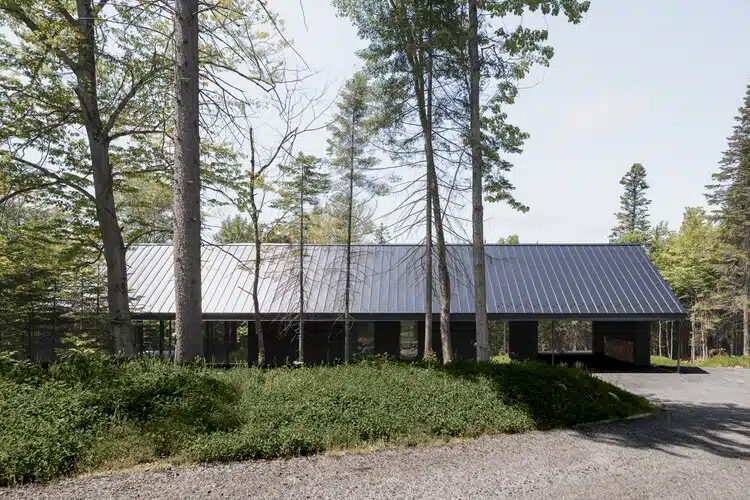
The residence is nestled within dense vegetation spread across rugged terrain, creating a direct connection between the building and its surrounding nature. The design ensures that the architectural presence is never abrupt; the building’s features gradually unfold along the access path, offering an immersive visual experience that evokes a sense of discovery and curiosity.
Balance and Spatial Sensitivity
The design approach is based on the principle of harmonious interaction with the site’s topography, while minimizing human intervention in the environment as much as possible. Consequently, tree removal has been limited, and the existing ecosystem preserved, allowing the building to become part of the natural landscape rather than imposing itself upon it.

Inspiration from Local Architecture
The design draws on a reinterpretation of traditional Quebec architecture, inspired by the classic house model characterized by a double-pitched roof resting atop a simple rectangular volume. This heritage reference is not replicated directly but reimagined in a contemporary manner, reflecting the continuity of architectural values in a modern context.
Spatial Composition and Connection with the Landscape
In this project, the original mass was deconstructed into three independent volumes, creating two clear openings that overlook the lake. These openings serve not only as visual elements but also as spaces that link the interior with the exterior, bringing the natural scenery into the heart of the residence.
Material Simplicity and Timeless Character
The architects relied on a limited material palette, enhancing the clarity of the design concept and imparting an architectural simplicity that expresses timelessness. This simplicity does not imply a lack of detail; rather, it reflects a refined aesthetic awareness that balances authenticity and modernity.


Organization and Visual Experience
Between the garage and the main entrance, the covered passage offers the first glimpse of the water, preparing visitors for a gradually unfolding spatial experience. Inside the residence, the peripheral circulation axis ensures fluid movement between spaces, with openings gradually widening as one progresses from one area to another, creating the impression that the common areas extend toward the covered terrace in the third volume.
Centrality and Intertwined Functions
The fireplace serves as a focal point around which the living spaces are organized, separating the activity of the kitchen and dining area while maintaining the tranquility of the living room. This arrangement reflects a precise understanding of daily activities, balancing social interaction with privacy.
Warmth and Immersion in Nature
Wooden ceilings impart a sense of warmth and grounding, while the overall design ensures that the architecture recedes behind the natural landscape. In this way, nature becomes the primary element in the visual experience, enhancing the feeling of immersion and connection with the surrounding environment.

The Lower Floor as a Haven of Tranquility
In contrast to the openness of the upper floor, the lower level is designed as a single, cohesive unit dedicated to solitude and relaxation. Darker tones and warm finishes dominate this level, creating a calming atmosphere that envelops the space and invites rest and mental rejuvenation.
Interaction with Nature
Carefully considered openings allow nature to permeate these intimate spaces, enhancing the sense of connection with the surrounding environment. The selected building materials extend this connection, linking the interior with the natural landscape. Their tones shift throughout the day as natural light interacts with the surfaces, creating an engaging play of shadow and reflection, poetically reflecting the continuous movement of nature.


✦ ArchUp Editorial Insight
From an architectural standpoint, the project serves as an example of an attempt to seamlessly integrate the building with its surrounding nature, with evident attention paid to materials and openings to guide light and enhance the sense of connection to the environment. This approach provides a framework for understanding how residential spaces can interact with natural topography and contribute to a more balanced living experience.
However, the design raises questions regarding the practical flexibility of the spaces and their impact on daily use, particularly concerning the arrangement of units and the deconstruction of the mass into three independent volumes. While this strategy may effectively enhance visual vistas, it could limit internal circulation or the versatile use of spaces over time. Additionally, the reliance on a limited material palette achieves aesthetic clarity but may reduce adaptability to changing weather or diverse climatic conditions throughout the year.
This project can serve as a case study for exploring the balance between architectural beauty and functional interaction with nature, particularly in future projects that aim to minimize human intervention in environmentally sensitive sites. The experience here offers a model for a contemporary approach that can be further developed to achieve greater practical flexibility without sacrificing visual and natural integration.
Prepared by the ArchUp Editorial Team
Don’t miss the chance to explore more from Architecture in fields like Design and Projects on the ArchUp website.