Rind Village: Architecture, Landscape & Vineyards Integration


Spatial Context of Rind Village
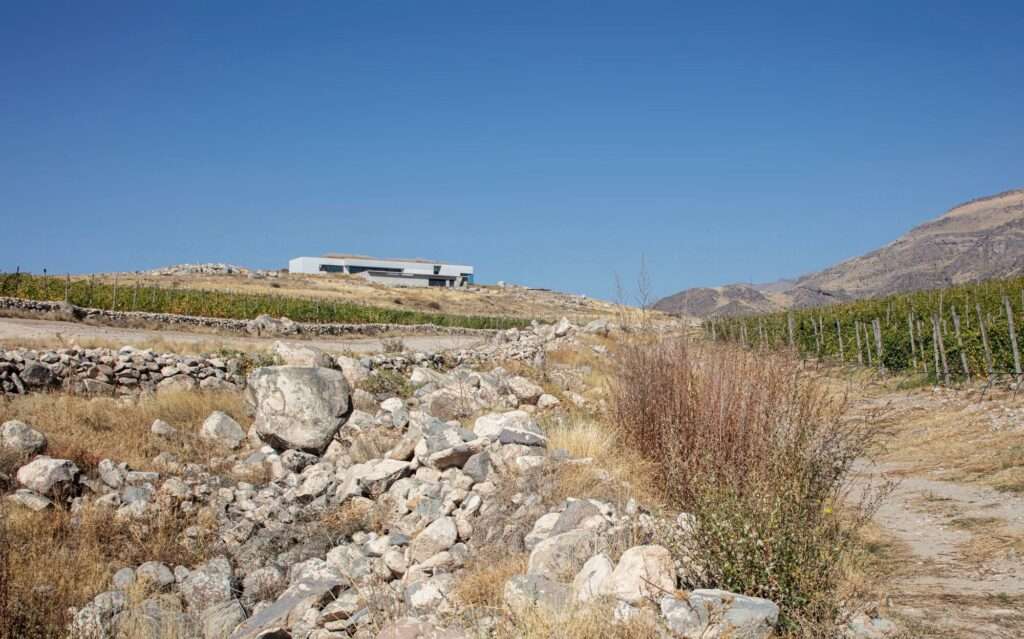
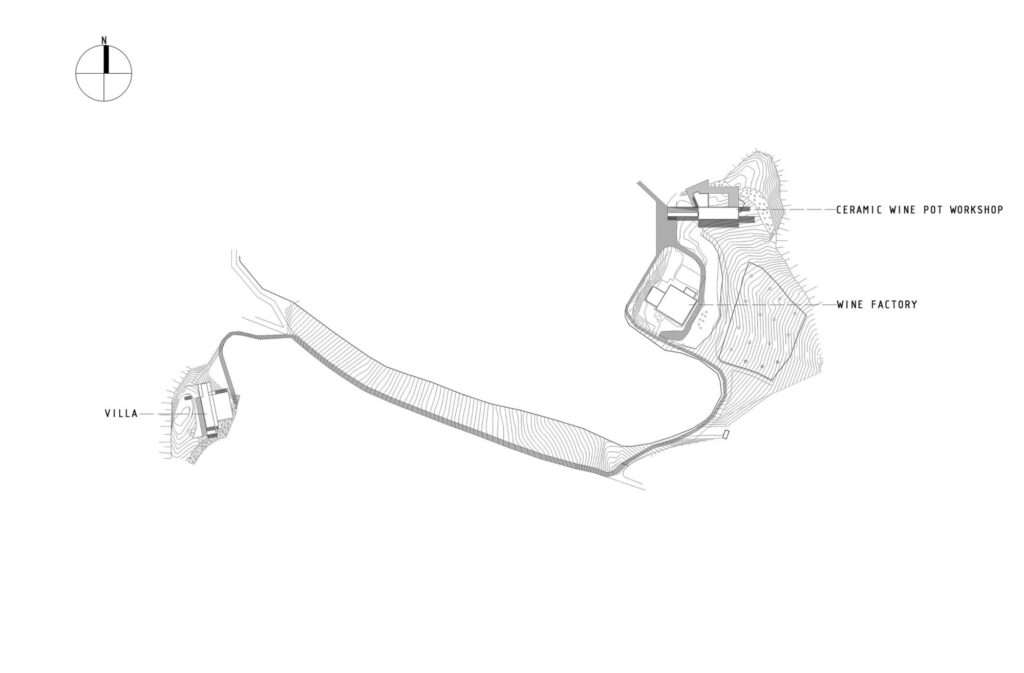
Rind Village is located in the Vayots Dzor region, one of Armenia’s key wine-producing areas. The village is situated on an elevated plateau surrounded by mountains, while its edges are defined by vineyards and the Zorah Winery, which collectively establish the overall framework of the region’s natural landscape.
Site Characteristics and Visual Relationships
The cultivated vineyard plateau lies at an elevation of approximately +1350 meters above sea level, with a slope descending toward the southeast. This condition enables a near-panoramic field of view reaching up to 360 degrees. In contrast, the garden extends toward the northwest along a hillside, where the slope has been utilized to embed the palace, creating a direct relationship between the design, the natural landscape, and the surrounding gardens.

Spatial Organization and Visual Axes
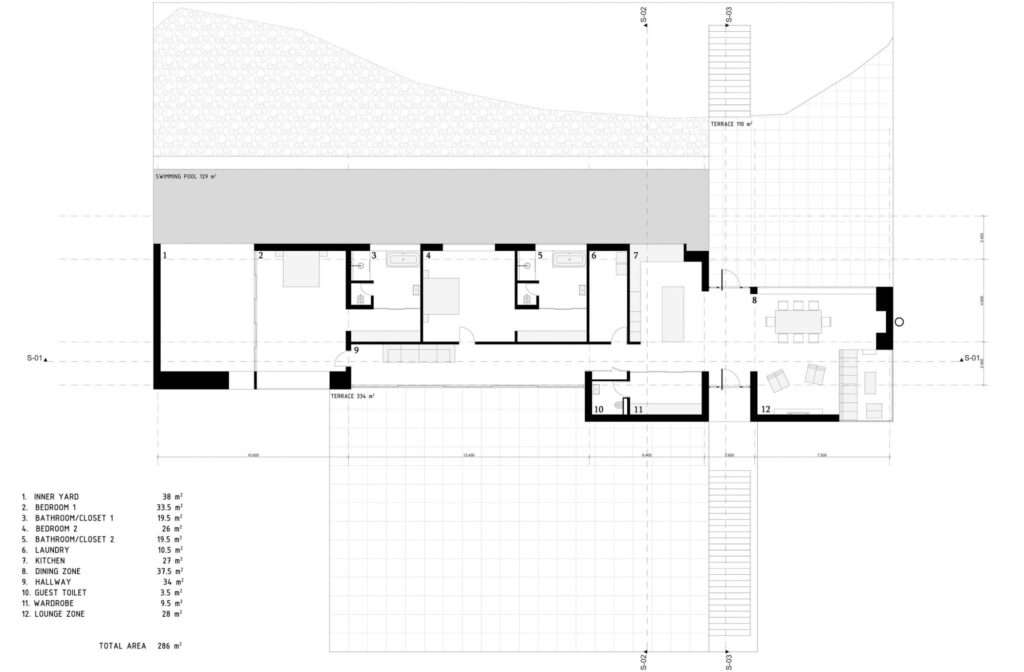
The palace consists of a single-story building based on an elongated linear layout, with its two main façades oriented toward the east and west. The entrance, along with a wide terrace and a shallow reflecting pool, overlooks the vineyards and the village, while the visual composition terminates at a distant mountain range on the horizon.
Integration with Topography and External Elements
On the western side, extending along nearly the entire length of the building, a 30-meter-long swimming pool runs parallel to the protected mountain slope. The design also incorporates a green roof aligned with the elevation of the adjacent hilltop, reinforcing the design integration into its natural surroundings and reducing its visual presence in the overall landscape.
Internal Organization and Circulation Axes
The layout is structured around two intersecting longitudinal and transverse axes that divide the spaces into active and quiet zones. The main entrance follows the transverse axis, crossing the building and leading to a courtyard sheltered by the hill. The longitudinal axis extends from the living room, connected to a lowered work nook set 40 cm below floor level, toward the master bedroom. On the western side, a full-length glazed corridor connects the interior to the outdoor platform, while additional openings from the bedroom lead to a private courtyard enclosed by walls on three sides and the pool on the fourth. The deep overhangs provide shading for both the glazed corridor and the living area.
Relationship with the Natural Landscape
Within this natural context, the surrounding landscape serves as the primary reference, while nature imposes its own constraints on the architectural form. The project is therefore approached as an attempt to integrate with the site, where the building appears as a rectangular mass seemingly suspended above the ground, lightly touching the soil and avoiding visual competition with the hilltop. The deep shadow created by the cantilevered roof further enhances the sense of detachment from the ground.
Organization of Interior and Exterior Spaces
On the western side, a transitional space forms between the natural slope of the hill and the building, defined by a low concrete barrier. The swimming pool is positioned within this space as an intermediate element between nature and architecture, creating a semi-enclosed courtyard surrounded by both natural and constructed elements. This arrangement allows the landscape to be reflected on the water surface while maintaining a clear relationship between interior and exterior spaces.
Privacy and Visual Openness
The design maintains a balance between privacy and openness through a precise handling of architectural elements and details. The result is a relatively protected interior space that remains visually connected to the surrounding natural landscape without being isolated from its context.


✦ ArchUp Editorial Insight
In the case of Rind Village, the spatial outcome emerges as a direct extension of the economic logic of agricultural land value and wine production in Vayots Dzor. Land subdivision systems associated with vineyards and elevated topographies act as a driving force directing investment toward residential structures linked to recreational use. Regulatory friction arises from steep slope constraints, seismic safety requirements, and the protection of view corridors, all of which impose limitations on massing and redirect the project toward a linear horizontal plan. Considerations of supply logistics and structural risk reduction further encourage a single extended floor as a strategy to minimize construction complexity and control cost. Ultimately, the architectural configuration becomes a spatial compromise between the exposure of the natural landscape and the organization of privacy, where the economic geography of vineyards is translated into a controlled architectural interface between agricultural production and low-density residential occupation.