

Seattle Unity: A Modern Spiritual Haven Bridging Community and Design

For decades, Seattle’s non-denominational Unity Church stood as a quiet landmark in South Lake Union, occupying an entire city block. Designed in 1960 by local firm Young, Richardson & Carleton, the mid-century structure featured a rounded sanctuary and a larger two-story rectangular wing. As the neighborhood once a hub for warehousing and manufacturing evolved into a tech-driven epicenter, the church remained a steadfast presence, welcoming all. By the mid-2010s, it became clear that while the congregation thrived, the building needed reinvention. With plans to downsize the footprint and construct a new multi-story space, the church enlisted Olson Kundig to reimagine its future.
A Vision of Inclusivity and Light
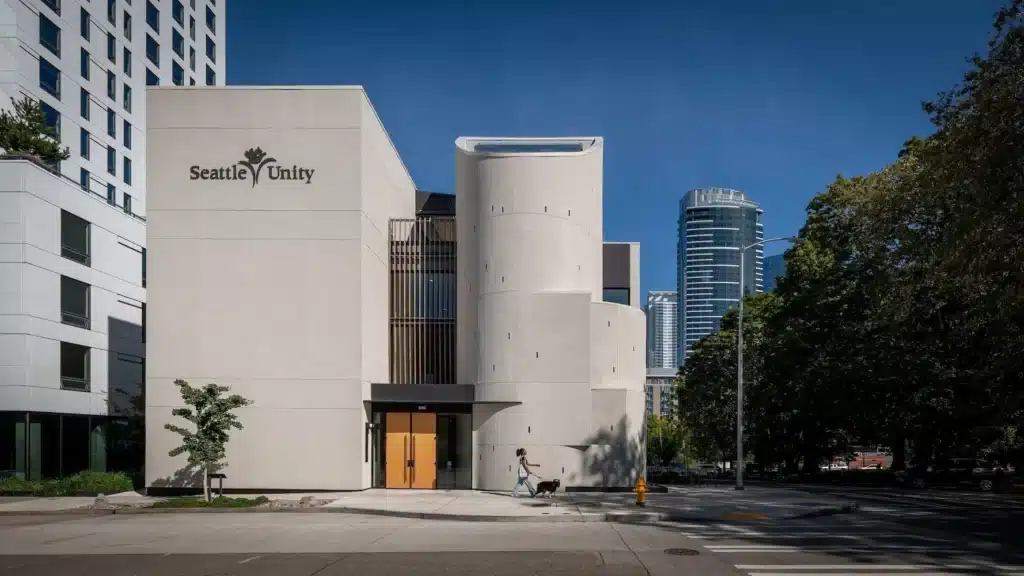
“They came to us with a vision for a building that felt spiritual and communal a space reflecting their mission of openness,” says Tom Kundig, Olson Kundig’s founder. The 14,530-square-foot structure, completed in 2022, avoids overt religious symbolism. Instead, its clean geometries and a curved corner element housing two light-filled meditation rooms signal a peaceful place for prayer and gathering, regardless of spiritual belief.
The exterior blends light stucco (a nod to the original church) with dark Kebony wood cladding on the north and south façades, tying the design to adjacent Denny Park, Seattle’s oldest public park. “We drew inspiration from the original building and the natural setting,” explains Kirsten Ring Murray, Olson Kundig owner. “Light, shadow, and connection to nature guided our choices, creating a serene space for reflection and community.”

Layered Meaning and Adaptive Spaces
The ground floor relocates previously basement-level functions offices, youth ministry, and a chapel into a sunlit cylindrical feature at the southwest corner. Meaningful details, like reclaimed wood cladding and a floor aperture displaying rocks collected by congregants over decades, bridge past and present.
Upstairs, the oak-clad meditation hall evokes a traditional Japanese tansu chest, with lantern-inspired lighting and a full wall of south-facing windows framing Denny Park. “The building orients toward tree-canopy views, immersing visitors in nature,” Kundig notes. Glass-block walls and etched glass panels amplify tranquility, doubling as a glowing beacon at night.
The second-floor Unity Hall now with a full kitchen hosts communal meals and events, while a covered terrace extends usability year-round. “Clean lines and functional details keep the architecture grounded,” says Murray, “allowing it to nod to sacred traditions while remaining modern and approachable.”

✦ ArchUp Editorial Insight
Seattle Unity’s redesign masterfully balances spiritual intentionality with contemporary adaptability, creating a space that honors its history while serving a diverse community. However, the project’s avoidance of overt religious symbolism, though inclusive, risks diluting the church’s distinct identity a challenge when merging sacred and secular functions. That said, the seamless integration of biophilic design and reclaimed materials transforms the building into a testament to sustainability and connection, proving that spaces of worship can evolve without losing their soul.


