

Star Homes: Reimagining Rural Housing in Sub-Saharan Africa for Health and Sustainability

In the heart of Sub-Saharan Africa—a region expected to double its population to 2.5 billion by 2050—housing is becoming a critical frontier of innovation. With 460 million new residents projected to settle in rural areas, the demand for healthy, sustainable, and affordable homes is more urgent than ever. The Star Homes project, based in Mtwara, Tanzania, offers a radical rethinking of rural architecture by connecting building design with public health outcomes. More than just shelter, these homes are designed to reduce disease, improve comfort, and lower environmental impact—offering a replicable model for the continent’s rural housing crisis.
For anyone looking for a reliable and up-to-date architectural resource, ArchUp offers fresh content covering projects, design, and competitions.
A Vision Built on Health and Climate Logic
The Star Homes project is not merely an architectural experiment—it is an intersection of science, public health, and vernacular design thinking. Led by architect Jakob Knudsen and public health expert Lorenz von Seidlein, the initiative recognizes that traditional rural housing in Sub-Saharan Africa often contributes to poor health outcomes. Homes with unventilated rooms, heat-trapping walls, and earth floors provide a breeding ground for disease vectors like malaria-carrying mosquitoes. In contrast, Star Homes draw inspiration from Southeast Asian typologies—light, elevated, and breathable structures designed to respond to hot-humid climates more effectively.


From Prototype to Data-Driven Impact
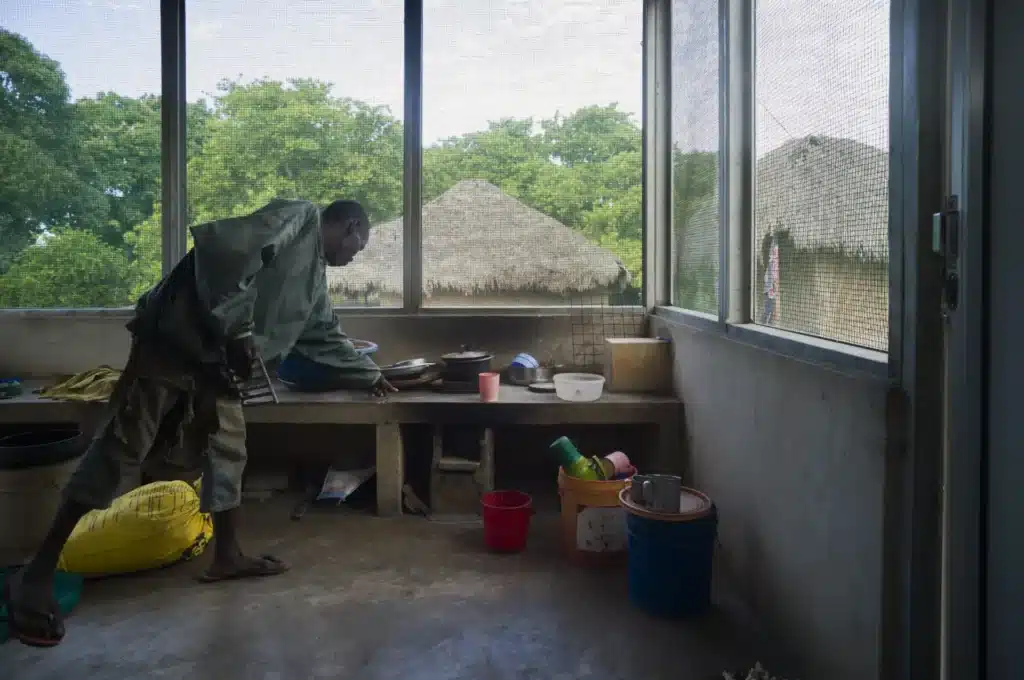
Initial prototypes were built in 2015 in the village of Magoda, followed by the construction of 110 Star Homes across 60 villages in Mtwara for broader testing. Each home followed a strict modular logic to allow for scientific comparability: the goal was not only to build better homes but to track health data across several years to test the real-world effects.
Participation was voluntary, but skepticism loomed large. Some families refused to move in; others used the homes irregularly. To counter misinformation, the project team embedded themselves in village life—hosting football matches, broadcasting educational radio plays, and working closely with local leaders. Eventually, trust grew, and by late 2021, all homes were fully occupied.
Health Gains with Environmental Benefits
Although the full study is still under peer review, early findings suggest that malaria incidence among children dropped by 30–40% in the Star Homes. Indoor mosquito presence fell by 50%, and young children showed signs of improved growth, likely linked to better sleep quality and reduced exposure to illness.
Just as importantly, the homes showed impressive environmental metrics. BIM-based life cycle analysis revealed:
- 37% less embodied carbon
- 40% less embodied energy
- 70% less concrete usage than conventional rural homes
Such reductions could make a major impact when scaled to meet the continent’s housing needs.

A Scalable Model for 2050 and Beyond
What makes Star Homes exceptional is their replicability. Built with affordable, locally available materials and optimized for prefabrication, these houses can be adapted for various rural settings across Africa. They challenge outdated assumptions that low-income rural housing must be low-tech or temporary. Instead, they present a dignified, resilient model—one that prioritizes health and the environment without sacrificing design integrity.
This approach encourages architects, urban planners, and policymakers to see rural housing not as an afterthought, but as a crucial arena for innovation. The success of Star Homes is a testament to what happens when architecture is integrated with rigorous public health science and respectful local engagement.
✦ ArchUp Editorial Insight
The Star Homes initiative presents a compelling case for integrating architecture with preventive medicine. The project doesn’t simply react to public health challenges—it anticipates them, embedding solutions within the very structure of domestic life. By fusing material innovation, scientific rigor, and cultural empathy, the homes become agents of wellness. For architects working in underserved regions, this model illustrates how design can do more than house — it can heal, educate, and protect. The lesson is clear: thoughtful architecture can radically alter life outcomes, especially when scale and sensitivity converge.


Conclusion: Architecture as Preventive Health
In a time of rapid population growth and intensifying climate challenges, the Star Homes project positions architecture as a proactive public health tool. By elevating design standards for even the most modest dwellings, it offers a blueprint for reducing disease, empowering communities, and minimizing ecological impact. It demonstrates that good architecture isn’t reserved for elite urban environments—it can and must begin in the villages, where the stakes are high and the potential for transformation is enormous.
Explore More with ArchUp
ArchUp documents the evolving profession of architects worldwide, from career insights and research to project profiles and industry news. Our editorial team publishes global salary trends, career advice, and opportunities for emerging talents. Learn more on our about page or contact us to collaborate.


