

STARAY in OōEli: Breathing Architecture Where the Boundary Between Technology and Nature Dissolves

The concepts of “breath” and “freedom” are at the very core of the design’s konceptsiya (concept). STARAY has always sought to translate this spirit into its products, and here, it is transferred to the realm of architecture. The pivotal question posed by the designers was: “How can a space be rapidly constructed within the context of OōEli?” The answer was to penetrate the void with a lightweight structure, resembling an aerial curtain, to form what can be called “architecture of air.”
The structure is designed to be a visual embodiment of the wind—a “vessel that carries air,” creating a space that makes one feel as if inside a giant, breathing shoe sole. This serves as a tangible metaphor for the brand’s own philosophy.
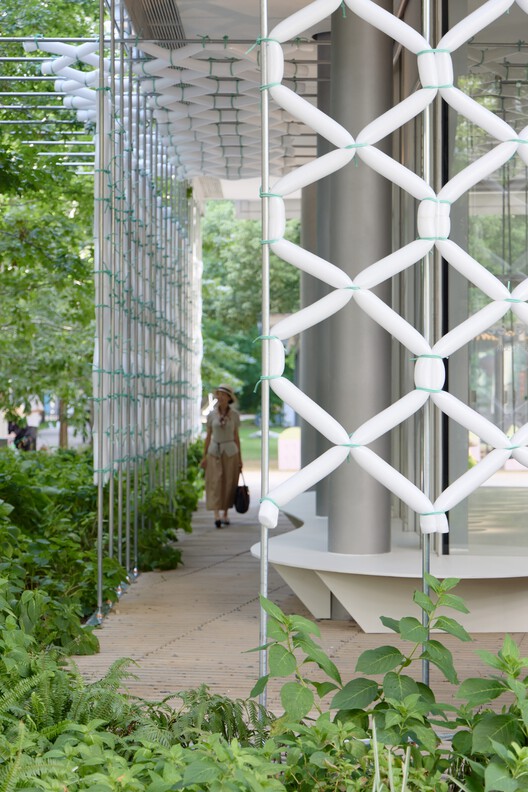
Construction Strategy: A Penetration That Transforms Boundaries into Opportunities
The architectural strategy relies on two main concepts: Penetration and the New Spatial Curtain.
- Visual and Physical Penetration: The structure pierces the dividing line between the inside and outside of Renzo Piano’s building, existing half indoors and half outdoors. This calculated displacement creates an unprecedented fusion between the store’s interior space and the surrounding architecture, expanding the sense of place and attracting passersby from the outside into a unique internal experience.
- The Multi-Functional Spatial Curtain: Beneath the eaves of the building, this curtain is formed using detachable, removable uprights. Some of these supports are anchored vertically to the ground, while others appear suspended in mid-air, enhancing a sense of lightness and weightlessness. This network is not a barrier but a visual and spatial mediator that connects all elements.
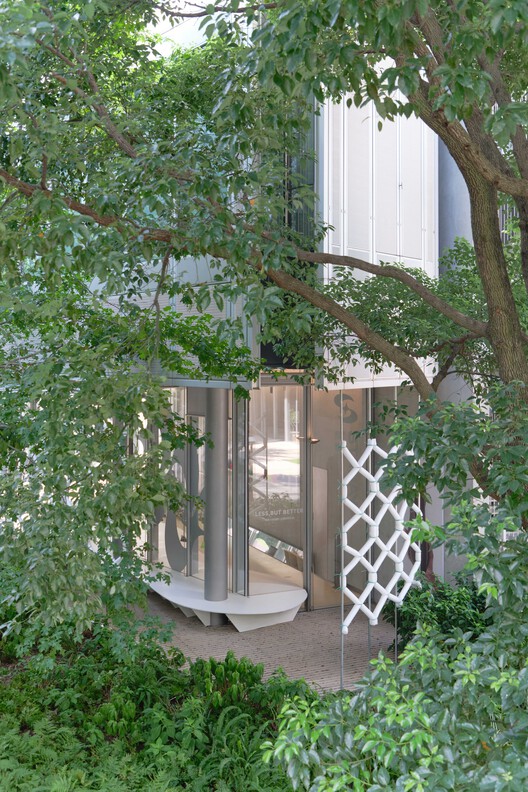
User Experience: Between Sitting, Contemplation, and Interaction
The role of this installation transcends that of an architectural sculpture; it is an immersive, functional space that interacts with both people and nature.
- Inside: Function Transformed into Art
Inside the hall, the lattice structure curves to become comfortable organic seating for visitors trying on shoes. The ordinary act of shopping becomes a unique sensory experience, where the user sits within a work of art that represents the product itself. - Outside: A Natural Theater of Light
As sunlight or evening mist filters through the gaps between the rods, a constantly changing theater of light and shadow forms beneath the dappled shades. This visual play creates what the designers called a “breathing space,” where visitors or passersby can pause, rest, and capture moments of contemplation and beauty.
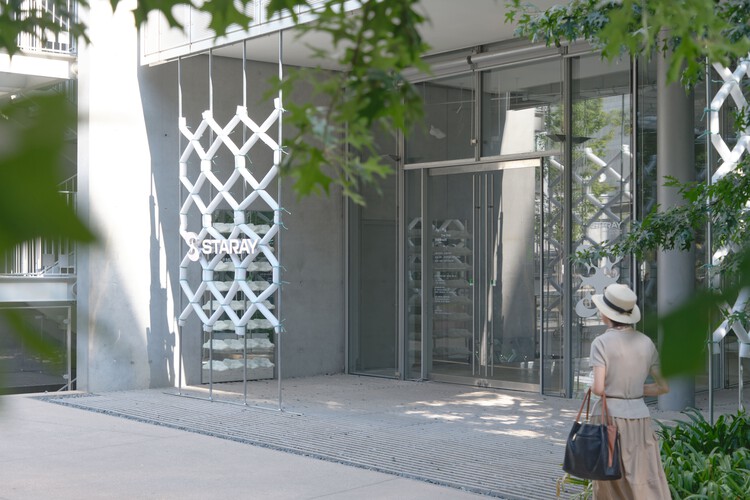
Materials and Sustainability: A Fabric of Nature and Technology
This architectural dream was realized using sustainable and intelligent materials that reflect the brand’s commitment to environmental values.
- The Lattice Structure: The primary framework, resembling a diagram of molecular structures, was created using 3D printing technology, ensuring high precision and reducing material waste.
- Foam Rods and Climbing Ropes: The design combines the lightness of foam rods with the robustness of climbing ropes, creating a geometric fabric that is both naturally irregular and orderly at once, resembling a living ecological interface.
- Disassembly and Reusability: All project components are designed for disassembly, reuse, or recycling, making it a pioneering model for temporary and responsible architecture.

Conclusion: Where Architecture Becomes Breath
The STARAY project in OōEli is more than an installation; it is a message. A message that the future of architecture lies in creating living spaces that adapt to people and nature, challenging traditional classifications. It proves that advanced technology can be human and organic, and that the aesthetics of a place can be born from a courageous dialogue between the old and the new. This project is not merely a place; it is a sensory experience where boundaries dissolve, leaving only memory.
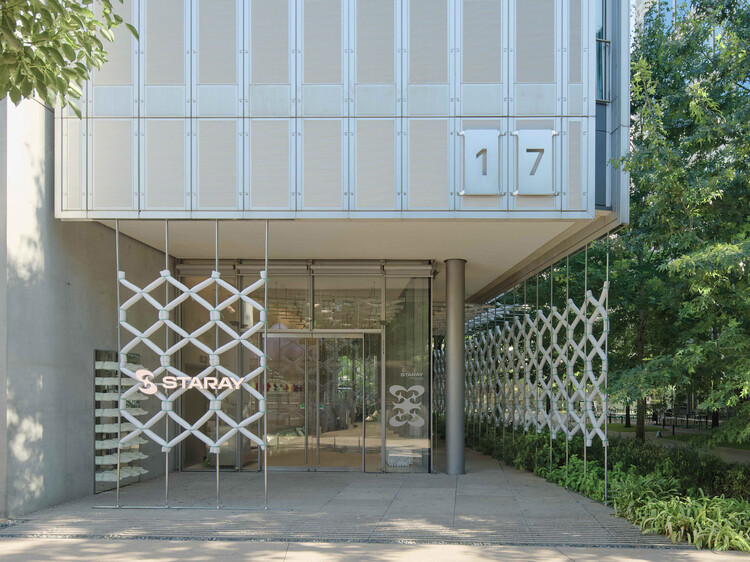
✦ ArchUp Editorial Insight
The project presents an ambitious approach to creating a rapidly deployable and demountable space within an existing architectural context, using a lattice structure of foam rods and ropes to engage with Renzo Piano’s building through the idea of “penetration.” From a critical perspective, the project remains a foreign entity placed upon the site rather than one organically integrated within it. The problematic relationship between the lightweight, temporary structure and the permanent building with its contemporary classical language is presented without a convincing resolution, creating a visual dialogue that some may read as a clash rather than an integration. Furthermore, the reliance on molecular metaphors and organic concepts, while theoretically appealing, risks simplifying the complex relationship between design and function into a mere aesthetic narrative. However, the project’s strength lies in its courage to raise a question about the possibilities of sustainable temporary construction and how architecture can be lightweight and recyclable, paving the way for more mature experiments in this field.
Brought to you by the ArchUp Editorial Team
Inspiration starts here. Dive deeper into Architecture, Interior Design, Research, Cities, Design, and cutting-edge Projectson ArchUp.


