
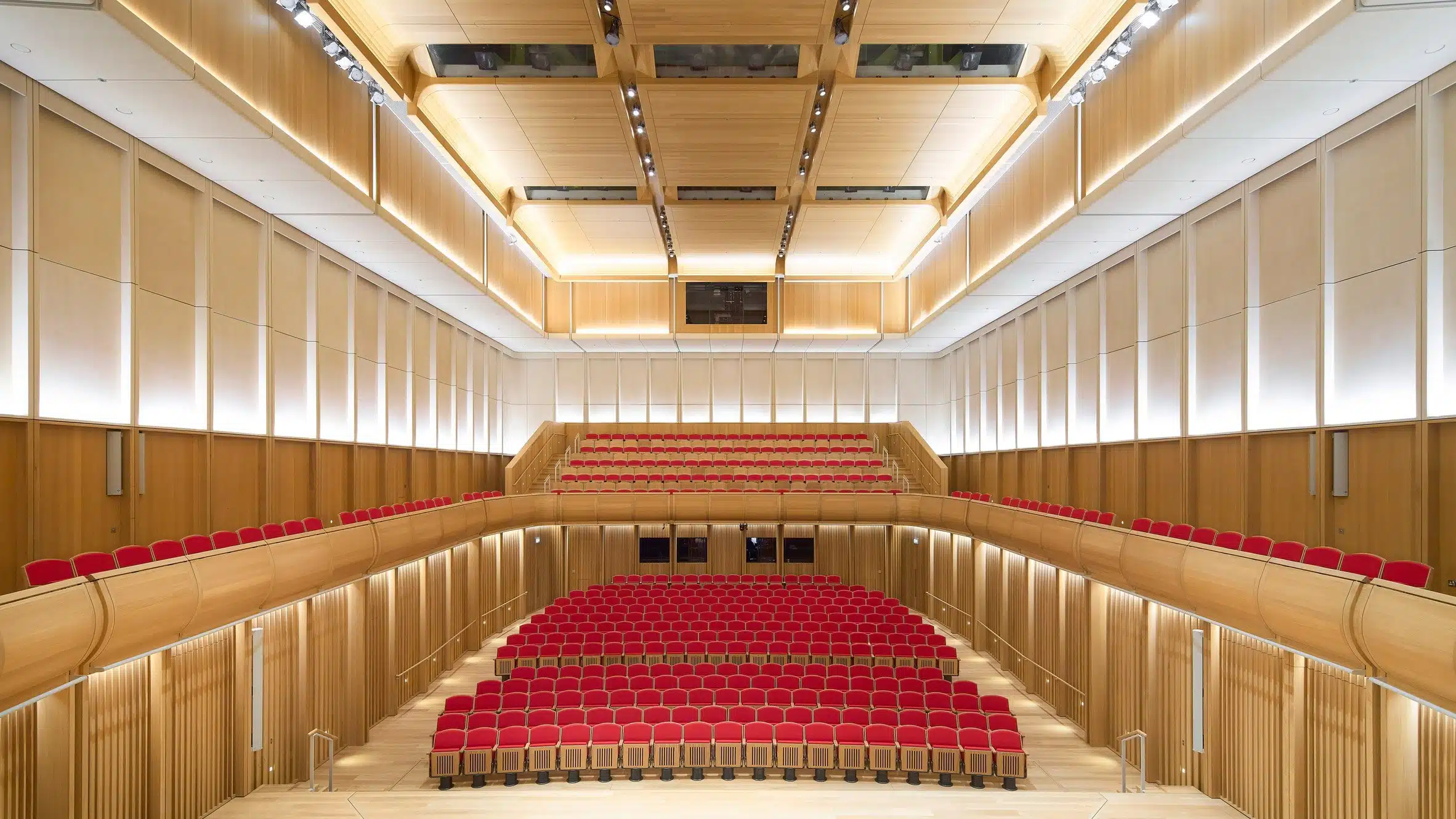
Stephen A. Schwarzman Centre for the Humanities at the University of Oxford

The structure crafted by Hopkins Architects melds the diverse humanities faculties, research institutes, and cultural-performance spaces in the Radcliffe Observatory Quarter of Oxford. Its purpose is to cater to the academic community and the public; thus, it will be a large academic and civic facility.
Project Overview
The center’s area covers more than 25,000 square meters and consists of the departments of research, the main library, a concert hall with 500 seats, and a theater with 250 seats. The project has been recognized for its lofty goal in sustainability and spatial planning. The plan integrates the public square, the classrooms, and the performing arts in a very smooth way.

Design Logic
The central atrium of four stories is framed by the architecture as the core of the structure. This area leads to the various teaching floors, gallery spaces, and auditoriums. The building is made of materials that are chosen to complement the historical context of Oxford while at the same time achieving new heights in environmental performance. The design is based on flexibility, transparency, and interaction among the different fields.
Table: Key Functions
| Function | Description | Rule |
|---|---|---|
| Great Hall Atrium | Central three-level vertical space | Acting as gathering forum and spatial organiser |
| Concert Hall | 500-seat performance venue | Demonstrates high acoustic and environmental standards |
| Teaching Floors | Upper-level academic and research spaces | Promotes disciplinary integration |
| Public Realm & Library | Café, exhibition space and library access | Connects university and city life |

Materiality and Sustainability
The building’s exterior is made of stone and brick, which are in harmony with the adjacent Oxford buildings. The building is so well designed that it even targets Passivhaus certification, which signifies having a negligible heating requirement accomplished by superb insulation. The scheme is proof that the architecture of big academic institutions can still be contextually sensitive while setting lofty environmental goals. For more information about eco-friendly materials, see building materials.
Urban and Cultural Context
The center is super well placed, right on the old hospital site and close to the future university campus, and it also has entrances to the public gardens and walkways. Therefore, it plays a part in the perception of the Radcliffe Observatory Quarter as an active urban spot rather than just a scholarly one. The coming together of culture, academia, and the public realm is indicative of the university’s more barrier-free architecture and also the education precincts of the city’s larger themes.

Architectural Significance
The center facilitates the architects and researchers to examine the issue of institution building in one massive design, which will combine research, performance, education, and public access. The treating of spatial hierarchy, sustainable systems, and material dialogue yields precious insights into the research and practice of contemporary architecture.
Architectural Significance
The center presents architects and researchers with a case study on how institutional buildings can be designed in a coherent way, combining research, performance, education, and public access. The attention paid to spatial hierarchy, sustainable systems, and material dialogue is a source of valuable lessons for architectural research and practice in the present day.

✦ ArchUp Editorial Insight
The University of Oxford’s Stephen A. Schwarzman Centre for the Humanities, created by Hopkins Architects, not only unites several research institutes, the cultural activities’ spaces, and the performance halls but also does so in an interconnected environment. The project’s virtues of sustainability and accessibility have been highlighted without ignoring the architectural heritage of Oxford.
The central atrium is the building’s heart, serving as the main point of connection for teaching, galleries, and theaters. The concept is that of public collaboration and engagement through open spaces and transparent circulation areas. The front of the building uses both stone and brick to match the city’s old texture, while excellent environmental systems reach Passivhaus standards.
This project shows the possibility of academic architecture to combine learning, culture, and sustainability under one umbrella. The merging of material sensitivity with a civic purpose makes the building a modern model of how universities can relate scholarship to the community.
Conclusion
The Stephen A. Schwarzman Centre for the Humanities is a clear demonstration of the architectural power that can be used to show academic ambitions, public engagement and environmental care in one building. This Centre shows that big institutions can have such buildings where everything is more or less open, flexible, and sustainable rather than closed monuments. For more information about the design and building methods, visit projects for construction and other projects.

Explore the Latest Architecture Exhibitions & Conferences
ArchUp offers daily updates on top global architectural exhibitions, design conferences, and professional art and design forums.
Follow key architecture competitions, check official results, and stay informed through the latest architectural news worldwide.
ArchUp is your encyclopedic hub for discovering events and design-driven opportunities across the globe.
Brought to you by the ArchUp Editorial Team
Inspiration starts here. Dive deeper into Architecture, Interior Design, Research, Cities, Design, and cutting-edge projects on ArchUp.


