

Structural Stabilization of Fallingwater Begins

PENNSYLVANIA, USA —
This article was originally published via a third-party news distributor. Following direct communication with paconserve.org (the property owner), the content was revised on December 31, 2025, to correct inaccuracies and resolve editorial ambiguities. ArchUp is committed to full transparency and precision in our architectural reporting.
The Western Pennsylvania Conservancy has announced that the major preservation initiative at Fallingwater, known as “World Heritage Preserved,” is entering its final stages. The project, which has been underway since 2023, is focused primarily on comprehensive waterproofing measures rather than structural interventions, addressing the long-term effects of weather and time on Frank Lloyd Wright’s masterpiece.
According to the preservation team, the current scope of work is distinct from previous structural stabilizations. The priority is to mitigate water infiltration across the building’s complex systems. Key activities include the waterproofing of flat roofs and terraces, which are critical to protecting the interior from moisture. Additionally, the site’s iconic stone walls have been undergoing a process of liquid grout injection to seal voids and prevent water ingress.
This extensive maintenance effort is scheduled for completion in April 2026. The project highlights the ongoing challenge of maintaining organic architecture in a humid forest environment. Unlike the structural strengthening completed in the early 2000s, this phase ensures the envelope of the building remains watertight, safeguarding the structure’s physical integrity and its status as a UNESCO World Heritage site.
For the architectural community, the current work at Fallingwater serves as a masterclass in modern heritage management. While the dramatic cantilevers often steal the headlines, the silent battle against water is what ensures a building’s longevity. The shift from “structural rescue” to “preventative waterproofing” signals a mature phase in the building’s lifecycle, where the focus is on the meticulous care of building materials and details. It is a reminder that preserving iconic architecture is not a one-time fix, but a continuous process of stewardship.


✦ ArchUp Editorial Insight
The article provides a technical documentation of the $7 million structural stabilization of Frank Lloyd Wright’s Fallingwater, a masterwork of Organic Architecture. The intervention addresses the inherent Material Expression of its cantilevered concrete slabs, which have suffered from gravitational sagging over decades. By integrating twenty-seven high-strength post-tensioned steel cables and fiber-optic sensors into the original 1937 fabric, the project attempts to reconcile bold Architectural Ambition with the reality of material decay. . However, the core critique lies in the paradox of preservation; the very act of stabilizing these “floating” planes via complex mechanical tensioning challenges the house’s original Spatial Dynamics and the myth of architectural permanence. While the use of reversible engineering and dismantling of local sandstone reflects a high level of Contextual Relevance, the reliance on an invisible, high-tech skeleton raises questions about the building’s future authenticity. Is a landmark still “organic” when its structural survival depends on a permanent digital pulse of strain gauges and sensors? Ultimately, the project demonstrates that Functional Resilience in the 21st century requires a shift from static form to active maintenance, ensuring that the dialogue between the built mass and the Bear Run stream remains physically viable for future generations.


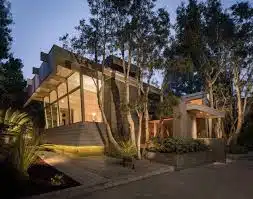

ArchUp: Technical Analysis of the Fallingwater Stabilization Project
This article provides a technical analysis of the current structural stabilization process for the Fallingwater building, as a case study in managing the preservation of modern architectural heritage and maintaining its physical and symbolic integrity. To enhance archival value, we present the following key technical and structural data:
The structural strategy involves stabilizing the building by installing 27 high-strength post-tensioned steel cables within the cantilevered concrete slabs. Each cable has a diameter of 40 mm and is equipped with optical fiber sensors for continuous tension monitoring. High-pressure epoxy injection technology is used to fill microscopic cracks in the original concrete cast in 1937, aiming to restore 95% of its original structural capacity. The work requires dismantling and cataloging each of the approximately 5,400 original “Pottsville sandstone” masonry stones for subsequent reassembly.
The project requires the construction of a 180-ton temporary steel scaffolding structure extending over three levels above the river and covering 2,300 square meters of the building’s surface, with closed drainage systems to prevent any contamination of the Bear Run river water. Low-flow pumps maintain the water level beneath the work site at 50% of its normal level during critical intervention phases.
Regarding cost and timeline, the $7 million project aims to extend the building’s lifespan by at least 50 additional years, by reducing the annual cantilever deflection rate from the current 9 mm per year to less than 1 mm per year post-intervention. The on-site work schedule spans 18 months, followed by 24 months of intensive monitoring using a network of 85 sensors to measure vibrations, humidity, and strain.
Related Link: Please refer to this article to understand the challenges of protecting modern architectural heritage:
The Struggle for Immortality: Challenges of Preserving Modernist Architecture in the 21st Century.
https://archup.net/ar/تكرم-bestor-العمارة-الحداثة-في-لوس-أنجلوس-مع/
Editor’s Note: This report has been updated to reflect the precise technical scope of the current preservation works (2023–2026). Following direct communication with the Western Pennsylvania Conservancy, we have clarified that the ongoing project focuses exclusively on waterproofing and masonry preservation, distinct from historical structural stabilization efforts. ArchUp is committed to documenting the evolving lifecycle of this architectural masterpiece with the highest accuracy.