

Switzerland’s Architectural Paradox: How Herzog & de Meuron’s Hortus Redefines Sustainable Building

Switzerland presents a striking contradiction in building culture. On one hand, it enforces some of the world’s strictest energy performance codes; on the other, this small Alpine nation consumes staggering amounts of carbon-heavy concrete producing more per capita than neighboring France, according to 2020 data from the Federal Office for the Environment. Against this backdrop, the decision by renowned Swiss firm Herzog & de Meuron (H&dM) whose portfolio includes landmarks like The Blue House (1980) to design a 150,000 sq ft office building with almost no concrete marks a paradigm shift.
Commissioned by developer Senn for a life-sciences business park in Basel’s Allschwil suburb, Hortus was envisioned as “Switzerland’s most sustainable office building.” As project lead Alexander Franz explains, the brief prioritized sustainability targets over conventional design parameters, upending H&dM’s typical process: “Instead of a classic program, we were given sustainability goals. Normally, we start with urban scale and massing, then consider materials. Here, we began with recyclable components.”
A Timber Revolution with Minimal Concrete
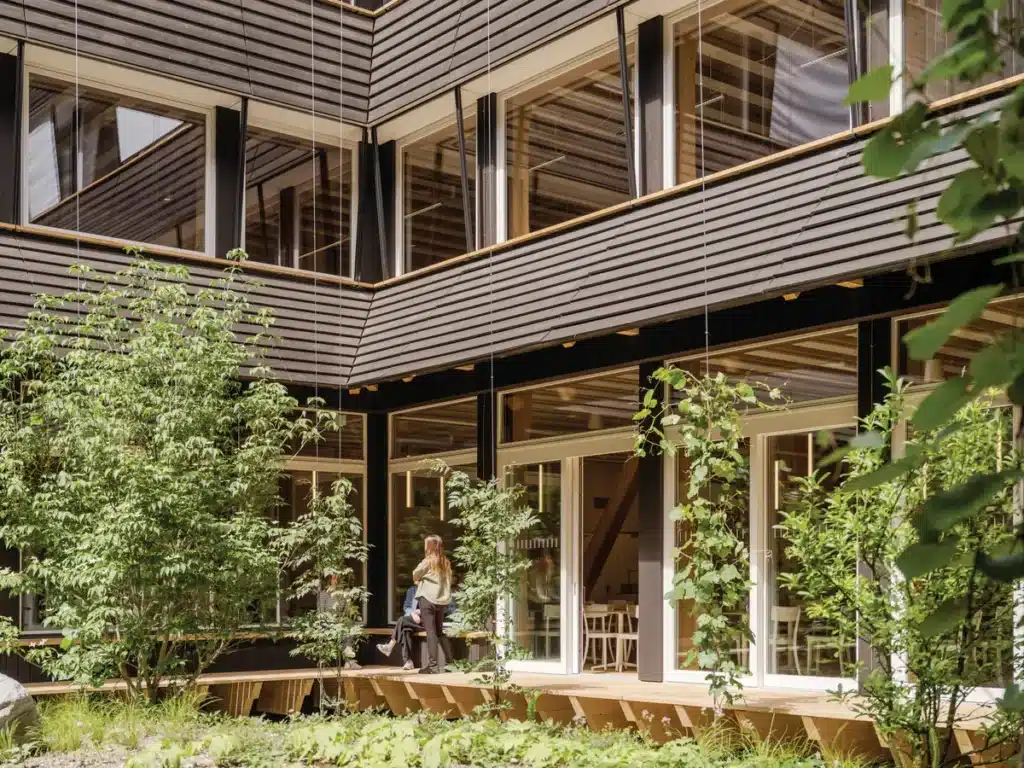
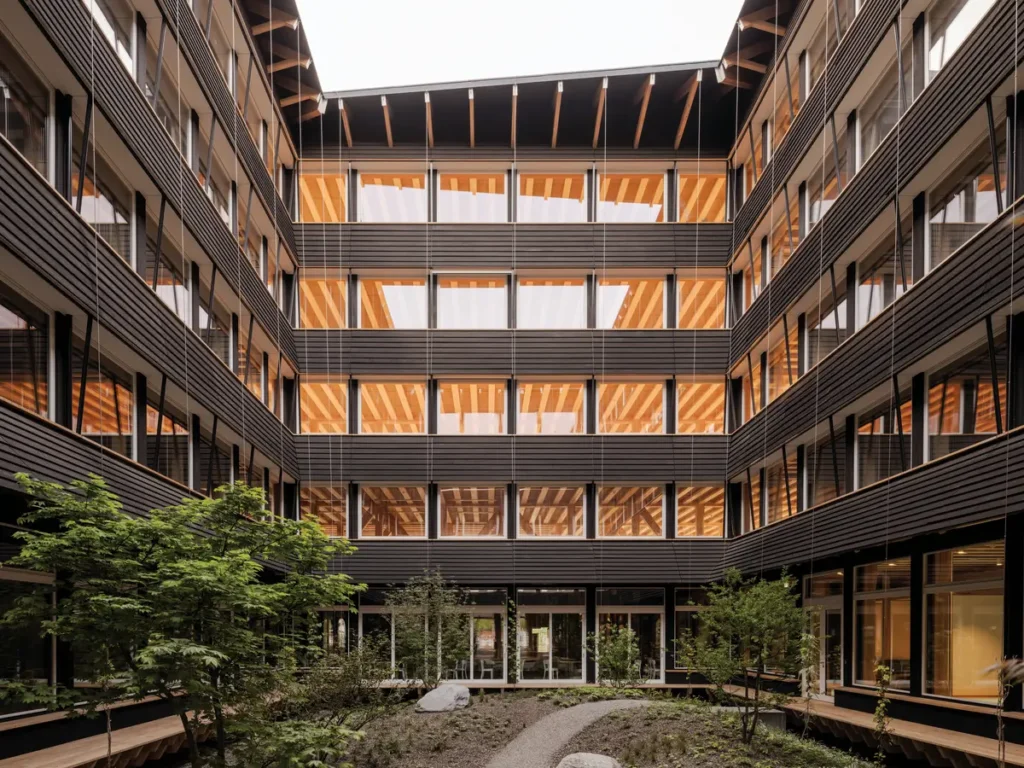
Though concrete couldn’t be entirely avoided, it was used sparingly—limited to 6.5-foot-deep foundations beneath each column. The primary structure relies on locally sourced beechwood, diagonally cross-braced for seismic compliance, while the façade uses faster-growing spruce. The five-story timber frame (one floor fewer than code allows) hovers above ground level to prevent wood-soil contact, eliminating the need for a basement.
Innovations in Energy and Design
- Passive Cooling: A central courtyard, landscaped by Piet Oudolf, creates a microclimate.
- Daylight Optimization: By reducing window area (33% less glass than typical Swiss triple-glazed façades) and using double-glazed units with half-solid spandrels, Hortus maximizes natural light.
- Carbon-Neutral Ambitions: On-site solar panels generate surplus energy, shared with adjacent buildings. H&dM claims operational and embodied carbon neutrality by 2056.
Material Breakthroughs
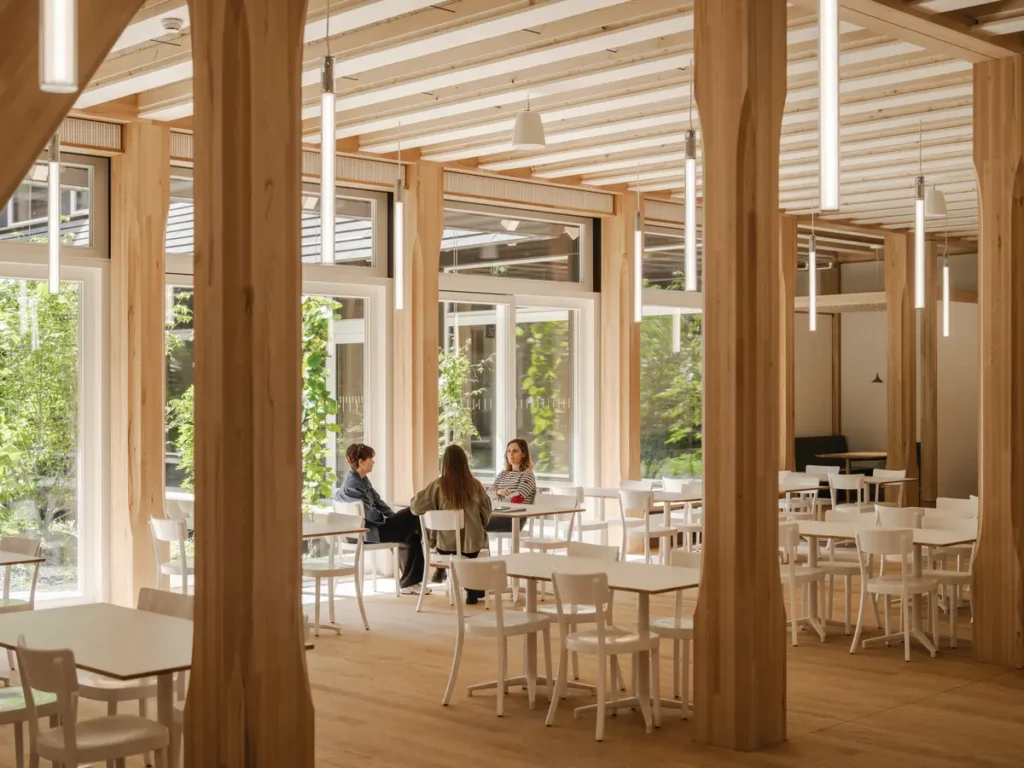
- Recyclable Structure: Gravity and traditional joinery replace metal fasteners, simplifying future disassembly.
- Untreated Steel: Emergency staircases use folded, uncoated steel for easy recycling.
- Low-Carbon Insulation: Cellulose (85% recycled newspaper) and clay plaster minimize emissions.
- Hybrid Flooring: The project’s standout innovation vaulted timber-clay floor panels reduces carbon tenfold versus concrete while providing thermal mass.

Challenges and Legacy
Despite its achievements, questions linger about scalability: Can Switzerland’s beech forests sustain such demand? Can local solar suppliers compete with global markets? Yet Hortus serves as a critical testbed for low-carbon architecture. As Jacques Herzog reflects, sustainability “leads to unexpected, astonishing beauty.” From its temple-like eaves to its raw-material interiors, Hortus embodies a utopian yet pragmatic vision one that may redefine Swiss construction.
✦ ArchUp Editorial Insight
Herzog & de Meuron’s Hortus challenges Switzerland’s reliance on concrete by embracing timber, clay, and radical sustainability targets, proving that eco-conscious design need not sacrifice elegance. While the project’s material innovations are commendable, its feasibility hinges on unresolved supply-chain questions particularly the scarcity of mature beechwood and the economic viability of localized production. Nonetheless, Hortus sets a bold precedent, demonstrating that carbon-neutral architecture can harmonize aesthetics, functionality, and environmental rigor. Its success lies not in perfection, but in sparking essential conversations about the future of building.


