Tampa Bay Rays Stadium Project Advances with $2.3 Billion Mixed-Use Development Plan

Major League Baseball Facility Proposed for Hillsborough College Campus
The Tampa Bay Rays are moving forward with plans for a new ballpark in Tampa, Florida. The proposed stadium would anchor a large-scale mixed-use development featuring housing, retail, and entertainment venues. This news marks a significant shift for the team, which has long sought a permanent home beyond its current facility in St. Petersburg.
113-Acre Site Selected for Baseball Stadium Complex
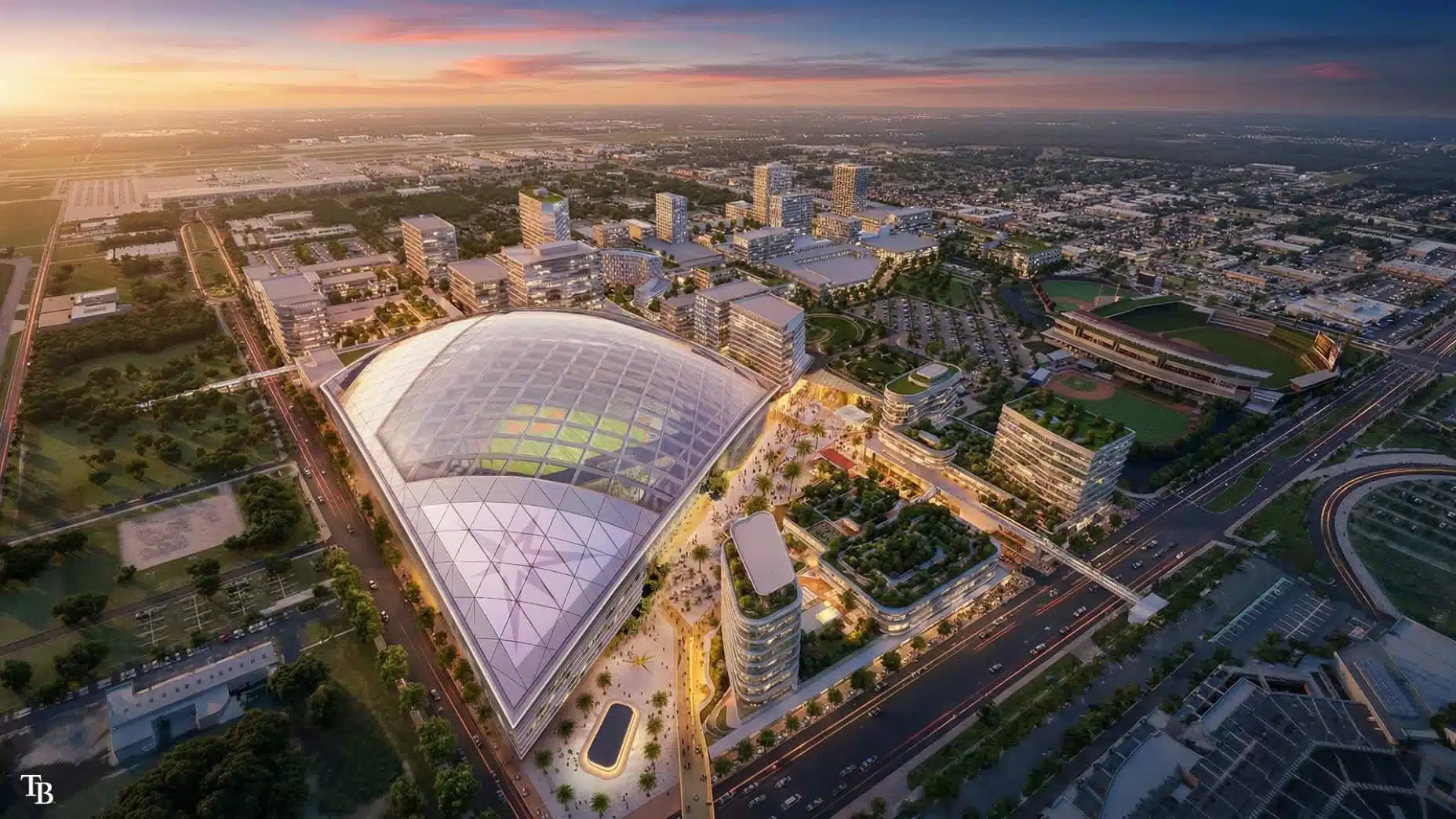
The Dale Mabry campus of Hillsborough College serves as the chosen location. This 113-acre site in Hillsborough County offers space for both the Tampa Bay Rays stadium and surrounding infrastructure. Local leaders and the College Board have expressed support for transforming the property into an active district centered around professional baseball.
The proposed ballpark would accommodate roughly 31,000 seats. Moreover, the architectural design integrates public spaces with neighborhood streets. Consequently, the development aims to create year-round activity beyond game days.
$2.3 Billion Budget Outlined for Stadium Construction
Early estimates place the Tampa Bay Rays stadium construction costs at approximately $2.3 billion. The ownership plans to cover at least half of these expenses, including future repairs and overruns. Meanwhile, remaining funds would come from county, city, and state sources.
![Eye-level perspective of the [ Tampa Rays Stadium ] entrance plaza featuring the Rays Lounge with a curved wooden slat ceiling and a large glass facade.](https://archup.net/wp-content/uploads/2026/02/2-7-1024x576.webp)
Additionally, a special tax district may form around the development. Commercial growth on nearby land could generate tax revenue to support infrastructure costs over time.
State Land Transfer Under Consideration
The Florida Cabinet is reviewing a transfer of roughly 22 acres of state-owned property to Hillsborough College. However, this transfer includes conditions requiring major construction to begin within five years. Furthermore, officials emphasize that any agreement must demonstrate clear public benefits.
State and local leaders have voiced support for bringing a new facility to Tampa. Nevertheless, the project requires formal approvals from city councils and county commissioners before proceeding.
2029 Target Date Set for Stadium Completion
The team hopes to finalize agreements and begin building processes to meet a 2029 opening timeline. Currently, games continue at Tropicana Field in St. Petersburg through at least the 2026 season following recent storm damage repairs.
![Nighttime rendering of a crowded fan zone outside the [ Tampa Rays Stadium ] with large LED screens, team mascots, and dynamic architectural lighting.](https://archup.net/wp-content/uploads/2026/02/3-4.webp)
Therefore, coming months will focus on finalizing land use agreements, public funding mechanisms, and design specifications. Community input sessions are planned as part of the approval process.
This Tampa Bay Rays stadium represents more than a sports venue. The proposal envisions a comprehensive urban planning initiative combining residential, commercial, and recreational spaces to serve the broader community for decades.
What impact will this mixed-use stadium development have on Tampa’s urban landscape?
A Quick Architectural Snapshot
The proposed Tampa Bay Rays stadium will feature 31,000 seats on a 113-acre campus. The mixed-use development integrates retail, housing, and entertainment spaces with the ballpark. Construction budget estimates reach $2.3 billion, with completion targeted for 2029. The site includes state-owned land transfer provisions and special tax district financing.
✦ ArchUp Editorial Insight
A franchise unable to sustain attendance at its current facility now anchors a $2.3 billion public-private financing structure around a 113-acre educational campus. The sequence is predictable: a team leverages relocation anxiety to unlock state land transfers, special tax districts, and municipal funding commitments. The five-year construction clause functions not as accountability but as a deadline that accelerates approvals and compresses community review cycles.
The 31,000-seat capacity signals a deliberate downsizing from previous stadium generations, reflecting declining in-person attendance trends masked by mixed-use revenue diversification. The urban planning wrapper of retail, housing, and entertainment exists primarily to justify public subsidy through projected tax generation, a financing model with a well-documented history of underperformance nationwide.
The stadium is not the product. The stadium is the instrument through which land value is restructured, public debt is created, and speculative commercial development gains political legitimacy.