The Demolition of Tunis’s Iconic Du Lac Hotel: A Clash Between Heritage Concerns and Development Plans

The capital of Tunisia is witnessing a new chapter in its urban identity conflict, as the iconic Hotel Du Lac, a landmark from the post-independence era, makes way for a modern development project. This demolition erases not just a structure of concrete and steel but also a page of Tunisia’s modern architectural history, sparking a fierce debate between heritage conservationists and proponents of urban and economic development. This event places North African Brutalist architecture under public scrutiny, highlighting the challenges of preserving architectural heritage in the face of modern demands.
An Architectural Landmark: The Hotel’s Design and Historical Significance
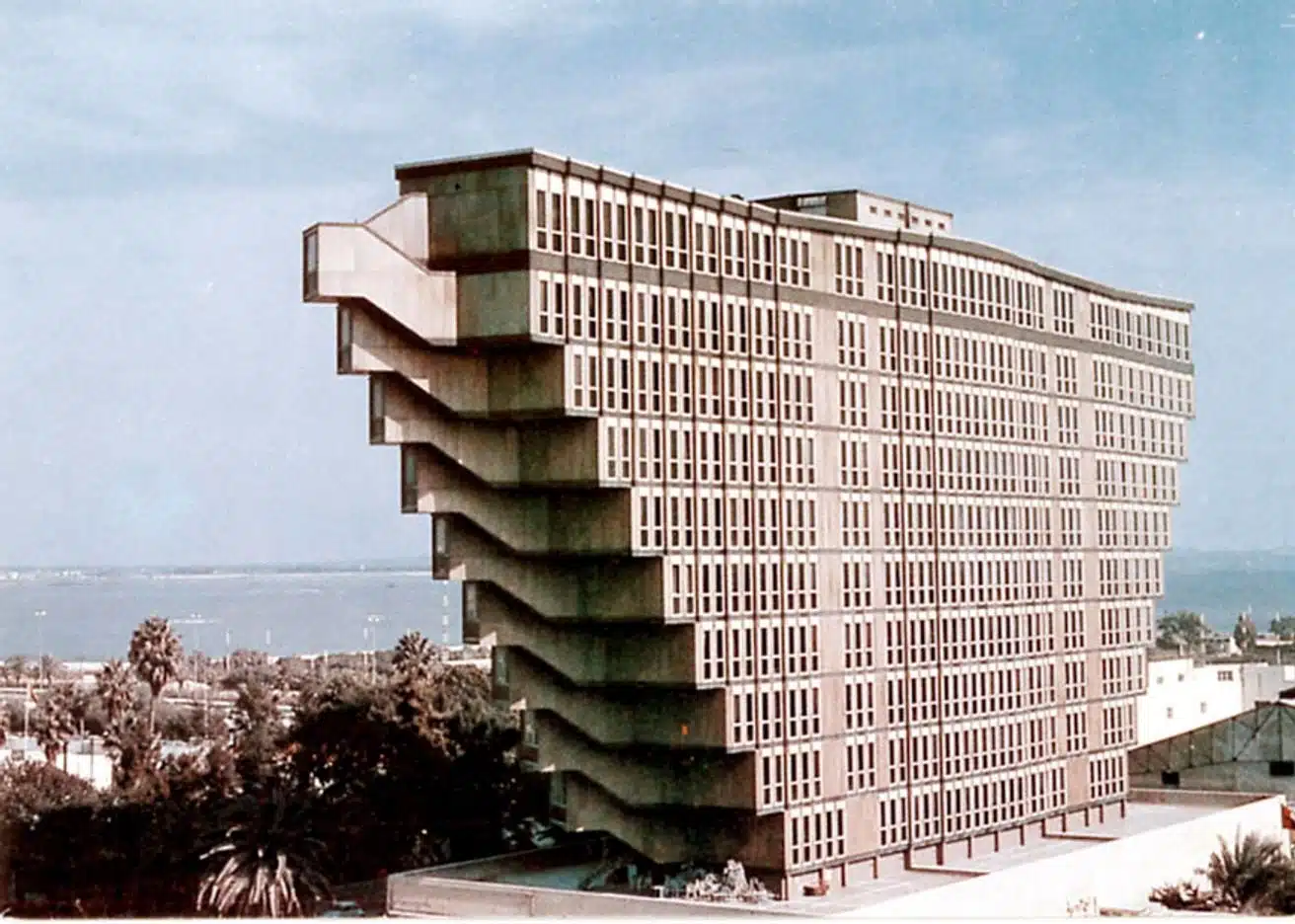
Designed by Italian architect Raffaele Contigiani, Hotel Du Lac was completed in 1973. With its inverted pyramid design, ten stories, and 416 rooms, the hotel was part of a ambitious national initiative in post-independence Tunisia aimed at boosting tourism and projecting an image of a modern, open country. The building was more than just a place for guests; it became an icon of Brutalist architecture in the region, characterized by its massive, bold concrete blocks that formed a prominent feature in the city’s skyline. During its active years, the hotel hosted renowned figures, most notably the legendary American musician James Brown, cementing its status as a symbol of Tunisia’s golden age of tourism.
The Path to Decline: From Luxury Hotel to Abandoned Building
Years of administrative mismanagement led to the hotel’s closure in 2000, plunging it into a cycle of neglect and structural decay. This towering edifice stood as a silent witness to the city’s transformations, while its empty floors were exposed to the elements. Despite its state of abandonment, the building maintained its architectural grandeur, attracting the attention of architecture enthusiasts and conservationists worldwide.
The Battle for Preservation: Civil Society vs. Development Decisions
Hotel Du Lac narrowly escaped demolition twice, first between 2010 and 2020, thanks to concerted efforts by conservation activists, architects, and civil society groups. Their pressure campaigns peaked in 2022 when the Tunisian Ministry of Culture granted the building temporary protected status, offering a glimmer of hope for its preservation. During this period, experts and architects presented feasibility studies and proposals for rehabilitating and reusing the hotel, demonstrating its potential for integration into the contemporary urban fabric without needing demolition. However, this protection expired in April 2023, reopening the door to the building’s inevitable fate.

The Demolition Decision and the New Project: Judicial Rationale and Development Promises
On August 15, 2024, demolition equipment began work under a court order based on reports citing the building’s structural instability and safety risks. The site is owned by the Libyan Arab Foreign Investment Company (LAFICO), which has held it since 2010 and plans to carry out a massive development project estimated to cost $150 million. The new project involves the construction of a 20-story luxury hotel and a modern shopping center. Officials, including Moïse Ben Othman, president of the local Bab Bhar council, confirmed that the new design would “maintain the silhouette” of the original hotel while utilizing more advanced construction systems and technologies. The project also promised to create 435 direct jobs, presenting the economic aspect as a primary justification for the demolition.
Reactions and Criticism: Accusations of Lack of Transparency and Heritage Neglect
The demolition decision faced sharp criticism from architectural historians, NGOs, and heritage advocates. The criticisms focused on several key points:
· Lack of Transparency: The architectural designs for the new project were not disclosed to the public or specialists for review and discussion.
· Disregard for Restoration Alternatives: The technical proposals and studies prepared by experts for rehabilitating and preserving the building were ignored.
· Swift Revocation of Protection: The quick termination of the building’s temporary protected status raised questions about the seriousness of the commitment to exploring preservation alternatives.
Tunisian historian Adadine Ghali described the hotel as one of the “top 10 brutalist gems in the world,” giving the issue an international dimension. An online petition to stop the demolition quickly gathered over 6,000 signatures, while international media like France’s Le Figaro described the loss as a “blow to global architectural heritage.”
Du Lac as a Symbol: The Broader Debate on Modern Architecture in Post-Colonial Cities
The issue of Hotel Du Lac transcends the demolition of a single building, becoming a symbol of a wider problem: the erasure of modern architectural heritage, particularly from the 1960s and 1970s, in post-colonial cities. These buildings, despite their architectural and historical value, are often viewed as “outdated” or “unprofitable,” making them the first casualties in the path of rapid urban modernization. The disappearance of Du Lac raises fundamental questions about the visual identity of Arab cities and how to balance development with preserving the diverse historical layers that form their collective memory.

Conclusion: An Icon Falls and an Uncertain Future
As demolition continues, an architectural icon that witnessed an important era in modern Tunisian history is crumbling. The $150 million project represents a new future for the site, but it leaves behind a wound in the city’s historical fabric and the memory of its inhabitants. The fate of Hotel Du Lac reminds us that heritage preservation is not an intellectual luxury but an investment in identity and collective memory, and that the dialogue between old and new must be balanced and inclusive of all voices.
✦ ArchUp Editorial Vision
The article details the timeline leading to the demolition of Tunis’s Hotel Du Lac, focusing on the conflict between preserving its Brutalist architectural heritage and the stated need for urban development. From an architectural perspective, the building’s inverted pyramidal design raises questions about the functional efficiency of its interior spaces, as the unconventional shape likely resulted in awkward angles and difficult-to-utilize areas. The extensive concrete facades, without advanced insulating treatments in the original design, would have contributed to significant thermal heat gain, impacting energy efficiency. Furthermore, the reliance on a purely concrete structural system limited future adaptability compared to more modern framing techniques. However, the innovative structural design successfully created a cohesive architectural massing with a strong and distinctive visual presence on the skyline, granting it a unique identity.
Brought to you by the ArchUp Editorial Team
Inspiration starts here. Dive deeper into Architecture, Interior Design, Research, Cities, Design, and cutting-edge Projectson ArchUp.