

The Rain Test: When Rare Storms Become the Only Honest Inspector of Buildings

In much of the Middle East and other arid regions, architecture grows under skies that rarely darken. Buildings rise confidently in climates where rain feels like a rumor, not a threat, and where dryness practically writes part of the building code. This confidence, however, is deceptive. For when rain finally does arrive—sudden, heavy, and uninvited—it does not fall gently. It interrogates. It reveals. It performs the kind of inspection no consultant, contractor, or municipality ever manages to execute with equal ruthlessness.
It is in those brief hours, sometimes mere minutes, that the building discovers who it really is.
Rain in dry cities is not weather; it is a stress test. And the buildings that fail it often fail spectacularly. The contradiction is simple: structures designed in an atmosphere of perpetual sun are forced to prove themselves during the rare moments when nature behaves unpredictably. Everyone in the industry knows this truth, though many pretend otherwise—water is the only element that does not negotiate.
Part of the problem lies in assumption. When a city receives only a handful of rainy days per year, architects tend to treat waterproofing as a footnote rather than a governing principle. Project managers relax their vigilance. Contractors prioritize speed. Developers approve designs that favor visual clarity over envelope integrity. Yet climate data shows that rainfall in arid regions tends to arrive all at once: a concentrated burst, often exceeding what similar buildings in wetter climates endure in an entire week. Under such intensity, every weakness—whether at a joint, a skylight, a parapet, or a drain—behaves not as a detail, but as a liability.
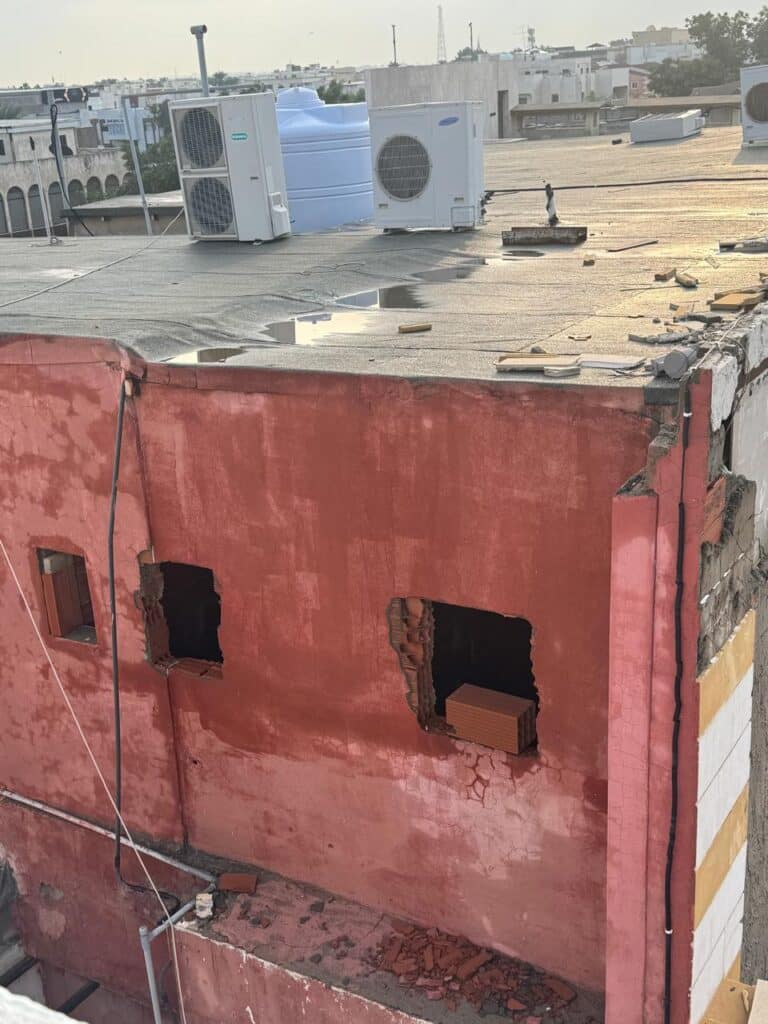
Skylights, for instance, often become the first point of surrender. In hot regions, they are selected for daylight, aesthetic purity, or emotional effect. But their edges—the unglamorous perimeters where glass meets membrane—tell a different story when rain falls. A single misaligned seal, an optimistic reliance on silicone, or a low curb height quickly transforms a source of light into a channel of infiltration. The same is true for façade joints, where the meeting of materials becomes the most fragile intersection in the entire Architecture system.
Roofs and terraces, beloved for their flatness in desert climates, carry their own vulnerabilities. Without proper slope, secondary drainage, overflow paths, and membrane protection, they behave like unintended reservoirs. Water sits, waits, and sooner or later finds an invitation inward. The roof that looked elegant in the render becomes a basin the moment the sky opens.
These failures are not isolated. They are urban. Dry-climate cities possess hard surfaces, limited green infrastructure, and soil conditions that reject absorption. When storms appear, water has nowhere to go, and so it rises unpredictably through basement ramps, service yards, mechanical shafts, retail edges, and underground parking. The city itself becomes a network of unintended channels. In this sense, the storm is not merely testing a building—it is testing an entire geography.
It is here that construction culture reveals itself. Many contractors in arid regions rely on the comforting assumption that water will evaporate quickly, dismissing small penetrations as harmless. But water behaves differently under pressure. Even ten minutes of driven rain can achieve what weeks of direct sun cannot undo. And evaporation, contrary to widely held belief, does not repair failures; it only hides them temporarily.
In an ideal world, buildings would undergo rigorous testing long before any storm arrived. International façade and waterproofing standards require controlled flood tests on roofs, negative-pressure evaluations for high-rise envelopes, and calibrated spray-rack tests on curtain walls—tests that simulate the violence of a real storm rather than the politeness of a garden hose. Yet in many markets, these procedures are shortened, diluted, or substituted with visual inspection. And visual inspection, unlike rain, never insists on the truth.
Climate projections complicate the picture even more. Studies from UN-Habitat suggest that arid zones will experience increasingly rare yet increasingly severe rainfall events by 2030. The storm of tomorrow is not the storm of yesterday; its volume is greater, its rhythm sharper, its consequences more abrupt. Building envelopes that survived past decades without issue may not survive the next five years. The climate has upgraded its test, but many construction practices have not upgraded their response.


For architects, this moment demands a shift in thinking. Waterproofing is no longer an accessory—no longer the quiet detail to be resolved after the design is complete. It is a spatial discipline. It shapes the behavior of roofs, façades, joints, penetrations, skylights, and terraces. It dictates how Construction teams coordinate material transitions. It determines whether buildings age gracefully or crumble at the first unexpected storm. To design in dry climates without designing for water is a contradiction that can no longer be excused by tradition.
Policymakers, too, stand at a crossroads. If building codes continue to assume dry conditions as the baseline, then the cities they regulate will continue to fail in moments that matter most. Inspection protocols, occupancy approvals, and urban drainage strategies must align with the climatic reality that storms will be fewer—but harsher. The era of “light rain” is ending. The era of “rare but punishing rain” has begun.
And so, the rain test becomes philosophical. Buildings that pass it earn something deeper than compliance—they earn credibility. Buildings that fail it, no matter how sophisticated their renderings or how polished their cladding, reveal that architectural beauty without environmental truth is merely decoration.
The storm does not care about budgets, schedules, or narratives. It respects only the integrity of the envelope.
In a region where the sky stays blue for most of the year, it is easy to forget that water remains the oldest critic of architecture. But when it falls, even once, it reminds everyone—architects, developers, contractors, and tenants that the building is alive, that it can fight or surrender, that it either holds together or comes apart.
✦ ArchUp Editorial Insight
This piece dives into a visceral truth often ignored in arid-region architecture: real storms, not simulations, are the ultimate test of building integrity. Through compelling observations from the Middle East and similar dry climates, the article outlines how rare downpours unmask design shortcuts—especially in waterproofing, drainage, and façade detailing. Yet while the premise is strong, the analysis stops short of linking these failures to deeper systemic issues like the lack of local building codes tailored for sudden climate anomalies or the absence of enforced post-occupancy evaluations. The article could have explored how predictive modeling, AI-driven maintenance, or “desert storm” stress-testing might become standard in 10 years. Still, its critique of cosmetic sustainability and superficial certifications hits a nerve. By spotlighting water as a forensic force, the article calls for a new architecture of humility—one not afraid to be soaked, leaked, and judged by the rain itself.
Rain is rare.
But it is also honest.
And honesty, in architecture, is always the hardest exam.


