The Valley Amsterdam A Living Hybrid of Nature and Urban Architecture

Introduction
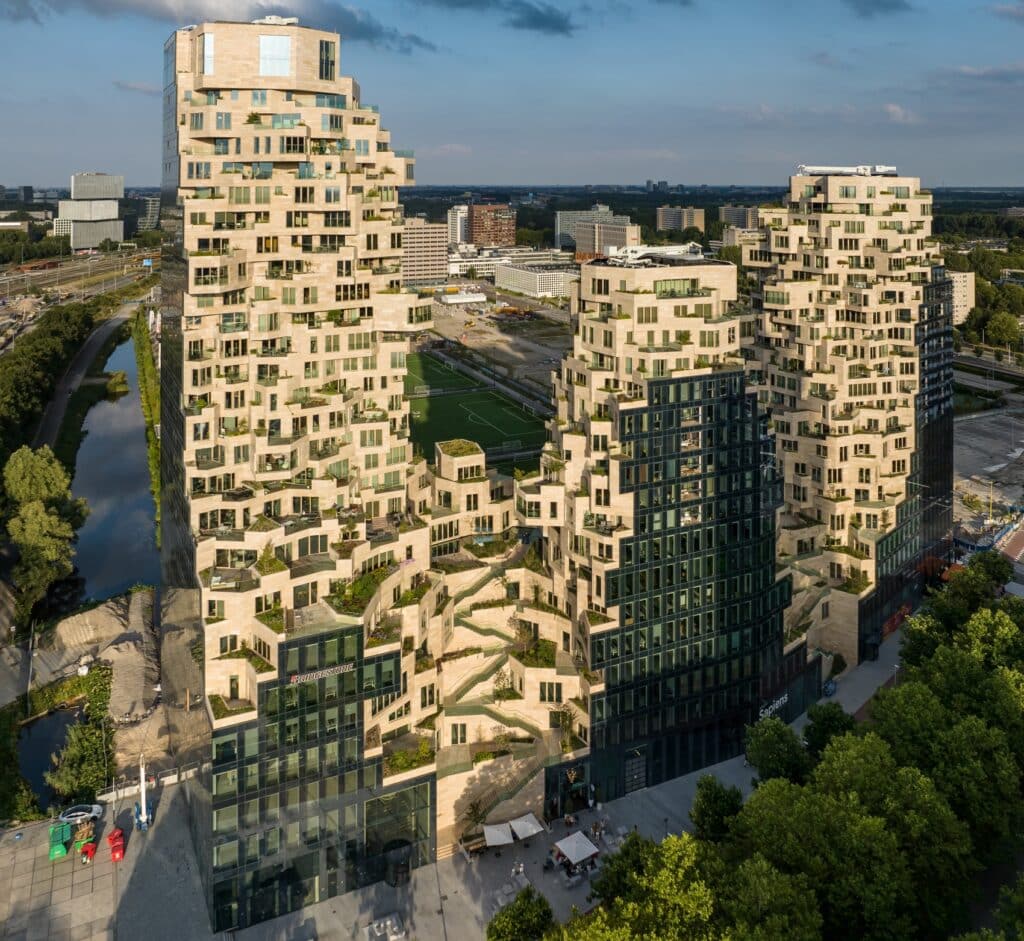
In the heart of Amsterdam’s Zuidas district rises The Valley a project that defies conventional notions of the modern city. Completed in 2021, this mixed-use complex designed by the Dutch firm MVRDV combines offices, apartments, retail, and cultural spaces into a singular architectural organism. The Valley’s cascading terraces and green façades transform the rigid skyline of Zuidas into a living topography, an evolving balance between nature and architecture.
The project’s name reflects its essence: an urban valley carved into a man-made mountain of stone and glass. It represents a new paradigm in Architecture one that no longer seeks to dominate the natural world, but to cohabitate with it.
Design Philosophy From Geometry to Ecosystem
At its core, The Valley is not just a Building; it’s a dynamic ecosystem. The concept emerged from MVRDV’s long-standing exploration of porous urban structures spaces that breathe, grow, and evolve with their surroundings.
The building’s external form appears chaotic at first glance, yet beneath that visual complexity lies a carefully orchestrated Design logic. Three towers of varying heights 67, 81, and 100 meters are connected by a series of terraces that form a lush “valley” at their center. The design simulates the organic erosion of rock by natural forces, blurring the boundary between constructed and natural landscapes.
Unlike conventional skyscrapers, The Valley’s geometry is intentionally uneven, its façades jagged and unpredictable. This sculptural irregularity allows for diverse micro-environments shaded terraces, open decks, and wind-protected gardens all of which contribute to the building’s environmental and social performance.
Construction Engineering Complexity into Reality
Translating this concept into a built form required unprecedented Construction innovation. The Valley’s façade consists of over 40,000 individual stone panels, each uniquely shaped and positioned to fit the sculptural contour. This demanded a hybrid workflow combining digital modeling, parametric engineering, and on-site craftsmanship.
Each stone panel was digitally mapped and pre-fabricated off-site, then installed through a highly coordinated logistical system. The integration of green terraces more than 3700 plants, shrubs, and trees introduced structural challenges related to weight distribution, irrigation, and long-term maintenance.
The engineering team employed a dual-structure strategy: a rigid concrete core for stability and a flexible steel substructure for façade modulation. This hybrid solution allowed the construction process to adapt fluidly without compromising strength or precision.
In essence, The Valley’s Construction represents a convergence of art and engineering where technological precision enables organic imperfection.

Sustainability Building a Living System
Sustainability lies at the heart of The Valley’s design philosophy. The project demonstrates how Buildings can act as active participants in ecological cycles rather than passive consumers of resources.
Key sustainable features include:
- Green Façades: The Valley hosts a vertical garden of native Dutch flora, managed through an advanced irrigation system connected to greywater recycling.
- Energy Efficiency: The structure utilizes geothermal heating, photovoltaic panels, and energy recovery ventilation systems to minimize emissions.
- Material Strategy: Locally sourced stone and recycled concrete were prioritized during Construction, reducing embodied carbon.
- Urban Biodiversity: The vegetation supports bird and insect habitats, reintroducing biodiversity into the dense Zuidas district.
Through its ecological framework, The Valley reimagines Sustainability not as an aesthetic gesture but as an infrastructural logic one that integrates energy, ecology, and human well-being.
The Social Dimension Architecture for Interaction
Beyond its physical innovation, The Valley redefines social life within vertical urban environments. Its layered program of residential, office, and public spaces invites continuous interaction between communities.
At street level, a vibrant public plaza and retail area connect seamlessly to the surrounding urban grid. Above, residential terraces offer private yet visually connected living environments. This duality between the collective and the intimate mirrors the natural structure of a valley, where diversity of terrain fosters diversity of life.
MVRDV envisioned the project as a “social mountain,” where daily encounters, cultural activities, and nature coexist. In doing so, The Valley challenges the isolation typically associated with high-rise living and Design, replacing it with permeability, openness, and connection.
Urban Integration The Valley as Catalyst
The Valley’s location in Zuidas Amsterdam’s financial district was strategic. Long criticized for its sterile corporate architecture, the area lacked the organic vibrancy of traditional European neighborhoods.
By introducing a structure that combines offices with residences, restaurants, and greenery, The Valley serves as a Project of urban repair. It reconnects Zuidas to the human scale, blending the rigidity of glass towers with the spontaneity of nature.
The project’s central atrium and public terrace create visual permeability, turning what could have been an isolated icon into a porous civic landscape. This spatial openness redefines the relationship between Architecture and the city, showing that density can coexist with ecological and social generosity.
The Technological Backbone
Behind its organic appearance lies a highly advanced technological infrastructure. Smart systems monitor the performance of the vegetation, regulate energy use, and maintain environmental comfort.
The Building Management System (BMS) integrates data from thousands of sensors tracking temperature, humidity, and air quality. This information informs real-time adjustments, ensuring both energy efficiency and user comfort.
The façade lighting and shading are also automated to respond dynamically to sun orientation, contributing to the building’s low energy footprint. This synthesis of Design and technology exemplifies the future of responsive urban Buildings.
Cultural Significance and Symbolism
Culturally, The Valley carries symbolic weight in the Dutch context. The Netherlands, a country historically shaped by its relationship with water and land reclamation, has always engaged with the balance between artificial and natural landscapes.
The Valley translates that heritage into a vertical metaphor a man-made topography that reconciles urban ambition with ecological humility. It embodies a new kind of Architecture that acknowledges human authorship while celebrating natural growth.
The result is a building that feels simultaneously monumental and intimate, artificial and organic a paradox that defines the complexity of our modern relationship with the environment.
Critical Reception and Global Influence
Since its completion, The Valley has attracted international attention from architects, environmentalists, and urban planners. Critics have praised its ambition to merge ecological systems with urban infrastructure, while some question its long-term maintenance demands.
Nonetheless, The Valley has set a new benchmark for future Projects seeking to bridge the gap between Construction and nature. Its approach influences global discourse on biophilic urbanism, hybrid typologies, and climate-adaptive Design.
By proposing a building that is both machine and mountain, The Valley redefines what urban Architecture can be in the Anthropocene era.
Conclusion
The Valley is not merely a Building it is a manifesto in stone and vegetation. It questions the binary between nature and the city, demonstrating that sustainable Architecture is not about mimicry but symbiosis.
Through its form, materiality, and ecological logic, The Valley invites us to imagine a future where Construction serves life, not the other way around.
It is a living hybrid, a poetic negotiation between chaos and order, growth and geometry and a testament to how thoughtful Design can transform urban existence.
✦ ArchUp Editorial Insight
The Valley in Amsterdam encapsulates the evolving dialogue between Contemporary Architecture and urban ecology. Its layered, terraced Design creates a living topography of stone and glass that merges residential, commercial, and green spaces into a unified urban organism. This project exemplifies Material Expression through its contrasting façade natural stone grounding the structure while reflective glazing dissolves its mass into the skyline. Yet, while the project celebrates Sustainability and spatial porosity, one might question whether its complexity risks overshadowing the human scale it seeks to enhance. The interplay of Spatial Dynamics and environmental integration positions The Valley as more than a Building it is an architectural experiment redefining the balance between density and livability, setting a benchmark for future urban development.
A deeper Architectural Discussion within modern Architecture explores how innovative Design and advanced Construction methods reshape global Projects in the pursuit of Sustainability and human-centered environments.