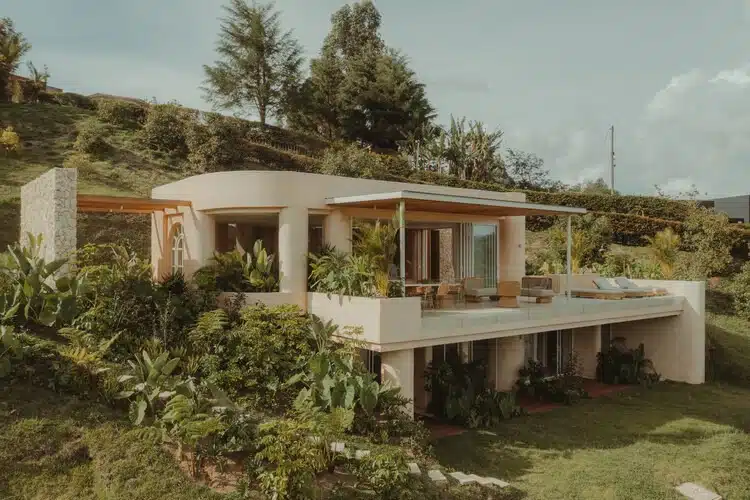
Ukrainian Mazanka Houses Project: Reinterpreting the Dialogue Between Heritage and Architectural Innovation

Exploring Small Structures and Ukrainian Mazanka Houses
Three small structures are situated on a plot of land in central Ukraine, each covering approximately 50 square meters. These summer houses represent an in-depth study in reinterpreting traditional architecture, surpassing visitors’ expectations tied to the familiar and well-known aspects of rural construction.
Traditional Roots of the Mazanka
For generations, the Mazanka has defined the landscapes of the Ukrainian countryside. Characterized by its whitewashed walls and thatched roofs, it reflects enduring folk building practices. Reliance on thick clay walls, smooth plaster finishes, and natural materials sourced from surrounding fields was a fundamental aspect of this architecture. Additionally, seasonal replastering was part of home maintenance, but it also took on a cultural dimension that reflected the values of the community.
Reinterpreting Traditional Architecture
By studying these patterns, the designers focused on the cultural and symbolic essence of the Mazanka rather than merely copying its physical forms. The central question was: what does the Mazanka mean to rural inhabitants, and what value does it hold in their daily lives, beyond its material features? This approach allows for a deeper understanding of architecture as a carrier of cultural identity and community traditions, while enabling its reimagining in a modern and renewed way.


Transparency and Light as a New Language
In this project, floor-to-ceiling glass walls replaced the traditional solid clay. This transparency was not merely a material choice but became a language expressing light and order within the dwelling, allowing natural light to flow freely and enhancing the sense of spaciousness and connection with the surrounding environment.
Thatched Roof as an Expressive Element
The thatched roof takes an unconventional form, exceeding the typical proportions of a Mazanka to become the defining feature of each structure. Its sculptural shape creates a distinctive visual effect, evoking images of traditional hats and organic mushroom caps found in nature. It also hovers above the glass walls, giving the impression of a semi-detached element that crowns the structures and imparts a dynamic character.
“Terroir” Design and Understanding the Architectural System
The architects employed the concept of “terroir” in reinterpreting the Mazanka, a notion that goes beyond mere material choices or historical references. By studying the cultural symbols embedded in rural architecture, the Mazanka was understood as a living system interacting with its environment, rather than a static artifact. This approach honors tradition while opening the door to radical innovation, integrating elements of the Ukrainian countryside into the interior spaces, blurring the boundaries between inside and outside, and unifying the dwelling with the surrounding nature.


Doors and the Concrete Mass
Heavy wooden doors provide clear points of entry, lending the delicate glass structures a sense of weight and balance. This contrast between transparency and material creates both a visual and functional equilibrium within the design, reinforcing the impression that the dwelling is part of its natural environment while remaining cohesive and grounded.
Architecture in Dialogue with the Environment
Photographs of the houses in winter show the massive thatched roofs hovering above snow-covered ground, demonstrating the dynamic relationship between the building, weather, and seasons. These structures do not remain static in the rural landscape; they interact with their surroundings, reflecting the design’s ability to integrate humans and nature into a seamless living experience.
Integrating Heritage and Innovation
The design team drew on centuries of accumulated architectural knowledge, extracting the essence and spirit of the traditional Mazanka rather than literally replicating its forms. This approach allows architecture to deeply respect heritage without succumbing to traditional rigidity. The guest houses demonstrate how cultural memory can inform contemporary expression, showing that tradition and innovation are not necessarily in conflict.
These transparent houses with their expansive thatched roofs represent a new chapter in Ukrainian architecture, simultaneously looking to the past and the future, grounded in a philosophy that breathes life into folk architecture and transforms it into a complete modern experience.


✦ ArchUp Editorial Insight
This project can be seen as an intriguing architectural study on reinterpreting heritage, demonstrating how contemporary design can integrate elements of the traditional Mazanka within a new context. Among its strengths, the use of glass walls and thatched roofs provides a clear perspective on how the buildings interact with light and their surroundings, allowing architects to explore the possibilities of merging tradition and innovation in a visually immediate way.
However, the project also raises several questions when considering expansion or replication. Practical challenges, such as the long-term maintenance of thatched roofs, preserving the thermal efficiency of glass walls, and adapting to different climatic conditions, may limit the broader application of this concept. Additionally, the focus on form and visual experience can sometimes overshadow consideration of everyday user functions or adaptation to practical living requirements.
From an analytical perspective, this project can serve as a model for inspiring innovative solutions in small-scale and rural architecture, leveraging heritage studies as a tool to enrich design thinking, while emphasizing the need to carefully address technical and practical aspects to ensure the sustainability of any future implementations.