Urban Oasis in Okinawa: House in Nishizaki by Studio Cochi Architects


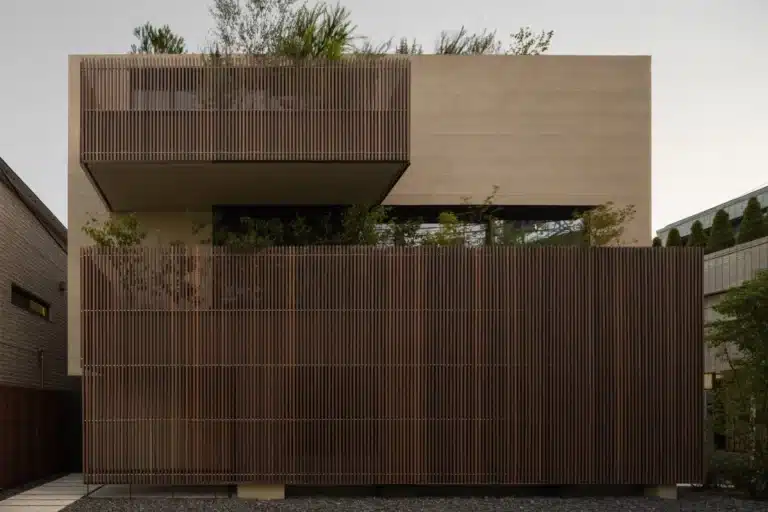
Thick walls of exposed concrete create a buffer from the surrounding city at House in Nishizaki, Japan, completed by architecture practice Studio Cochi Architects. Located in a newly developed residential area on a former landfill site in Okinawa, the clients sought an “urban oasis” protected from overlooking by neighboring buildings on the densely-planned site.
Design Solutions for Privacy and Light
To achieve this, Studio Cochi Architects utilized skylights, a front porch, and a cavernous, full-height courtyard at the rear to pull daylight deep into the plan. The client’s primary request was for an urban oasis with no line of sight from the surrounding area, while allowing as much natural light and airflow as possible. The north of the home is zoned residential, while a commercial area stretches south across a large highway. The challenge was to maintain distance from the city’s chaos and ensure a comfortable indoor environment.
Interior Layout and Features
Protected from the street by the parking area and small yard, the ground floor of House in Nishizaki contains a tatami room alongside a living, dining, and kitchen area, which opens onto the rear courtyard through a double-height glazed door. A staircase wraps around the back of the courtyard, serving as a small, interstitial room, with a space on one of the large concrete steps to sit and read.


Upstairs and Spatial Composition
Upstairs, a small bathroom sits in a cuboid volume that hangs over the living space below. A skylit walkway lined with wooden storage leads to the bedroom, which overlooks the living area below from a small study space and the front yard from a small balcony shielded by an area of the concrete facade. The studio aimed to create a spatial composition that brings about visual changes and accompanying shifts in feelings as one moves from a closed space to an open space, and vice versa.
Raw Concrete Aesthetic
Both inside and out, the rough exposed concrete of the structure has been left visible, complemented by a large front door and balustrade rails in weathered metal. In the living areas, the rawness of the concrete is softened by dark wooden carpentry. Exposed concrete walls were also a feature of Check Pattered House in Saitama by IGArchitects, where they were contrasted with large planes of translucent glazing.


Finally, find out more on ArchUp: