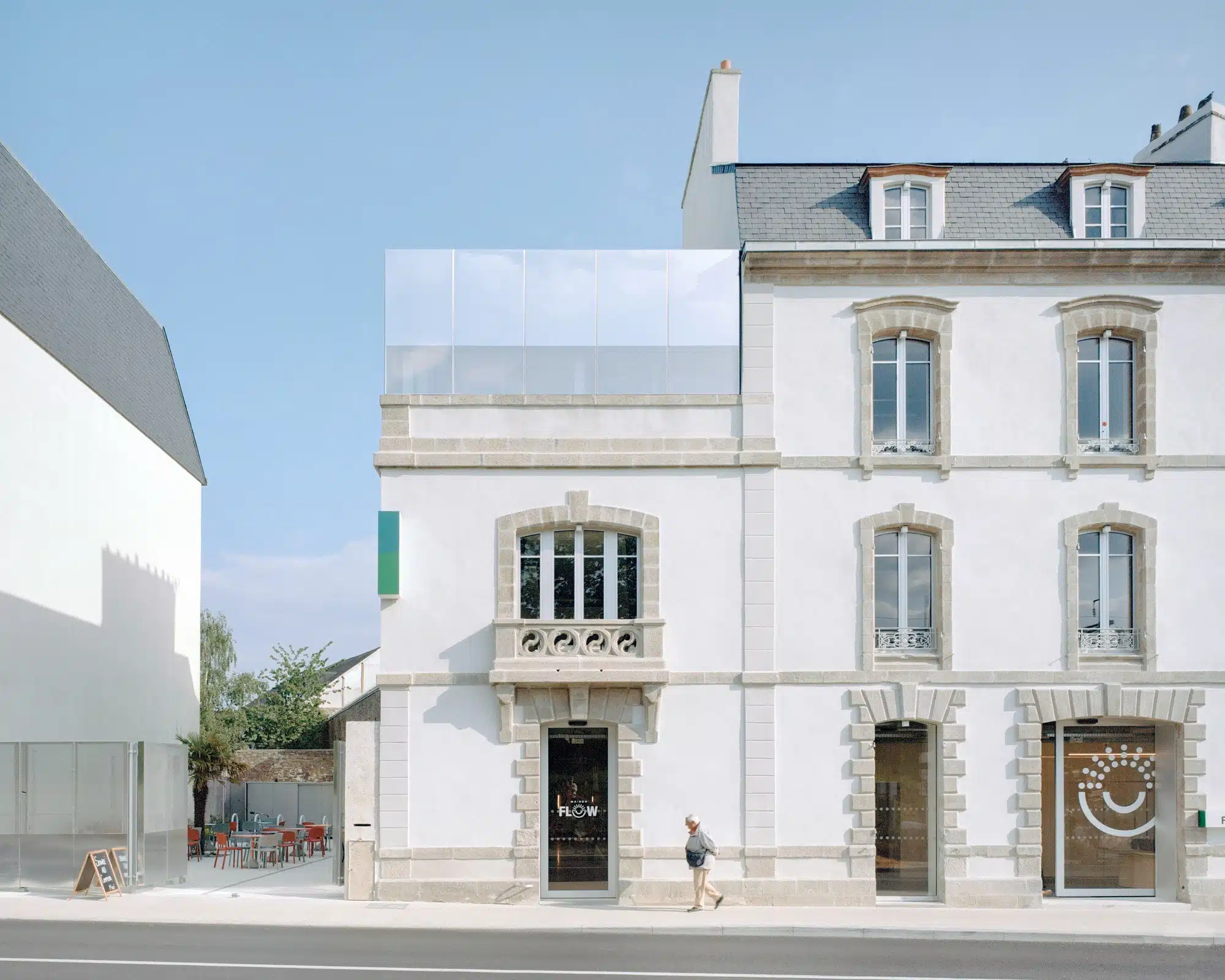
Van Station: Adaptive Reuse of a Historic Industrial Complex

Urban Context and Site Heritage
The project is located in a strategic position opposite the Van railway station, within a historic industrial fabric dating back to the 19th century. The complex consists of an old house, a 44-meter-long hall, and the remains of a former glass roof that once formed part of a winter garden. Despite the Architecture value of the site, it remained abandoned for a long period, leading to a gradual deterioration of its structural and architectural condition.
Deterioration as a Trigger for Architectural Intervention
Over time, the site suffered from evident neglect and degradation of its core elements, placing it in an unstable structural condition, particularly in the main hall, which represents the largest and most sensitive component within the overall composition.
Reactivating Function Through Reinterpretation
In this context, the objective was not merely a conventional restoration, but rather a reinterpretation of the latent potential within the existing structure. The approach therefore aimed to open the site to new and multiple functions, including wellness, work, cultural activities, and dining, within a flexible space capable of adapting to different uses. This aligns with contemporary Design strategies that prioritize adaptability.
The Hall as a Driver of Structural Transformation
On the other hand, the transformation of the main hall became a central axis in the rehabilitation process, coinciding with the treatment of accumulated structural degradation over time, with the aim of restoring balance between preserving the historic fabric and updating its function within a flexible contemporary framework. Such Construction challenges require innovative structural thinking.
| Field | Details |
|---|---|
| Architects | Office Zola architectes |
| Area | 1800 m² |
| Year | 2025 |
| Photographs | Maxime Delvaux, Office Zola architectes |
| Manufacturers | ALKERN, BEHAR, Coil, Egoluce, Master Industrie, Nora, SBI, Schuco, Sfel, TD ACOUSTIC |
| Lead Architects | Laure Gahéry, Edouard Guyard |
| Structural Engineering | Arest |
| Acoustics | Alhyange |
| MEP Design | kypseli |
| Category | Mixed Use Architecture, Offices, Sustainability |
| Construction Economics | BMF |
| Fire Safety System | kypseli |
| Signage | Briand&Bertherau |
| City | Vannes |
| Country | France |

Removal as a Tool for Spatial Reconfiguration
As part of the building’s rehabilitation, a decision was made to remove an entire section of the roof along its full length. This intervention was not a mere structural dismantling, but a deliberate act aimed at redistributing spatial potential within the architectural mass.
Introducing Light and Expanding Functional Capacity
This act of removal enabled a series of fundamental transformations; it contributed to the creation of new spaces and increased spatial capacity, while also improving the structural performance of the building. It further allowed natural light to penetrate deep into the interior, while maintaining a key constraint of preventing any opening toward adjacent properties, in accordance with regulatory requirements.
The Inner Courtyard as a New Spatial Core
Through the void created by the removal, a planted courtyard was established, redefining the relationship between interior and exterior. Consequently, a “flexible space” emerged, characterized by a high degree of adaptability and potential for evolution, becoming the building’s vital core and primary spatial driver. This approach reflects principles found in innovative Projects that integrate nature with built form.
Flexibility and Structural Economy
The architectural approach here reflects a clear emphasis on condensation, modularity, and functional flexibility. This is expressed through the distribution of working areas beneath the structural trusses, as well as the introduction of suspended spatial units and multi-purpose halls, enhancing the space’s capacity for reinterpretation according to needs.
Rapid Transformation Systems and Reuse Redefinition
In the same context, the main event hall was equipped with technical elements enabling rapid spatial reconfiguration, such as a retractable tiered seating system accommodating up to 140 seats, in addition to a movable partition connected to safety systems. Thus, the space can be reconfigured within minutes. This level of versatility is often highlighted in Architecture Competitions focused on adaptive reuse.
The Hidden Infrastructure as a Driver of Flexibility
Moreover, these invisible engineering systems reinforce the notion of adaptability and reversibility, generating a layer of modularity on both the physical and visual levels, granting the building a continuous capacity for transformation without losing its structural coherence.


Balancing Preservation and Innovation
The structural approach is based on achieving a precise balance between preserving the historic fabric and introducing contemporary innovative elements. Within this framework, the original stone structure was restored, while also reusing stones resulting from demolition processes, thereby reinforcing material continuity and reducing construction waste. A thorough understanding of Building Materials was essential for this process.
Diverse Materials and New Structural Layers
In parallel, floors and additional levels were constructed using wood, chosen for its lightness and flexibility, which suits the nature of the internal modifications. At the same time, a reinforced concrete portal frame was introduced, providing clear structural support while helping to liberate interior spaces and reorganize them. Detailed Material Datasheets guided the selection of these components.
An Experimental Approach to Technical Solutions
The technical decisions were characterized by an experimental attitude, where each structural condition was addressed individually to determine the most appropriate solution. As a result, hybrid systems emerged, combining different materials and techniques, with sections and assemblies designed to adapt to the specific constraints of each space.
Aluminum as a Visual and Functional Language
In this context, aluminum was selected due to its light weight, recyclability, and reflective properties. Externally, it blends visually with the surrounding environment, while internally it enhances natural lighting by capturing light variations and redistributing them within the space. This material choice aligns with trends documented in the Archive of contemporary architectural solutions.
Precise Interventions Rather Than Formal Gestures
Ultimately, the project moves away from expressive architectural gestures in favor of a series of precise, coherent interventions focused on the functional performance of materials. Through this restrained approach, spatial elements, light, and vegetation are allowed to naturally shape the architectural experience, reinforcing the project’s long-term sustainability. Such thoughtful integration is a recurring theme in Top News regarding modern heritage conservation.


Rehabilitation as a Strategic Environmental Choice
Choosing rehabilitation over full reconstruction represents a direct approach toward reducing the project’s carbon footprint. From this perspective, the material continuity of the building becomes part of sustainability itself, rather than merely a Construction decision.
Low-Impact Materials and Redefining Finishes
In this context, the materials used reflect a strategy of constructive restraint; bio-based insulation materials and breathable lime plaster layers were adopted, alongside leaving technical systems exposed instead of concealing them within the building cavities. Finishes were reduced to a minimum, while existing heritage elements were reused, reinforcing the continuity of the site’s material memory. This careful selection of materials aligns with the detailed information found in Material Datasheets.
Environmental Performance Based on Passive Strategies
On the operational level, the approach relies on low-energy solutions grounded in passive strategies such as cross-ventilation, solar shading systems, and the use of light colors to reduce heat absorption. Additionally, rainwater harvesting systems were integrated to enable more efficient reuse within a closed operational cycle.
Quiet Radicality in Architectural Practice
Ultimately, the project embodies what can be described as a “quiet radicality,” where transformation occurs through careful subtraction rather than excessive addition, and innovation emerges through simple yet effective solutions. Through this approach, Architecture adopts a restrained, sober, and enduring language that reveals the quality of space, light, and material rather than imposing a formal presence.


✦ ArchUp Editorial Insight
The project operates as a repurposing of a 19th-century industrial asset adjacent to the Van railway station, driven by a financial rationale that links embodied carbon reduction, enhancement of land value, and compliance with heritage conservation requirements. Regulatory constraints preventing openings toward adjacent properties, the structural deterioration of the main hall, as well as insurance considerations and demolition costs, collectively form the governing framework of the intervention. The removal of the roof along the entire length of the hall transforms the interior void into a courtyard system that redistributes light and intensifies patterns of use. The program integrates wellness, work, culture, and dining through flexible units, suspended structures, and reconfigurable fittings. Such innovative spatial solutions are often explored in Interior Design approaches that prioritize adaptability.
The material strategy relies on the reuse of stone, the introduction of timber, reinforced concrete portal frames, and aluminum as a performative system solution. The approach is grounded in an operational balance between preservation and functional densification, achieved through passive ventilation strategies and an exposed technical infrastructure. This balance is a recurring theme in Research focused on sustainable heritage conservation.
By integrating these methods, the project demonstrates how existing Buildings can be transformed into high-performance spaces without erasing their historical identity. Furthermore, the use of reclaimed stone and bio-based insulation reflects a deep engagement with Building Materials that support a circular economy. The overall strategy contributes to ongoing Discussion within the architectural field regarding low-impact rehabilitation.
This approach to adaptive reuse and environmental responsibility positions the project as a relevant case study for Architecture Competitions focused on innovation in heritage contexts. The documented process and outcomes add valuable knowledge to the broader Archive of contemporary sustainable projects.