

Vipp Guesthouse Project: Redefining the Relationship Between Contemporary Design and Traditional Environment

The Guesthouse and Its Geographical Significance
The Danish brand Vipp recently inaugurated a guesthouse located on the remote island of Stormolla in Norway, where rugged peaks descend directly into the sea. This location reflects the close relationship between nature and architecture, offering an opportunity to study how contemporary design interacts with harsh and isolated environments. The guesthouse is designed as a modern fishing cabin elevated on wooden stilts, allowing the structure to adapt to challenging terrain and extreme climatic conditions.
Merging Contemporary and Traditional
What distinguishes this project is not only its geographical location but also the way the architects integrated modern aesthetics with local traditional roots. The wooden stilts are not merely structural or decorative elements; they clearly reference the traditional rorbuer cabins that have hosted fishermen for generations. Through this approach, the design demonstrates respect for local heritage while providing a contemporary style that meets modern living needs.
Design Vision and Practical Functionality
The Norwegian studio LOGG ARKITEKTER embraced a design principle that balances aesthetics with practical functionality. The wooden structures are designed to withstand weather fluctuations and adapt to tidal movements, reflecting a deep understanding of the relationship between humans and nature in Norway’s coastal regions. Additionally, the design offers a spatial experience that combines openness to the sea with protection from harsh climatic conditions.


A Village Born from Respect
The guesthouse does not stand in isolation from its surroundings; rather, it forms part of the True North Lofoten village, a carefully curated collection of modern accommodations. The village was designed by the renowned Norwegian firm Snøhetta, with a focus on creating a small, integrated community of cabins, each individually designed by different studios. This approach reflects what Kjetil Trædal Thorsen of Snøhetta calls the concept of “quiet integration”, crafting meaningful design without overpowering the surrounding natural landscape.
Blending the Building with Nature
LOGG ARKITEKTER brought this concept to life in what architect Diederik Advocaat Clausen described as “dissolving the boundary between shelter and seascape.” The wooden facade is designed to respond to weather conditions and angular lines, giving the structure a natural appearance, as if it has organically grown from the surrounding rocks.
Spatial and Light Experience
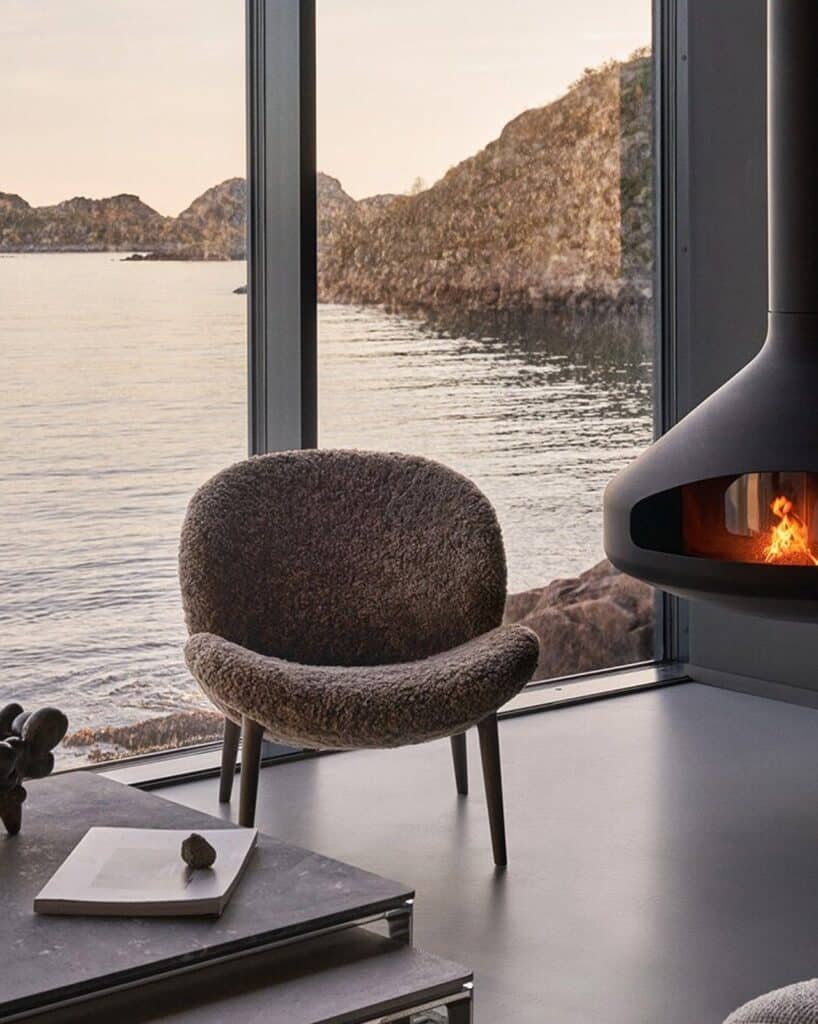
Large windows enhance the sense of openness to the ocean, with constantly changing views throughout the day. From the continuous daylight of the Arctic summer to the surreal dance of the Northern Lights in winter, the design offers a unique sensory experience that connects occupants directly with the surrounding natural environment, while maintaining the building’s function as a contemporary, comfortable retreat.


The Simple Interior and Harmony with the Environment
Inside the Scandinavian retreat, Vipp’s signature minimalist character is evident, designed to harmonize seamlessly with the natural surroundings. Dark grey walls and floors reflect the nearby rocks and coastline, while carefully chosen furnishings create cozy areas where visitors can relax and enjoy uninterrupted ocean views.
The Fireplace as a Spatial Focal Point
A ceiling-hung fireplace serves as the central gathering point, while custom furnishings echo the colors and textures of the exterior environment, contributing to a seamless integration between interior spaces and the surrounding natural landscape.
Varied Experiences Across Locations
This retreat marks Vipp’s thirteenth design project worldwide, showcasing how contemporary design can maintain brand consistency while adapting the visitor experience to each specific location. Visual dimensions and daily interactions with the surrounding environment, such as the movement of the sea and sky, make every visit a unique experience, emphasizing immersion in nature rather than reliance on artificial entertainment elements.


✦ ArchUp Editorial Insight
Vipp’s guesthouse can be seen as a model illustrating how contemporary design can be integrated with the natural environment and local heritage, while making use of traditional building elements such as wooden cabin stilts. The project offers a clear sensory experience through large views and openness to the sea, demonstrating careful attention to spatial details and weather-influenced materials, a positive aspect that architects can study when seeking solutions adapted to harsh environments.
However, the project raises several questions when considering its potential replication or generalization. The heavy reliance on individually designed cabins limits scalability or expansion, and the focus on visual harmony with nature may make it difficult to achieve economic or practical sustainability on a larger scale. Furthermore, the intricate and meticulous design imposes high maintenance requirements, and the experience tied to integration with the landscape may be constrained by seasonal changes and the Arctic climate, reducing year-round usability.
This project can be utilized as a case study to develop architectural approaches that combine environmental adaptability with aesthetic innovation, focusing on how to achieve a better balance between aesthetics, functionality, and practical sustainability in similar tourism or residential projects in remote or sensitive environments.
Prepared by the ArchUp Editorial Team
Don’t miss the chance to explore more from Architecture in fields like Projects and Design on the ArchUp website.


ArchUp Editorial Management
The article provides an in-depth analysis of the relationship between contemporary design and the natural environment, with a distinguished focus on site integration and local traditions. To enhance its archival value, we would like to add the following technical and structural data:
We would like to add that:
· Structural System: Relies on pressure-treated timber columns with a height of 4.5 meters, designed to withstand wind loads up to 45 m/s.
· Thermal Insulation: Consists of 28 cm thick timber panels, achieving a thermal transmittance (U-value) of 0.18 W/m²K.
· Materials: Utilizes thermally modified Scandinavian pine wood, with a rock foundation integrated into the natural topography.
· Sustainability: The energy system relies on 8 kW solar panels, complemented by a 10,000-liter rainwater collection tank.
Related Link:
Please review for a comparison of ecotourism projects:
[Designing Residential Units in Remote Areas and Sensitive Environments]
ArchUp Editorial Management
The article provides an in-depth analysis of the relationship between contemporary design and the natural environment, with a distinguished focus on site integration and local traditions. To enhance its archival value, we would like to add the following technical and structural data:
We would like to add that:
· Structural System: Relies on pressure-treated timber columns with a height of 4.5 meters, designed to withstand wind loads up to 45 m/s.
· Thermal Insulation: Consists of 28 cm thick timber panels, achieving a thermal transmittance (U-value) of 0.18 W/m²K.
· Materials: Utilizes thermally modified Scandinavian pine wood, with a rock foundation integrated into the natural topography.
· Sustainability: The energy system relies on 8 kW solar panels, complemented by a 10,000-liter rainwater collection tank.
Related Link:
Please review for a comparison of ecotourism projects:
[Designing Residential Units in Remote Areas and Sensitive Environments]