
Unveiling a New Architectural Project: World’s Largest Renewable Energy Farm After China in Bisha

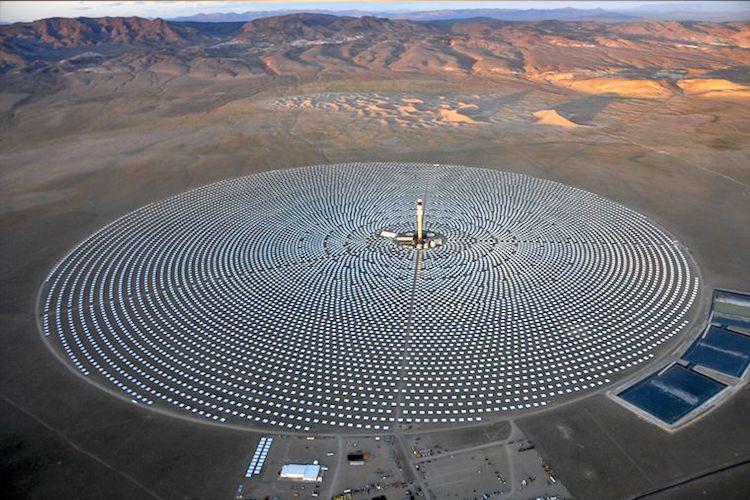
A newly unveiled architectural project in Bisha, Saudi Arabia, is set to become the world’s largest renewable energy farm after China. The project spans extensive desert terrain and integrates solar panels and wind turbines within a structured architectural layout. This update represents a significant development in sustainable architectural designs for 2025.

Design Concept
The masterplan organizes solar arrays and wind turbines in a precise grid to maximize energy output. The project covers approximately 12,000 hectares, with units arranged to minimize land-use conflicts and allow for future expansion. Official reports indicate a modular design that ensures maintainability and continuous operational efficiency. For detailed architectural schematics, visit architectural design.

Sustainability
Sustainability is a core element of the architectural plan. Photovoltaic panels and wind turbines employ high-efficiency materials capable of withstanding harsh desert conditions. Passive cooling techniques reduce reliance on mechanical ventilation in service buildings. According to official documentation, energy production is expected to exceed 9 GW, making it one of the most prominent sustainable architectural designs worldwide. Learn more about green energy strategies at sustainability.

Materials & Construction
The construction team installs reinforced concrete foundations for turbines and assembles corrosion resistant steel frameworks for solar arrays. Engineers design glass-enclosed control buildings to resist sand abrasion while maximizing natural daylight. The project team implements phased construction methods to manage its large scale efficiently, using pre-assembled modular units that workers transport on-site.

Urban Impact
Despite its desert location, the project includes a network of access roads and maintenance facilities linking nearby towns while minimizing environmental impact. Analysts indicate that the farm could serve as a model for future renewable energy developments near urban areas. For more information on urban planning aspects, consult cities.
ArchUp Editorial Insight
Media reports outline an architectural project in Bisha, aiming to become the world’s largest renewable energy farm after China, with solar panels and wind turbines organized over 12,000 hectares. The coverage provides clear data on design, materials, and scale but lacks deeper architectural analysis on environmental integration or urban planning impact. Critically, emphasizing largest after China feels more like a headline grab than substantial design insight, and omitting operational or ecological nuances hints at narrative superficiality. One positive: accurate figures on energy output (9 GW). Looking ahead, the lingering question remains whether this project will endure as a sustainable design benchmark or fade as a mere media statistic.







ArchUp: Technical & Structural Analysis of the Bisha Renewable Energy Farm
This article examines the Bisha Renewable Energy Farm in Saudi Arabia as a case study in large-scale energy infrastructure. To enhance its archival value, we present the following key technical and structural data:
The project has a production capacity of 9 gigawatts, comprising 6 GW of solar power and 3 GW of wind power, making it the world’s second-largest renewable energy facility after China’s Ganjiangtan complex (16 GW). It spans 12,000 hectares (120 km²) and features the precise arrangement of 18 million solar panels and 2,500 wind turbines.
The structural system relies on deep concrete foundations reaching 15-25 meters for 220-meter-tall turbines, and anti-corrosion steel frames set at 15-25 degree angles for solar panels. The technology employs passive cooling systems that reduce panel temperature by 15°C, along with bifacial solar panels achieving 22.5% efficiency.
In terms of operational performance, the project achieves grid integration through 12 substations and a battery storage facility with a capacity of 2 GW/h. It provides energy for 2.5 million homes and reduces carbon emissions by 12 million tons annually. The total investment amounts to $6.5 billion, with full operational commencement expected by 2030.
Related Link: Please refer to this article for a comparison of large-scale renewable energy infrastructure technologies:
The Architecture of Renewable Energy: Designing Large-Scale Facilities and Urban Integration
https://archup.net/zed-ishikari-emission-free-data-center/