Albi’s Ingenious Pedestrian Bridge: A Harmonious Blend of Heritage and Modern Design

Nestled along the serene Tarn River, the quaint French town of Albi is a UNESCO World Heritage Site renowned for its medieval red-brick cathedral and historic center. Since 2010, Albi’s cultural significance has been globally recognized, with its iconic 13th-century Pont Vieux—once the sole river crossing until the 1860s—standing as a testament to its architectural legacy. The town’s infrastructure evolved with the arrival of the railway in 1864, marked by a striking brick bridge downstream, and the equally elegant Pont Neuf road bridge in 1867. Unlike the low-lying Pont Vieux, Pont Neuf spans the valley at an impressive 100 feet above the water, offering panoramic views.
In 2013, Albi sought to reduce traffic on Pont Neuf while enhancing connectivity between its historic core and suburbs. The solution? A suspended pedestrian and cycle bridge, seamlessly integrated into the urban fabric. Designed by Brussels-based Ney & Partners, this innovative structure not only complements the town’s heritage but also revitalizes underutilized public spaces like Place du Calvaire.

Design Brilliance: A Bridge That Dances
The competition brief allowed designers to choose either side of the railway bridge for the new crossing. Ney & Partners opted for the downstream elevation, a strategic decision with multiple advantages:
- Minimized visual intrusion when viewed from the historic center.
- Improved accessibility to suburban areas.
- Framed vistas of the old town through the bridge’s arches.
- Revitalized Place du Calvaire, a previously neglected public square.
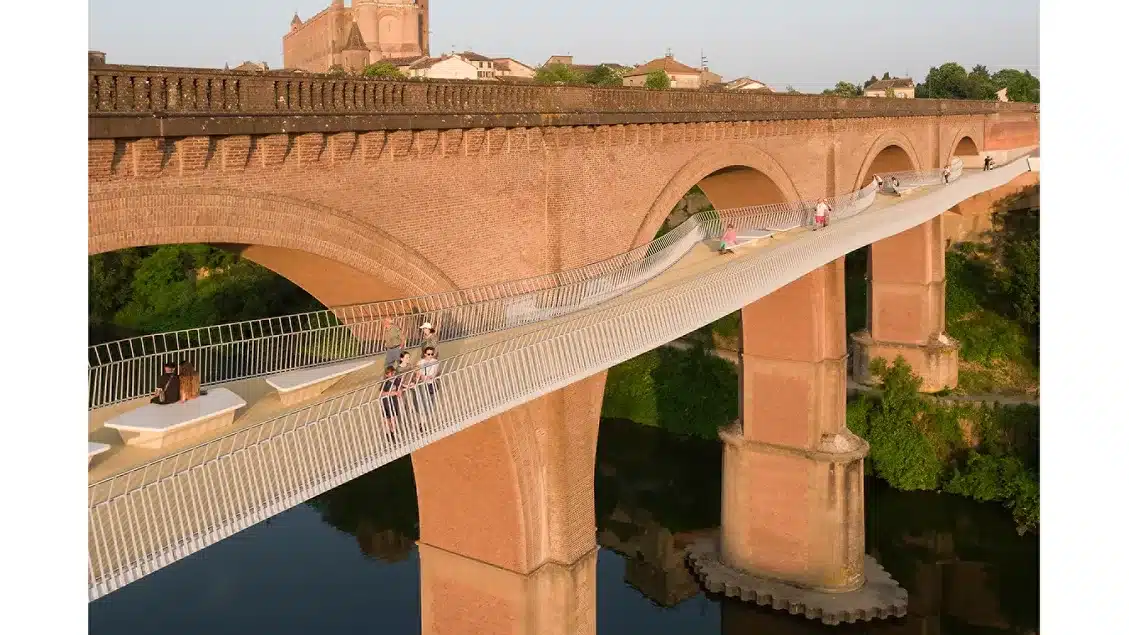
A key challenge was reconnecting Place du Château (on the UNESCO-listed side) with Place du Calvaire, severed by railway tracks. Ney’s ingenious response was a cantilevered link descending from the bluff, passing beneath the bridge’s first arch.

Engineering Elegance: Lightweight Steel Meets Brick Heritage
Spanning 600 feet, the pedestrian bridge is a masterclass in lightweight steel construction, suspended between the spring points and crowns of the brick arches. Instead of a linear path, Ney designed a dynamic, undulating structure that:
- Sways laterally at each arch, creating urban belvederes overlooking the old town.
- Ripples vertically, aligning with the rhythm of the arches for a tactile crossing experience—especially for cyclists.
- Features a sleek balustrade that accentuates its fluid form.

Construction Challenges and Triumphs
Prefabricated sections were assembled on-site using temporary supports, later welded into place. Despite delays from procurement setbacks, COVID-19, and the Ukraine war, the bridge finally opened in May 2024—proving worth the wait.
✦ ArchUp Editorial Insight
Albi’s new pedestrian bridge exemplifies how contemporary design can respect and elevate historic landscapes. Ney & Partners’ solution cleverly addresses urban fragmentation while creating a visually subtle yet functionally bold link. However, the design’s undulating form, though innovative, risks prioritizing aesthetics over accessibility for some users—a tension common in avant-garde infrastructure. Despite this, the bridge succeeds as a catalyst for urban renewal, transforming a disused space into a vibrant public asset. Its delayed completion only underscores the resilience required to marry vision with reality, resulting in a structure that feels both timeless and timely.
Explore the Latest Architecture Exhibitions & Conferences
ArchUp offers daily updates on top global architectural exhibitions, design conferences, and professional art and design forums.
Follow key architecture competitions, check official results, and stay informed through the latest architectural newsworldwide.
ArchUp is your encyclopedic hub for discovering events and design-driven