Architects as Mediators: 3 Strategies for Balancing Community, Government, and Business Interests

Introduction: Architecture as a Bridge for Dialogue in an Interconnected World
In the contemporary architectural landscape, the role of the architect has expanded far beyond designing buildings and realizing aesthetic ideas. It has transformed into a multidimensional field undertaking broader, more complex responsibilities. In contexts marked by inequality, environmental crises, and territorial disputes, architecture becomes a unique tool for negotiation, capable of mediating between the interests of diverse, and often conflicting, actors. In this scenario, the architect is no longer just a designer but a “cultural translator,” a “social facilitator,” and, frequently, a defender of collective community rights. But how can architecture genuinely mediate conflicts and drive transformation in profoundly unequal realities? This question is the focus of our journey across three continents.
Three Exceptional Models: Architecture as a Common Language
This article explores the answer to this fundamental question by analyzing three pioneering experiences in the so-called Global South, where architects acted as mediators in complex processes involving local communities, private companies, governments, and international donors. The models of SEALAB in India, Yasmeen Lari in Pakistan, and Comunal Taller de Arquitectura in Mexico tangibly prove that architecture is not merely a final physical product but a social and political process capable of connecting vastly different worlds and building bridges of sustainable understanding.
Model 1: SEALAB – Mediation and Inclusion as Foundational Design Principles in India
SEALAB, a studio based in Ahmedabad, India, and founded by Anand Sonecha and Mariana Paisana, is known for its community-focused projects that value slow, participatory processes attentive to local cultural identity. Its work was recently recognized in the 5th edition of the ArchDaily Next Practices Awards.
School for the Blind: Reinventing the Tools of Architectural Dialogue
The School for Blind and Visually Impaired Children in Gandhinagar is a prominent example of this mediating role. The project aimed to create an accessible educational environment for students from remote areas while meeting the needs of teachers striving to provide quality education and social integration opportunities. It was clear from the outset that the active participation of both students and teachers would be essential to ensure the space was functional and intuitive.
From Paper Models to Pre-Construction Simulation
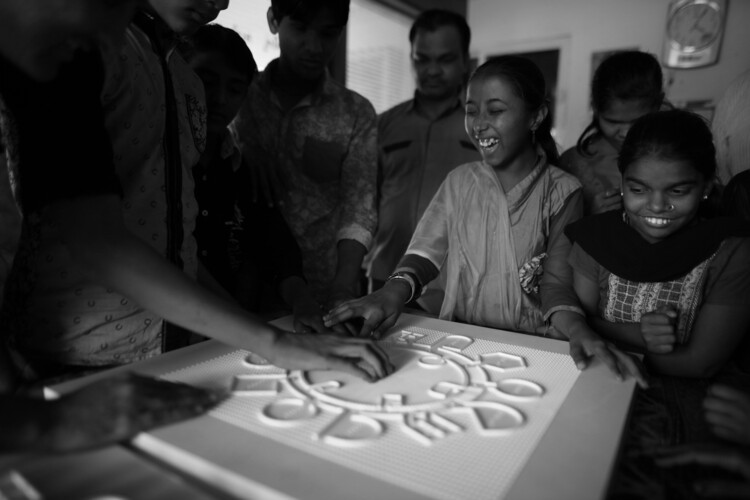
To achieve this goal, the studio reinvented its tools for communication and engagement throughout the design process. At various stages, meetings and workshops were held with students and teachers to involve them directly in decisions about the building’s form and layout. Initially, cardboard models allowed students to explore the space with their hands, but it quickly became apparent that this method was limited in conveying internal volumes and architectural details.
As an alternative, 3D-printed models were introduced, enabling robust, tactile representations of the spaces. These models included furniture and human figures, helping students understand the building’s scale and functional layout. Additionally, a “texture code” was developed and applied to plans and models to differentiate between interior and exterior areas, circulation zones, and classrooms, complemented by Braille signage for each space.
Before construction, the studio organized a full-scale simulation on-site, allowing administrators, teachers, and some students to walk through the spaces and provide feedback on circulation, spatial perception, and organization. During construction, specific building techniques, such as different plaster textures for floors and walls, were tested with students to assess their effectiveness for tactile orientation and navigation.
This participatory, multisensory approach proved essential for creating an inclusive educational environment where users could understand, navigate, and appropriate the space independently. This project exemplifies how architecture and mediation can work hand-in-hand, using innovative communication and participation strategies to meet the needs of historically marginalized communities and ensure architectural design is genuinely accessible to all.
Model 2: Yasmeen Lari – Humanitarian Architecture and Community Autonomy in Pakistan
In Pakistan, architect Yasmeen Lari—the first woman to practice architecture in the country—has transformed the field through her approach to “zero carbon, zero waste, and zero dependency” architecture. After decades of designing corporate buildings, Lari shifted her focus to social practice through the Heritage Foundation of Pakistan, responding to environmental disasters and humanitarian crises.
Mediation in the Face of Disaster: A Community without Intermediaries
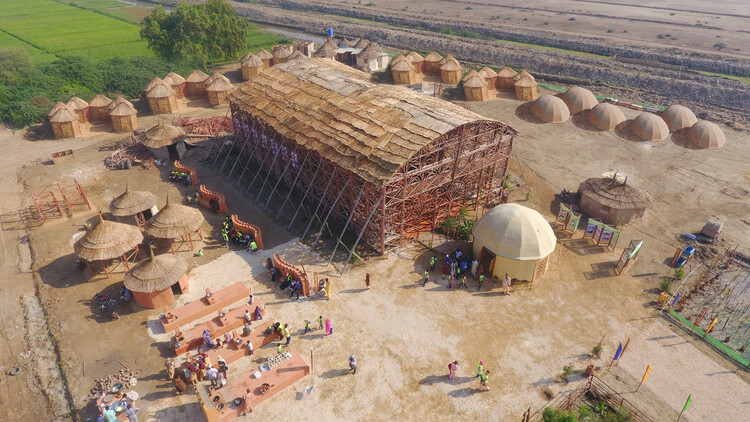
Her most notable work followed the devastating floods of 2022, which left millions homeless. While the government and private companies proposed costly, industrialized solutions disconnected from rural realities, Lari championed a model based on community autonomy. Using bamboo, earth, and other vernacular techniques, she developed elevated shelters resistant to floods and earthquakes.
Multi-Level Mediation: From Donors to “Barefoot Entrepreneurs”
Mediation occurred primarily in negotiations among international donors, private companies, and local communities. Instead of accepting ready-made models imposed by funders, Lari persuaded them to invest in local materials and community training, reducing costs and strengthening the local economy. A key element was the formation of “barefoot entrepreneurs”: residents trained to build homes and teach others in the community, thereby multiplying the project’s impact.
This approach also required dialogue with the Pakistani government, which initially did not recognize the technical validity of vernacular construction. The Heritage Foundation acted as a political mediator, advocating for regulatory changes to legitimize these methods. The result was the construction of over 40,000 sustainable homes with minimal environmental impact and significant community empowerment, especially for women.
Lari’s work demonstrates how architecture can invert traditional dependency, transforming communities into active protagonists while encouraging private companies to adopt more ethical and sustainable practices.
Model 3: Comunal Taller de Arquitectura – Cultural Resistance and Public Policy in Mexico
In Mexico, Comunal Taller de Arquitectura, based in Oaxaca, develops projects rooted in direct community participation, respecting cultural traditions and reinforcing local autonomy. An example is the Rural House in Puebla, designed in collaboration with residents of the Sierra Norte de Puebla, a region with a strong indigenous identity and significant socioeconomic challenges.
A Bridge Between Policy and Local Knowledge
The goal was to propose housing solutions that responded to local needs without imposing external, industrialized models. Mexican government housing programs often rely on rigid concrete and steel standards, frequently disregarding the cultural and economic context of communities. Comunal’s role was to bridge the gap between these formal requirements and traditional ways of life.
Participatory Design: From Workshops to Prototypes
The process included participatory workshops where residents mapped their needs and shared construction knowledge passed down through generations. Full-scale prototyping allowed solutions to be tested and ensured that local materials and techniques were valued. In Puebla, this led to the use of wood, earth, and traditional building systems, reinterpreted to meet safety and technical requirements.
Construction relied largely on community labor, reducing costs and fostering a sense of ownership. The project produced environmentally sensitive housing, adapted to the local climate, and rooted in indigenous culture. Beyond creating houses, the process generated collective empowerment, encouraging communities to actively shape their spaces.
Comunal’s work highlights architecture as a political act: it challenges standardized government models, promotes cultural diversity, and affirms communities’ right to participate in shaping their territories.
Conclusion: Convergences and Lessons Learned
Despite operating in distinct contexts—India, Pakistan, and Mexico—the three models reveal clear points of convergence. Prototyping became a key tool for dialogue between architects and communities; valuing local materials and knowledge reinforced cultural identity and sustainability; negotiation among diverse actors was critical for project feasibility; and community autonomy emerged as a vital legacy.
Together, these experiences show that architecture can be more than a technical service: it can build bridges between different worlds, fostering social inclusion, cultural preservation, and sustainable innovation. In the Global South, where inequalities and tensions are most pronounced, this mediating role is not just desirable—it is essential for addressing contemporary challenges.
✦ Archup Editorial insight
The article highlights the transformation of the architect’s role from a technical executor to a mediator and facilitator in community projects within the Global South. Upon closer examination of the applied methodologies, it is noted that the focus on participatory processes can, in some cases, significantly extend the project timeline, raising questions about the scalability of this model or its applicability in contexts requiring rapid response, such as emergencies. Furthermore, the near-total reliance on local materials and expertise, while beneficial, may limit the introduction of advanced technical improvements that could enhance the long-term environmental or structural performance of the buildings. However, the fundamental value of these projects lies in their success in building local community capacity and creating a strong sense of ownership, ensuring the project’s continuity and social sustainability even after the design team’s involvement ends.
Brought to you by the ArchUp Editorial Team
Inspiration starts here. Dive deeper into Architecture, Interior Design, Research, Cities, Design, and cutting-edge Projectson ArchUp.