Architectural Creations Inspired by Escher’s Magical World: When Geometric Dreams Become Tangible Reality

Few artists have captured the architectural imagination like M.C. Escher. Renowned for his mathematically precise lithographs and woodcuts twisted geometries, redefined logic, and spatial paradoxes Escher’s work explores impossible structures, endless staircases, and perceptual illusions. From Relativity, where gravity seems to operate in multiple directions, to the infinite loops of Ascending and Descending, his art challenges viewers’ assumptions about reality itself.
Yet, while Escher’s imagery is undeniably architectural, he treated architecture as a medium for visual play, conceptual layering, and spatial contradiction. His two-dimensional optical illusions don’t easily translate into functional three-dimensional forms. Where Escher used flat surfaces to simulate spatial impossibilities, architects must grapple with physical and programmatic constraints. If architects ever secure a commission requiring such disorienting spatial experiments, their challenge won’t be merely mimicking illusion—but constructing experiences that play with perception while remaining functional, navigable, and habitable.
Today, designers and architects embrace this challenge, crafting interiors and buildings that evoke Escher’s artistic sensibilities. Whether through looping staircases, tessellated surfaces that multiply space, or sculptural forms resisting logical reading, these projects blur the boundaries between what’s seen and what’s built. Below, we highlight contemporary architectural works channeling Escher’s spirit not as homage, but as a springboard for spatial and structural experimentation.
1. Chongqing Zhongshuge Bookstore
By X+Living | Chongqing, China
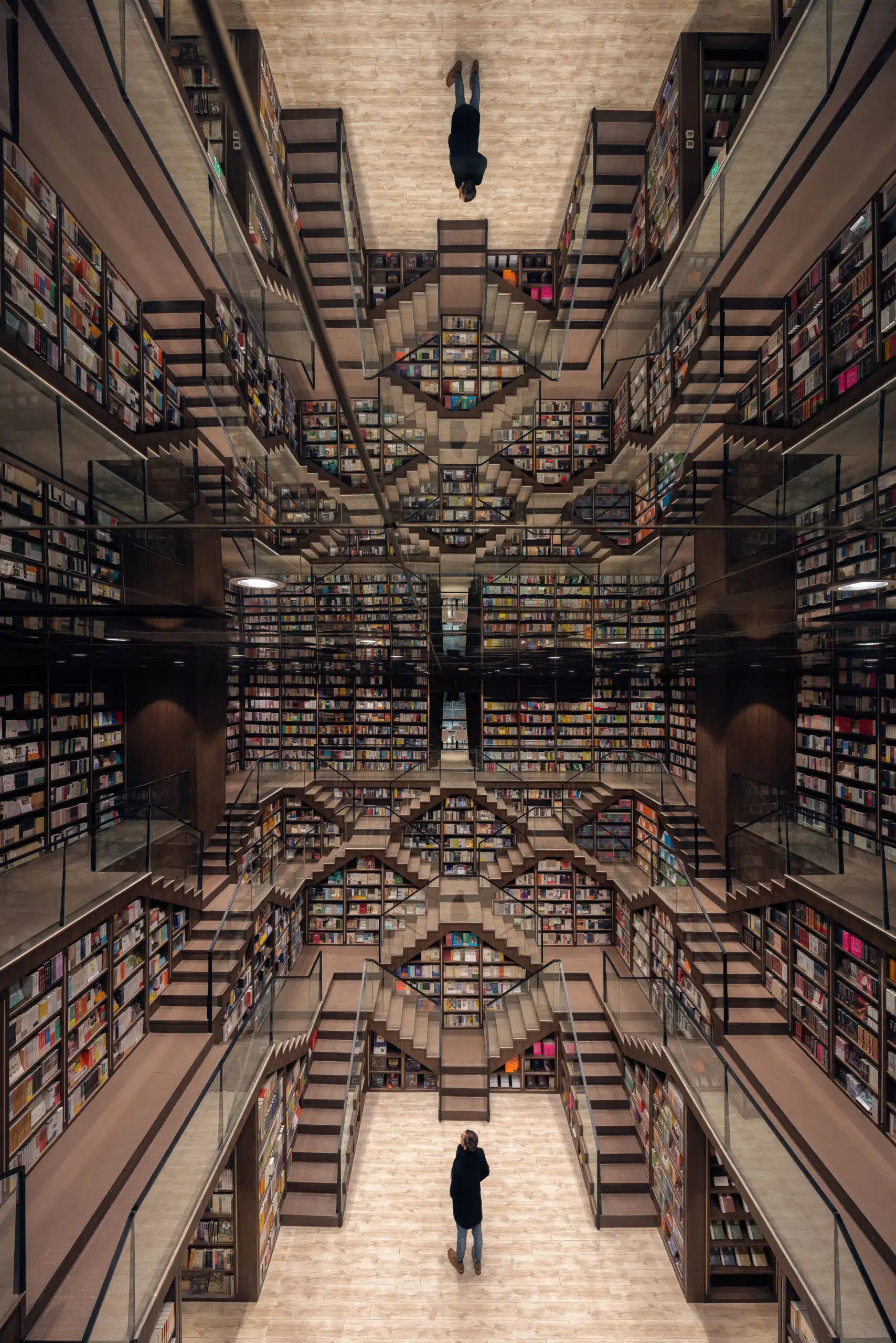
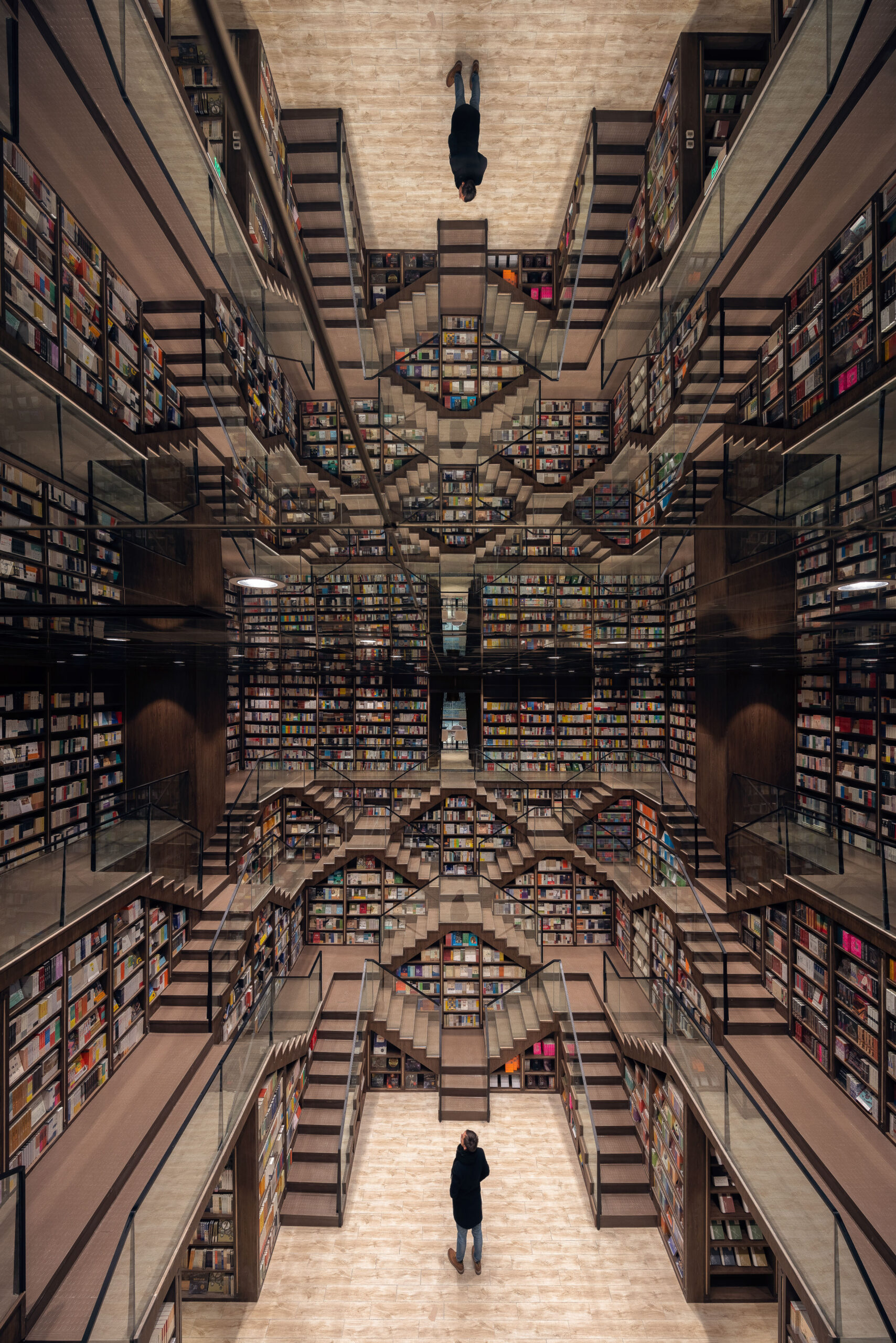
The term spatial spectacle perfectly describes Zhongshuge Bookstore, where mirrored ceilings and tiered staircases create a dizzying visual maze. In its iconic “Stair Hall,” stacked steps double as seating and bookshelves in a fisheye symmetry. The mirrored ceiling amplifies the illusion, crafting a cascade of stairways and stories that echo Escher’s impossible geometries.
Reflections add a dynamic interplay of repetition and spatial mirroring, tricking the eye, while circulation paths, seating, and shelves merge into a singular architectural element. The result is both playful and perplexing a theatrical space where visitors hover between reality and illusion, much like the logic-defying prints that inspired it.
2. Haikou Gaoxingli Insun Cinema
By One Plus Partnership | Haikou, China
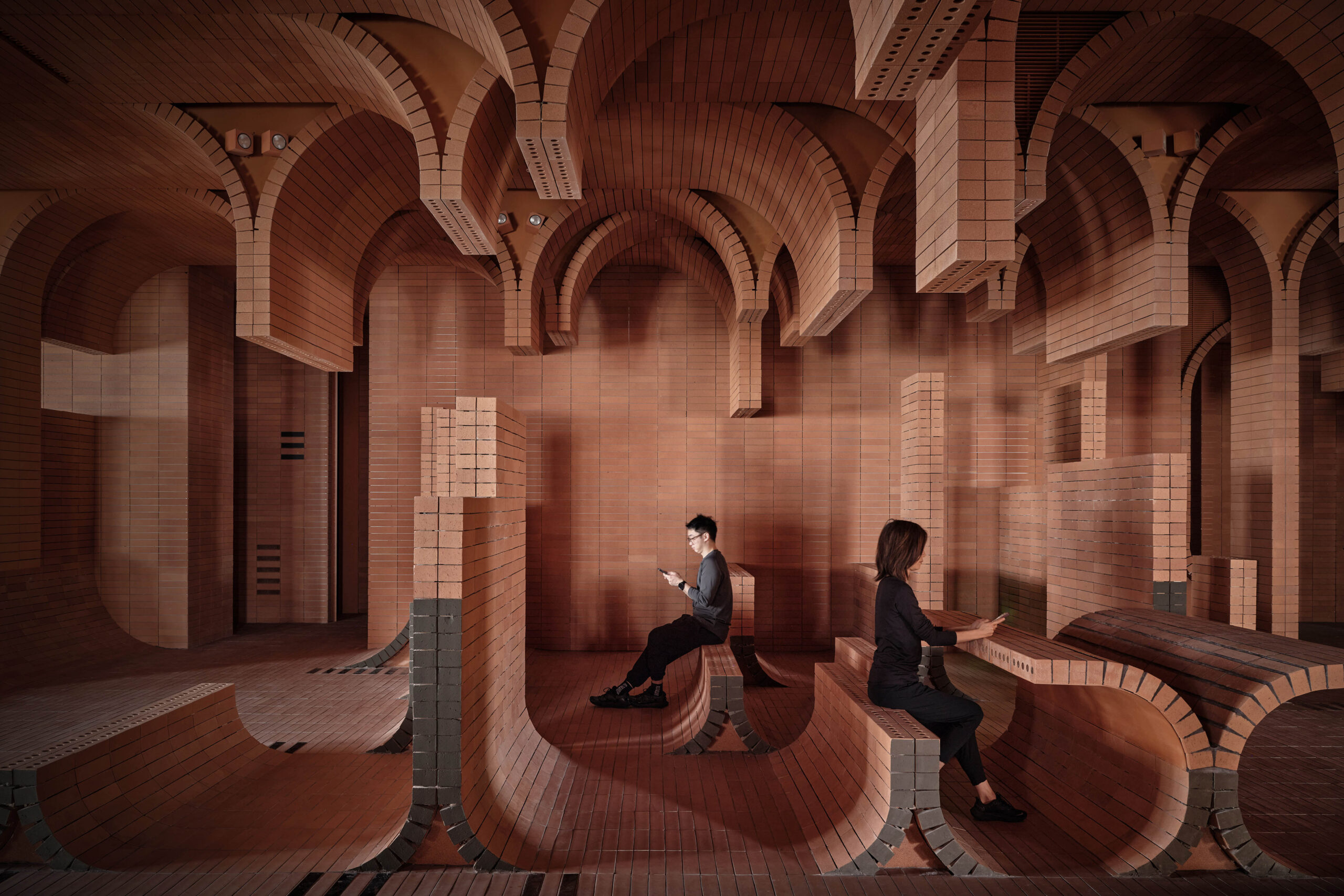
Wavelike curves, inverted arches, and looped forms create a spatial illusion worthy of an Escher sketch in this surreal brick lobby. Designed by Hong DesignWorks, the space is entirely clad in colored sandstone bricks, stacked and curved to rise from the floor and suspend from the ceiling, blurring lines between furniture, architecture, and sculpture.
Visitors sit within the undulating forms, becoming part of the terrain. Every curve serves a purpose as seating, counters, pathways, or spatial dividers. The effect is rhythmic and whimsical: a continuous, warped brick field evoking the flow of water, time, and memory.
3. JKU Linz School of Education
By Querkraft Architects | Linz, Austria
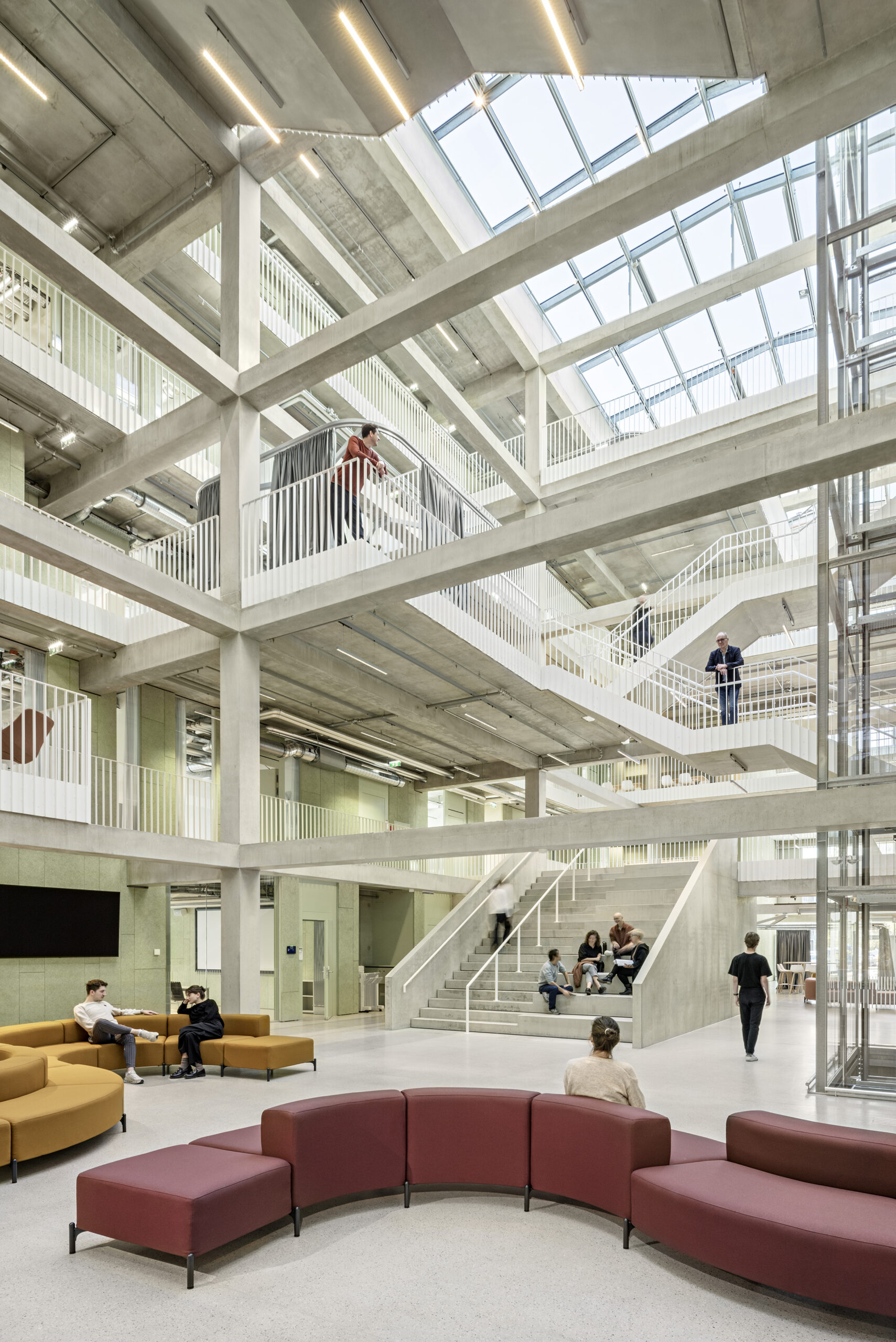
At first glance, the central atrium of JKU Linz resembles an Escher drawing translated into concrete. Layered staircases, shifting sightlines, and exposed structural elements form a dynamic visual grid, where vertical and horizontal axes dissolve. The five-story academic building, designed by Franz & Sue, features a 10×10-meter grid of concrete columns enabling open, reconfigurable interiors balancing spatial clarity with a playful stacking of voids and diagonal movement.
Raw concrete and steel amplify the spatial rhythm, while the atrium becomes a theatrical core linking offices and seminar rooms across levels. Floating walkways and intersecting staircases invite perpetual motion and shifting perspectives, mirroring the dreamlike recursive geometries that made Escher’s work timeless.
4. Dream and Maze
By Studio 10 | Guilin, China
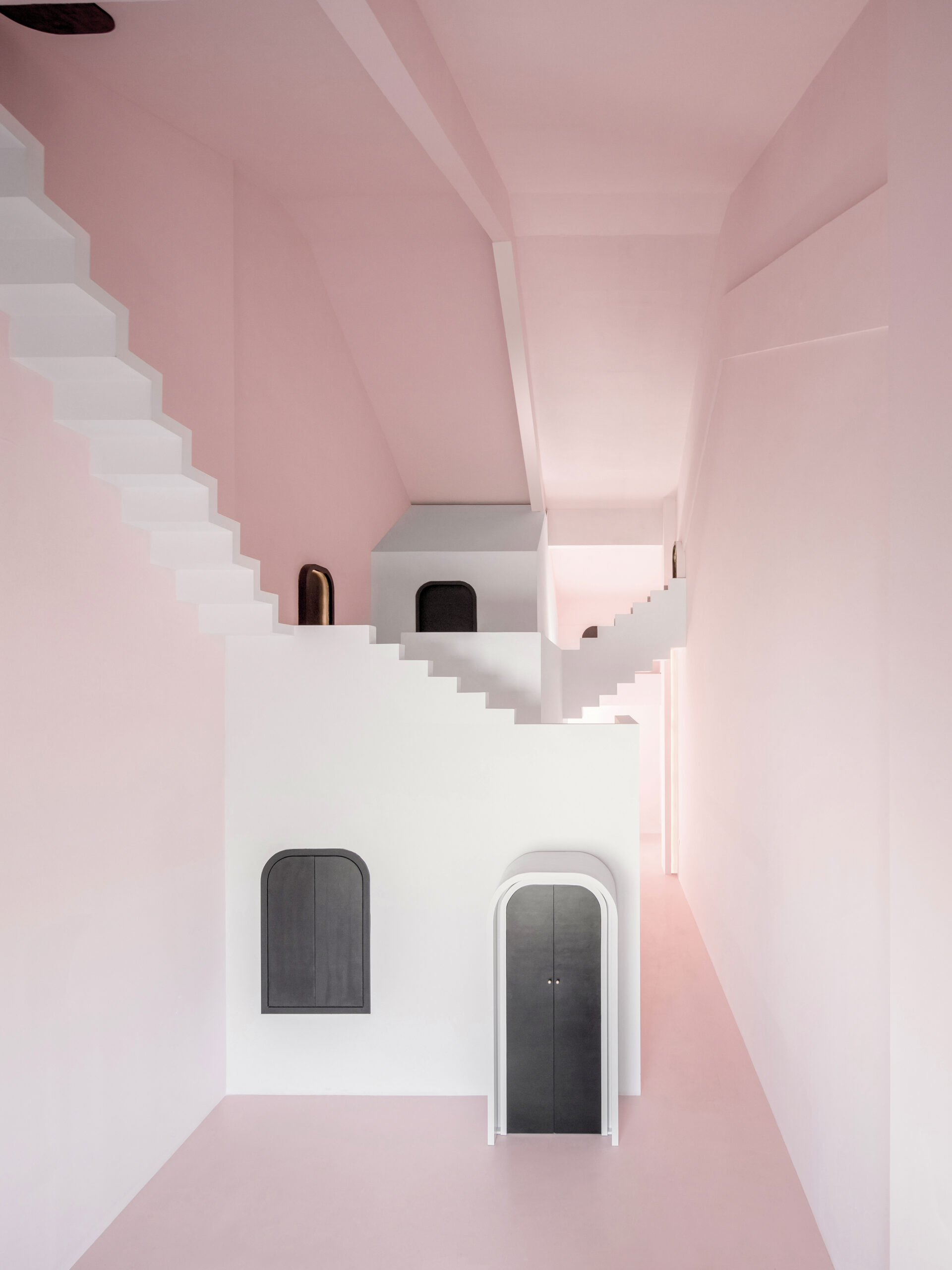
Studio 10 transforms guest rooms into immersive spatial illusions directly inspired by Escher. In Dream, pale pink-and-white panels soften a world where staircases lead nowhere, planes warp between dimensions, and real-world elements hide behind black doors. Light, shadow, and depth are manipulated to create a serene yet surreal space.
In Maze, forest-green surfaces frame gravity-defying staircases and gilded doors hinting at imaginary portals. By concealing functions and amplifying illusion, Studio 10 invites guests into a paradoxical environment where Escher’s impossible geometries aren’t just visual tricks, but inhabitable structures.
5. Wine Ayutthaya
By Bangkok Project Studio | Ban Run, Thailand
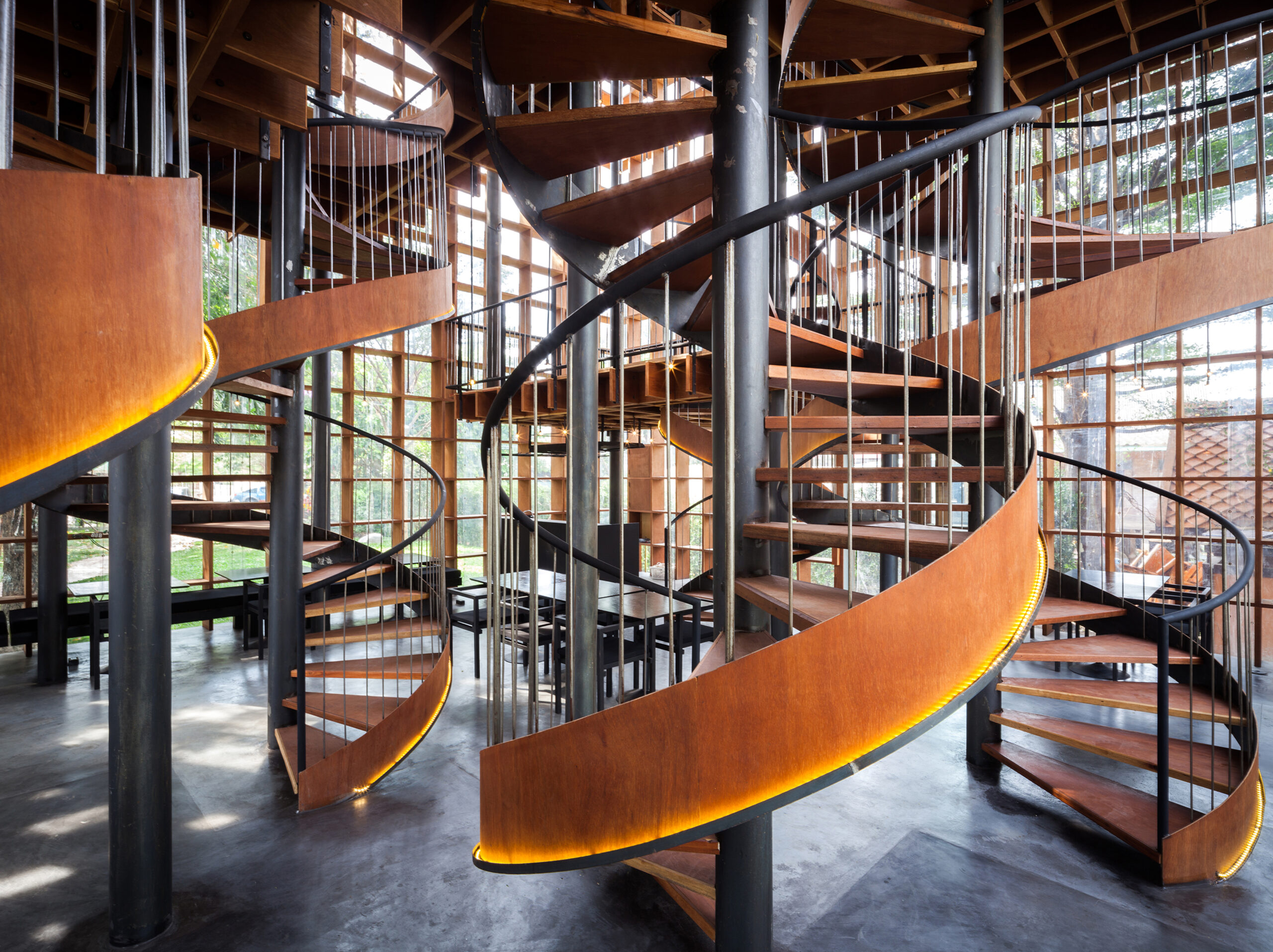
Wine Ayutthaya explores new possibilities for spatial movement through a network of spiral staircases, interlocked platforms, and pivoting points—an architectural tribute to Escher’s layered logic. Constructed entirely from steel-reinforced plywood arranged in an exposed waffle system, the structure merges floors, walls, and ceilings into a single continuous lattice.
Inside, five spiral staircases ascend to four offset platforms, each framing distinct views of the Chao Phraya River. Circulation doubles as structural support, erasing boundaries between form and function. Light filters through perforated plywood, softening the interior and scenting the air with wood and wine. This spatial dance transforms humble materials into an immersive experience of layered perception.
6. Puma House
By Nendo | Tokyo, Japan
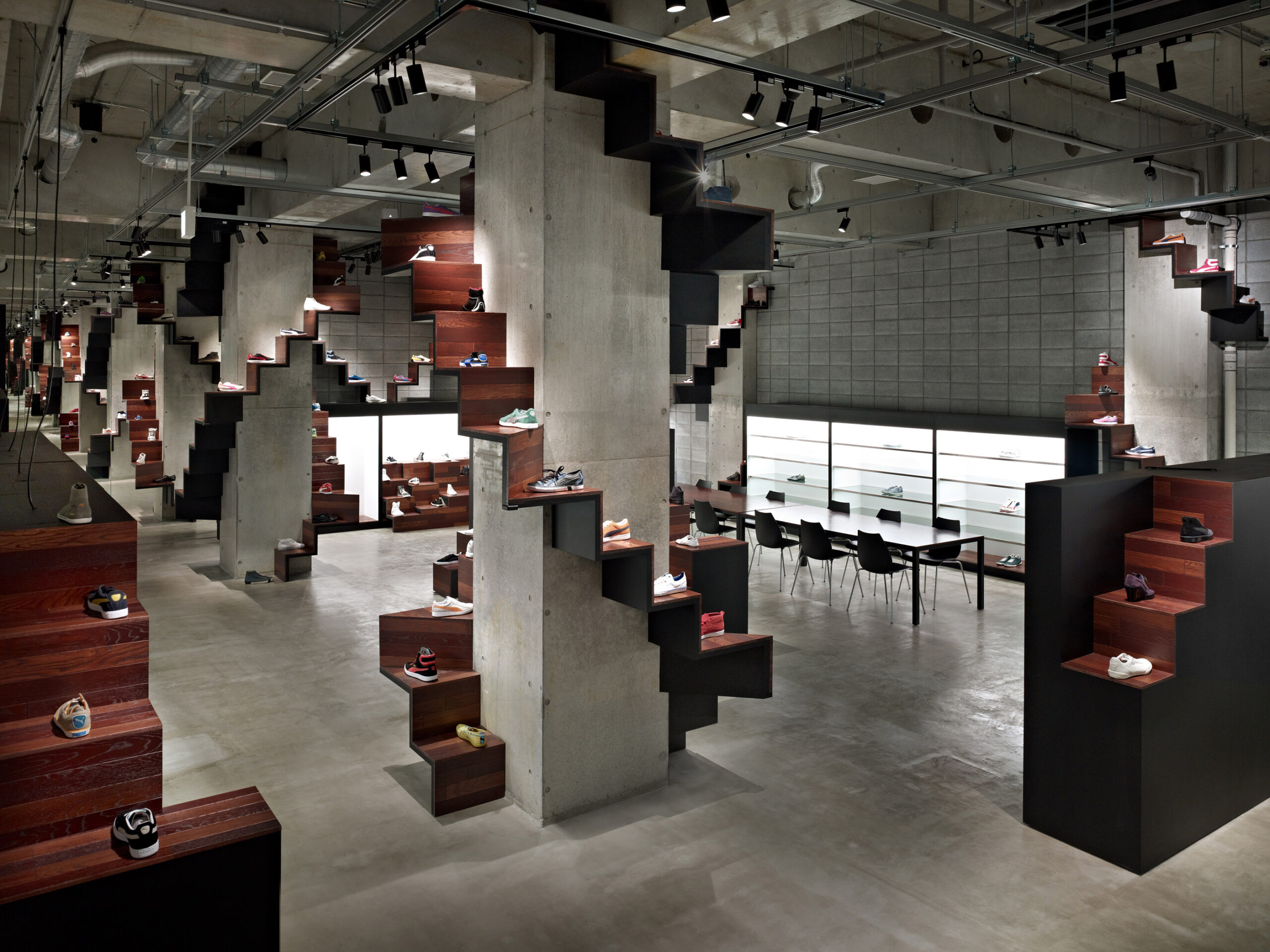
At Puma House Tokyo, staircases lose their function and gain new meaning. Designed by Nendo, this multi-purpose gallery and press space features fragmented sculptural staircases that climb columns, wrap corners, and hover mid-air. These “non-staircases” serve as display ledges for Puma sneakers, turning the interior into a rhythmic field of movement and suspension.
Echoing Escher’s impossible constructions, the design creates visual confusion through recursive geometry and skewed spatial logic. Rich wood contrasts with raw concrete and minimalist fixtures, adding warmth while evoking stadium seating. Here, form follows concept: athleticism, motion, and abstraction converge in a dynamic space encouraging both visual play and physical exploration.
7. Known, Installation
By Metaverse Architects | Shenzhen, China
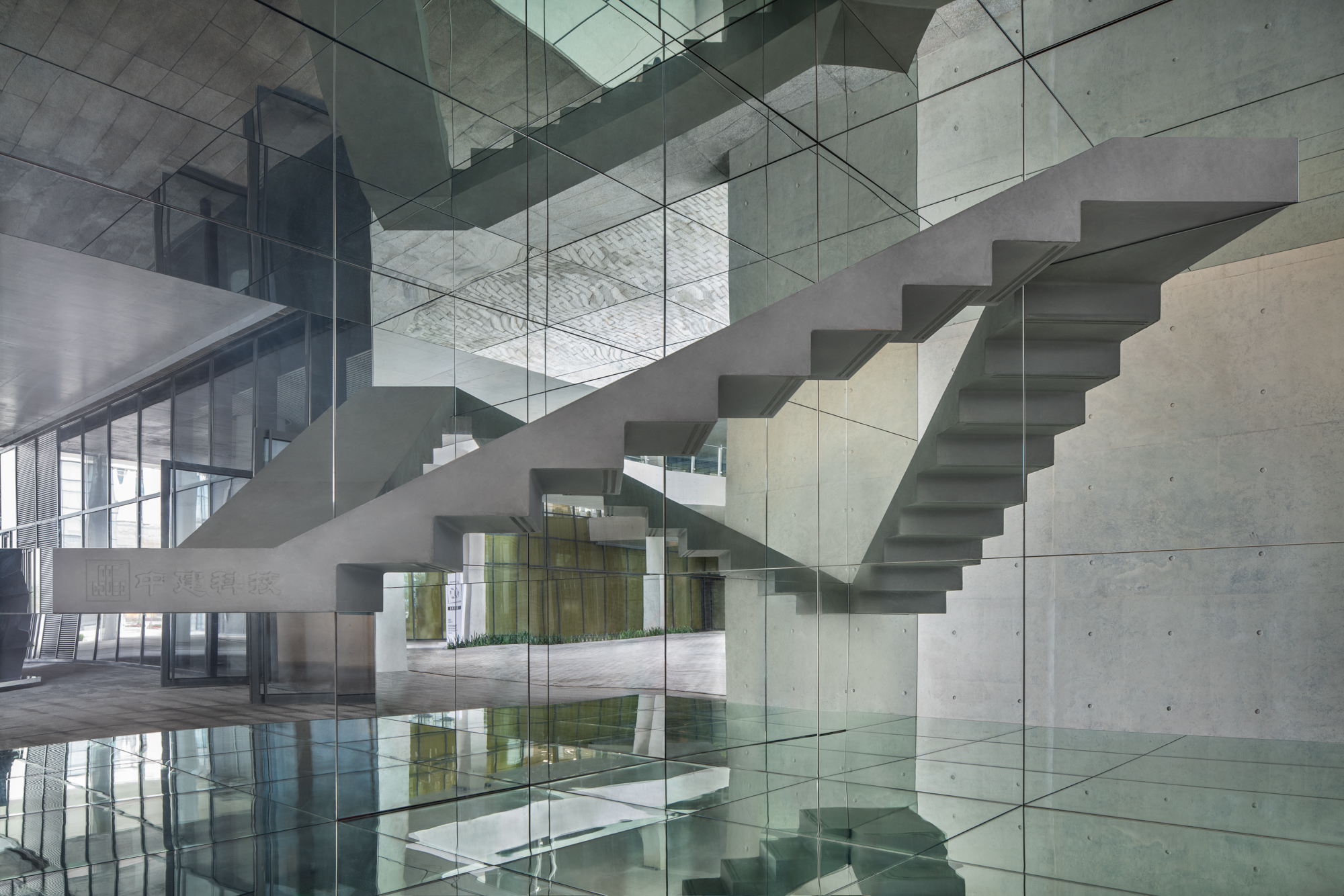
In this striking installation at Pingshan Art Museum, a concrete staircase hangs upside-down within a mirrored room, creating a visual paradox reminiscent of Escher’s Relativity. Titled Known, the artwork critiques industrial modernity and urban perception, using concrete, steel, and glass to generate an infinite loop where reflection renders direction meaningless.
Four mirror planes spawn an endless spiral of steps real and illusory blurring the distinction between up/down and subject/object. The piece challenges manufactured urban space while inviting viewers to question their spatial assumptions. It’s not just architectural; it’s a meditation on perception, where staircases become both symbol and illusion, floating into infinity within perfectly constructed uncertainty.
✦ ArchUp Editorial Insight
M.C. Escher’s legacy thrives in architecture that bends perception, blending art with habitable form. These projects masterfully evoke his recursive geometries, yet some risk prioritizing illusion over usability spaces like Dream and Maze dazzle but may overwhelm daily function. However, the brilliance lies in their audacity: they prove architecture need not be static. By marrying Escher’s playfulness with structural innovation, they invite us to experience space, not just inhabit it. The Chongqing Bookstore and JKU Linz atrium, for instance, strike a rare balance theatrical yet navigable, challenging yet intuitive. Here, Escher’s spirit isn’t just replicated; it’s reimagined for living, moving bodies.
Brought to you by the ArchUp Editorial Team
Inspiration starts here. Dive deeper into Architecture, Interior Design, Research, Cities, Design, and cutting-edge Projectson ArchUp.