

Architecture, with Spirit: A Reflection on Direction, Proportion, and Purity

I once sat in a lecture where the speaker, after stacking dozens of sketches of so-called Islamic cities, announced that there is no such thing as Islamic architecture. He claimed the category was invented by Orientalists. It was a striking statement, almost provocative, yet perhaps only partially true. Because while the forms of minarets, domes, or courtyards may vary, the essence of Islamic architecture was never ornamental. It began with a city and a cube. With Madinah and the Kaaba. With direction, purity, and a geometry that carried more weight than a thousand stylistic labels.
In recent decades, much has been said about Feng Shui, Chi energy, and spatial alignment in architecture. From Silicon Valley homes to Japanese gardens to high-end interiors in Manhattan, the influence of Eastern wisdom has permeated the profession. These practices are fascinating, and they teach us how human psychology responds to thresholds, mirrors, and voids. Yet one must recognize that learning from such systems does not require faith in them. They can be studied as cultural grammars, valuable yet not binding. For those who design within Qur’anic paradigms, another foundation exists, deeper and more precise: the mathematics of orientation, proportion, and purification.
The Kaaba is not merely a monument, but the origin of architecture and the eternal architectural identity of Makkah. All the structures that surround it, even if they change, remain part of an identity that is granted by the Kaaba alone.”
Direction as Divine Orientation
Long before contemporary discussions of energy flow, the Qibla was established as a fixed metaphysical anchor. Every mosque, regardless of geography, orients toward Makkah. This is not merely symbolic. It dictates the layout of prayer halls, the division of courtyards, and the placement of entrances. It is the original system of sacred navigation. In that sense, Islamic architecture carries its own spiritual GPS, a divine code of direction embedded into every structure.

“The Kaaba, with its simple cubic geometry, is a symbol uniting earth and heaven, embodying both the spiritual and functional essence of Islamic architecture. It is not an object of worship, but a spiritual compass harmonizing the built form with the soul’s orientation and ethics.”
Purity as Prerequisite
The first mosque in Islam was not monumental; it was a testament to simplicity and humility, and above all, to tahara (purity). This concept, often discussed in theology, is an architectural principle in its own right—it shaped the flow of water, the zoning of courtyards, and the very spirit of the built environment. As the Qur’an reveals regarding the mosque built on piety:
“فِيهِ رِجَالٌ يُحِبُّونَ أَن يَتَطَهَّرُوا ۚ وَاللَّهُ يُحِبُّ الْمُطَّهِّرِينَ” (سورة التوبة، الآية 108).
The essence of this architecture is not found in ornamental forms like minarets or domes, but in a deeper, purer foundation. This is exemplified by the first House of Worship itself, as the Qur’an reminds us:
“إِنَّ أَوَّلَ بَيْتٍ وُضِعَ لِلنَّاسِ لَلَّذِي بِبَكَّةَ مُبَارَكًا وَهُدًى لِّلْعَالَمِينَ. فِيهِ آيَاتٌ بَيِّنَاتٌ مَّقَامُ إِبْرَاهِيمَ ۖ وَمَن دَخَلَهُ كَانَ آمِنًا” (سورة آل عمران، الآية 96-97).
Purity here is not merely aesthetic; it is structural. It is the very DNA of the built environment. It is a core principle that distinguishes the essence of Islamic Architecture from its secondary, decorative elements.
The Golden Ratio, and the Sacred Square
Mathematics has long fascinated architects. The golden ratio has been traced in temples, cathedrals, and even Le Corbusier’s Modulor. But in Islamic buildings, proportions acquire a more profound meaning. The Kaaba is not a square by coincidence. Its dimensions are rooted in balance, its edges tied to symmetry, its presence defiant of ornamentation. Around it, millions circle, aligned not only by faith but by geometry that transcends culture. The cube holds silence, yet speaks mathematics.

Spatial Psychology and Sacred Geometry
At INJ Architects, we explored how emotional responses to space—what makes one feel at ease or anxious—are not random. By integrating Qur’anic concepts of proportion and emptiness with mathematical spatial modeling, we tested how a person might feel inside a space before it is even built. The hypothesis is clear: when space follows divine logic, it becomes not just beautiful, but benevolent. This is not about style. It is about ethics. About designing buildings that serve the soul as much as the market.
Learning Without Worshipping: Beyond Feng Shui
To be clear, Feng Shui has a legacy worth studying. Its rules about orientation, mirrors, and furniture remind us how humans interpret space. But for Islamic societies, and for those who design within Qur’anic paradigms, a richer framework already exists. One that places the Qibla above the mirror, the Kaaba above the mandala, the mathematics of shadows above speculative energies. We can learn from Feng Shui without worshipping it. It becomes spice, not the main dish.
Makkah as Urban Archetype
In debates on cities, high-rises, and skyline erosion, one must not forget that the true architectural language of Makkah is not in its towers. It is in the permanence of the Kaaba. Everything else is rebuildable. Nothing is sacred except that cube. When a city is anchored to a fixed spiritual object, it gains not only orientation but also moral clarity.

Contemporary Translation: Ghiras Al Madina
These principles are not confined to history. In Ghiras Al Madina, a contemporary project in the heart of Madinah, we drew inspiration from the Prophet’s Mosque in its earliest form. Palm trunks became columns, shadows became tools of proportion, and courtyards facilitated both shade and purification. The experiment was not nostalgic, but mathematical: a re-translation of sacred logic into contemporary design. It revealed how even in modern contexts, geometry and purity can guide innovation.
“Purity is not merely aesthetic or ritual; it penetrates the very DNA of the built environment — influencing water flow, spatial zoning, and even how cities grow around sacred sites, making cleanliness a prerequisite for spiritual and architectural harmony.”
Synthesis based on concepts from Ibrahim Joharji’s writings
Toward a New Spiritual Architecture
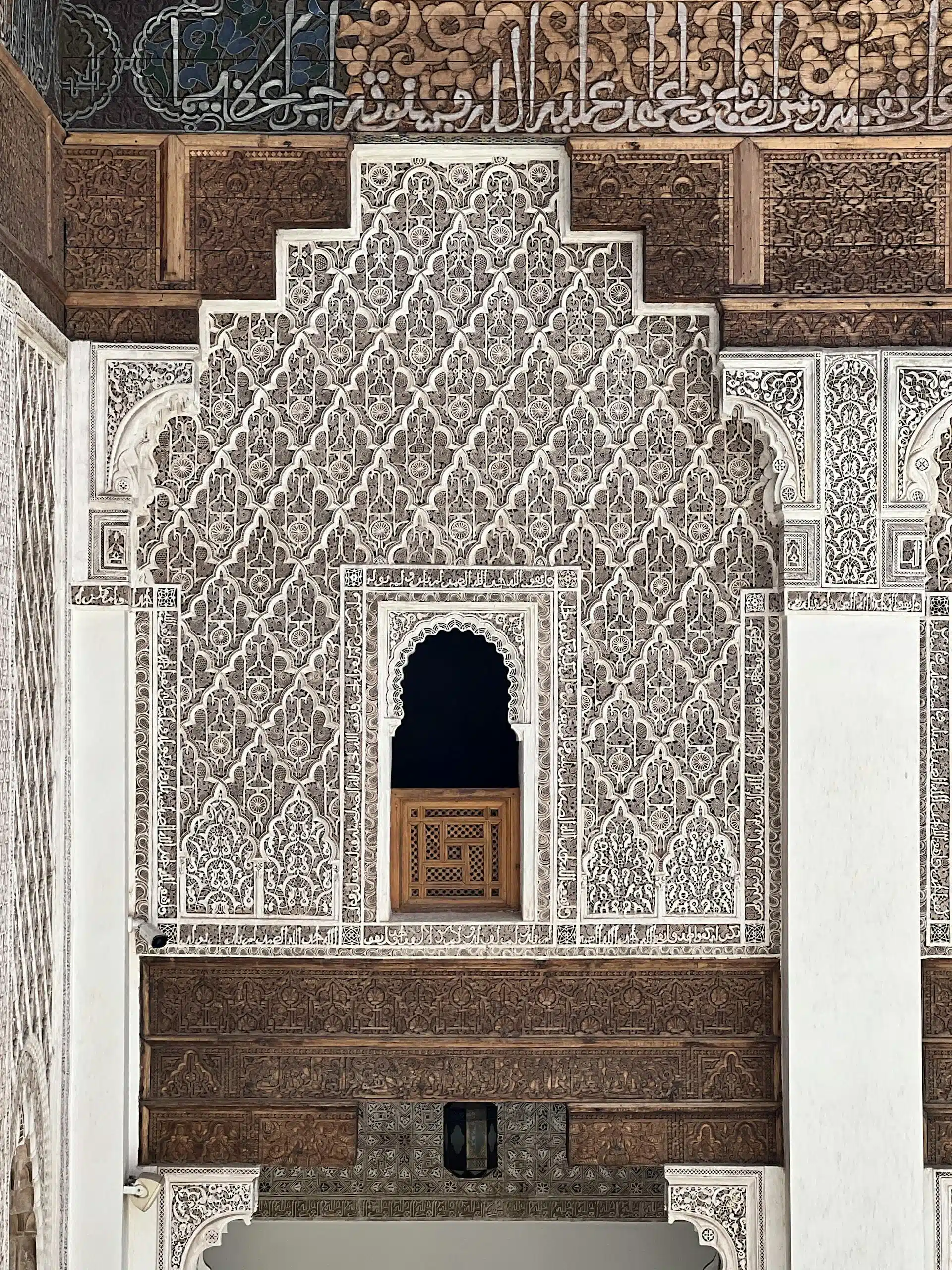
This is not about reviving domes or copying mashrabiya screens. It is about rethinking the ethical foundation of the built environment. Can a home be ethical? Can an airport be moral? Can a classroom be spiritually nourishing? The answer lies in design choices, in the metaphysical laws we choose to follow. Orientalists may debate categories, but believers live within an architecture that already carries unity, balance, and direction. If we listen carefully, we will hear that the soul, like a compass, always points home.
✦ ArchUp Editorial Insight
This article dives into the elusive yet enduring intersection between architecture and spirituality, exploring principles like Feng Shui, directional sciences, and the golden ratio—but ultimately anchoring its narrative in the mathematical purity of Islamic architecture.
Rather than promoting mysticism, the piece suggests that geometry and proportion—as embodied in structures like the Kaaba—carry deeper moral and cosmological meanings. The critique is layered: while modern design often borrows from symbolic systems like Feng Shui for “aesthetic seasoning”, the author argues that Islamic architecture offers a foundational logic for purity, harmony, and divine alignment.
This thoughtful positioning elevates the article beyond style commentary. Looking ahead, its core argument remains durable: that design rooted in mathematical and ethical clarity may better withstand the tests of time and trend. The integration of spiritual science and geometric discipline makes this a rare architectural meditation—both ancient and provocatively contemporary.



🟦 Editor’s Note:
This article offers a profound exploration of spirituality in architecture and could be developed into a new architectural perspective worthy of discussion. One point that could enhance its research value is addressing the role of orienting towards the Qibla as an influential architectural element, not merely a functional detail. This aspect has not been extensively discussed in the specialized literature and could be supported by a schematic analysis or diagram illustrating how interior spaces respond to this axis.
Adding historical examples or architectural comparisons would help place the idea within a broader intellectual context, transforming it from a spiritual reflection into a viable architectural subject for study, without claiming to be a “new theory” or an “unprecedented proposition.” In this way, the content becomes balanced, critical, and consistent with established academic standards.