Architectures of Planetary Well-being | ArchDaily

Architectures of Planetary Well-being
Home » Events » Architectures of Planetary Well-being

Architectures of Planetary Well-being

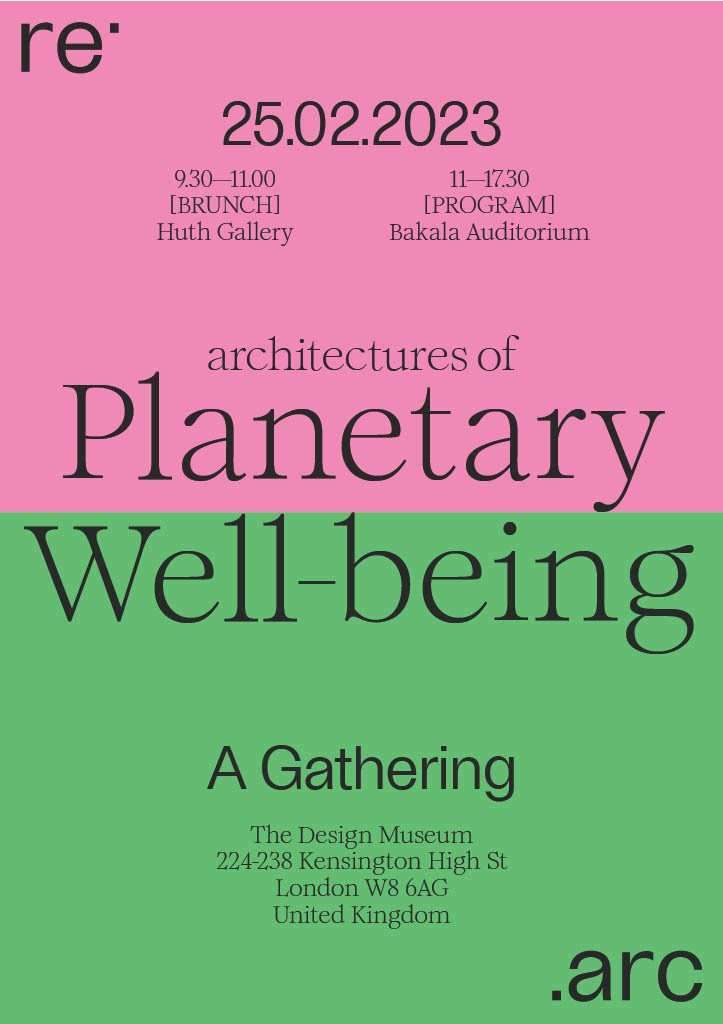
re: arc institute presents architectures of planetary well-being, an in-person gathering, at the London Design Museum, on Saturday, February 25.

The biannual event is dedicated to the collective exploration of architectures of planetary well-being a framework for ongoing practices of custodianship. And care toward our social and ecological environments

This inaugural multi-format iteration re: arc institute invites practitioners, dreamers, and the curious to imagine the relational change needed to move beyond extractive paradigms.

The program opens with a session on Embodiment and Social Change with Camille Barton, followed by a keynote on Life-Affirming Infrastructures by Amahra Spence. And a Science Fiction Workshop with Angela YT Chan. Additionally, The day culminates with a panel discussion on Community Participatory Architecture with members from Space Black, Build Up, Okra, and Paradigm Network.

Brunch and snacks will be provided.

Date: Saturday, February 25, 2023
Time: 9:30 to 17:30
Location: London Design Museum – Bakala Auditorium and Huth Gallery |
224-238 Kensington High St, London W8 6AG, United Kingdom

RSVP | https://rearcinstitute.rsvpify.com

Furthermore, About re: arc institute

re: arc institute is a philanthropic initiative committed to supporting architectures of planetary well-being by acknowledging the interdependence of our social and ecological systems. Furthermore, The institute funds the development of community-led solutions that address the root causes. And consequences of climate breakdown and nurture the creative reimagining of our current social and ecological processes and systems.

Furthermore, For inquiries, reach out to Minah Kwon at minah@rearc.institute
 

Finally, read more on Archup:

Further Reading From ArchUp

  • VeloNotte Bergamo: Tales of Cement

    VeloNotte Bergamo: Tales of Cement Duse building by Zenoni Giorgio; Gambirasio Giuseppe; Barbero Walter — one of the highlights of Velonotte BergamoLET’S SPEND THE NIGHT TOGETHER WITH BRUTALISM!The nocturnal grand tour on bikes through the history of the postwar architecture of BergamoIn Italian & EnglishAfter London, Istanbul, Rome, Verona, St. Petersburg, Berlin and many other

  • FF – Distance Edition: Leers Weinzapfel Associates

    The Boston-based practice hosts an online studio visit.The League’s FF – Distance Edition events are informal online studio visits offering a behind-the-scenes look at leading design practices. This season’s events feature practices navigating the legacies and possibilities of American infrastructure, from ecological systems and transit hubs to community facilities and social networks.Leers Weinzapfel Associates was founded

  • ArchiVision: Celebrating the 10th Anniversary of the Museum for Architectural Drawing

    ArchiVision: Celebrating the 10th Anniversary of the Museum for Architectural Drawing Image: © Katrin Günther, Vyacheslav Mizin, Zaha Hadid Foundation, Christoph Langhof, Alexander Brodsky, Artur Skizhali-Veys, Peter Wilson; Collage: Annika PaetschOn the occasion of the anniversary exhibition of the Tchoban Foundation Museum for Architectural Drawing in Berlin, Sir Peter Cook, Mikkel Frost, Jean-Louis Cohen, Sergei

  • USC School of Architecture: Border Walk Virtual Discussion

    From a modest fence built in the early 1900s to a sophisticated surveillance, tracking, and barricade system today, the US-Mexico border is both a work of architecture and an exercise of planned obsolescence. It is a continually updated construction zone, a seemingly impenetrable infrastructure that nevertheless allows thousands of undocumented and stateless people to move

  • Michael Nguyen – Clarity of Seeing, Fantasy of Interpretation

    Michael Nguyen – Clarity of Seeing, Fantasy of Interpretation Düsseldorf. Planar Lineup of Time: At first glance, the photo looks like a straight collage consisting of 3 vertical parts. The 3 facades or two houses represent 3 different styles of architecture, with look and feel conveying past, present and future. Share ShareFacebookTwitterMailPinterestWhatsappOrhttps://www.archdaily.com/991433/michael-nguyen-clarity-of-seeing-fantasy-of-interpretationThe Max Planck Institute

Leave a Reply

Your email address will not be published. Required fields are marked *