The Arkhive Project: Redefining Sustainable and Flexible Construction with Robotics

Smart Architecture and Reflections on the Future
At present, our interest in architecture is no longer limited to creating beautiful spaces. Instead, the focus has shifted toward building more intelligently and sustainably, and exploring ways not to treat our planet as a resource to be consumed and discarded later. This new perspective pushes us to rethink every detail of design and execution.
Innovation in the Use of Robotics
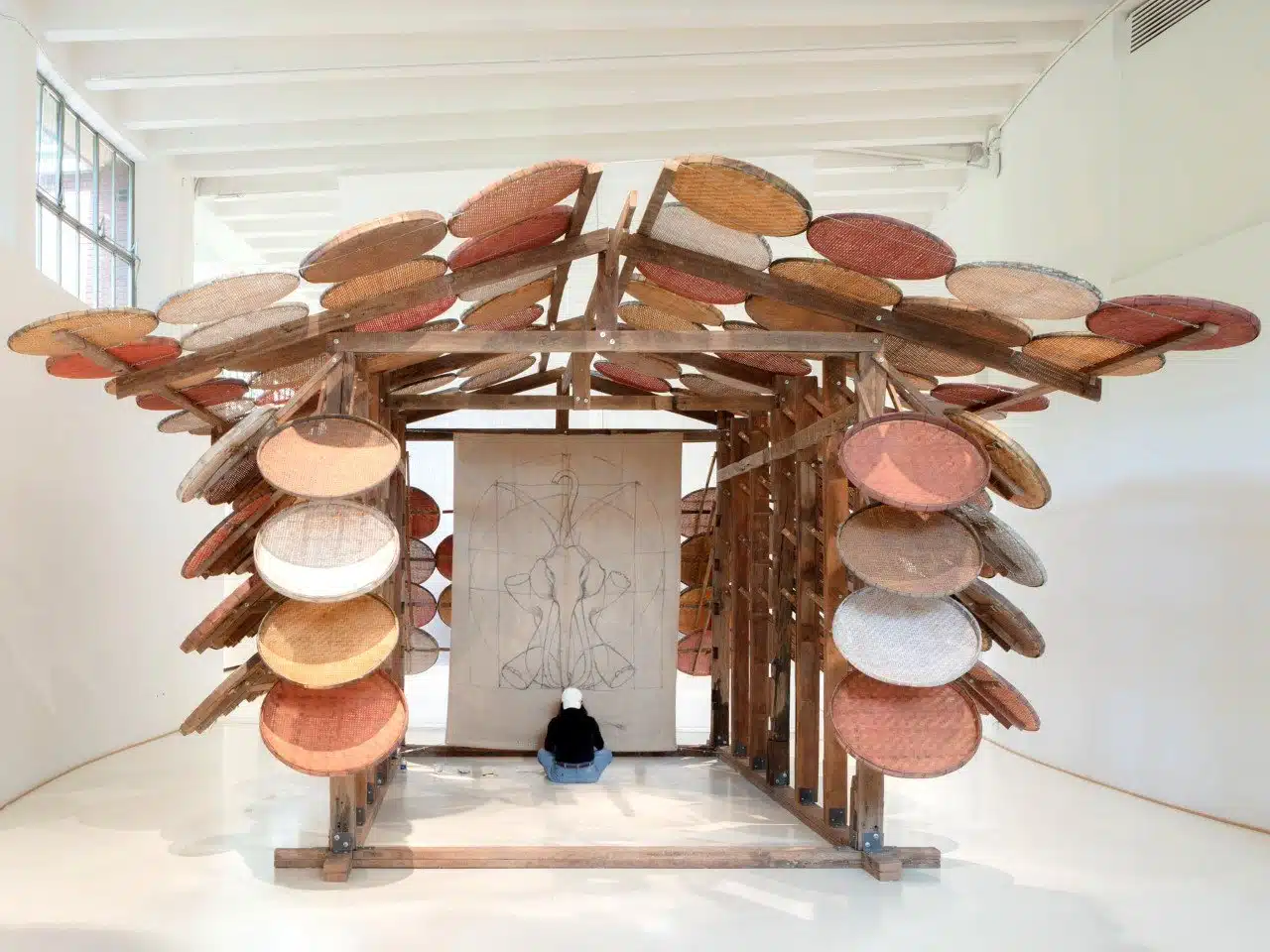
Take the example of Arkhive: a wooden structure that looks like it came straight out of a sci-fi movie. But what sets it apart is not only its appearance, it’s the way it was built. The entire structure was assembled by industrial robotic arms, operating with precision that human hands cannot match. Here, the integration between modern technology and architecture becomes evident, prompting us to imagine the future potential of construction.
Addressing the Problem of Waste in Construction
More importantly, Arkhive is not just a striking technical showcase; it addresses one of the biggest challenges in construction: waste. It was designed by students of the Design for Manufacture program at University College London with the goal of combining innovative thinking with practical design, opening the door to more efficient and sustainable construction methods.

Rethinking the Traditional Construction Cycle
Consider the way we usually build: we design structures, construct them, use them for a certain period, and then, at the end of their lifespan, demolish them and send their waste to landfills. Upon closer inspection, it becomes clear that this cycle is inefficient and generates an enormous amount of waste.
Deconstructable and Reusable Construction
This is where the Arkhive project comes in, completely overturning this scenario. Every component of its wing can be disassembled and reassembled in different configurations without losing any material, much like LEGO bricks, but on an advanced and complex scale.
The secret lies in what are known as reversible joints. Instead of nails, screws, or adhesives that permanently bind components, these connections can be taken apart and reassembled multiple times as needed. The system relies on modular wooden components that prioritize flexibility over absolute permanence. Consequently, when a structure has fulfilled its purpose at a given site, it doesn’t turn into waste, it becomes raw material for an entirely new project in the future.
Integrating Sustainability with Technology
What truly sets this project apart is the combination of sustainable thinking with advanced robotics. University College London has invested over £400,000 in developing robotic facilities focused on low-carbon building materials and innovative practices.
The Arkhive project reflects a major shift in architectural education; schools no longer focus solely on teaching students to draw beautiful buildings, they now teach how to tackle real-world problems using technology that is reshaping the entire construction industry.


Experiencing Circular Construction in Reality
The Arkhive wing was installed in the St Andrews Botanic Garden in Scotland during the summer of 2025, serving as a venue for public events. Imagine attending a lecture or community gathering within a space that embodies a completely different approach to construction.
This pavilion not only sparks conversations about sustainable architecture but also serves as a practical model of circular construction on a larger scale, where components can be reused and waste is significantly reduced.
Rethinking the Construction Industry
The significance of a project like Arkhive lies in addressing a critical issue of our time. The construction industry is responsible for a large portion of global carbon emissions and waste production.
If we want to tackle the challenges of climate change and the depletion of natural resources, it becomes essential to completely rethink the way we build, not just the materials we use, but the entire lifecycle of buildings, from design to use and reuse.


Hands-On Education and Preparing Future Leaders
Students involved in the Arkhive project do not limit their learning to architectural theory within classrooms; they gain direct hands-on experience with industrial robotic systems. These students work to translate ambitious ideas from concept to full-scale construction, equipping them with the ability to tackle real-world challenges in the construction industry.
This type of education prepares individuals to drive genuine transformation in industries, rather than merely continuing repetitive traditional practices.
Sustainable Innovation Instead of Sacrifice
What is particularly striking about projects like Arkhive is how they make sustainable construction appear less about sacrifice and more about innovation. The focus is not on settling for less advanced buildings in the name of sustainability, but on using advanced technology to create structures that are more flexible, efficient, and intelligent than what we have built for centuries.
Arkhive presents a vision of a future in which buildings evolve from being static structures to dynamic systems that develop alongside our changing needs, reflecting new possibilities for adapting to environmental and social challenges.


✦ ArchUp Editorial Insight
The Arkhive project can be seen as a valuable experiment for understanding how to integrate sustainability and flexibility into modern construction. It represents a first step in testing reversible joint techniques and robotic-assisted construction. These elements may help designers and students think differently about the building lifecycle and material reuse.
However, the project remains limited in several ways when attempting to generalize it to a broader scale in the construction industry. First, the focus on modular wooden structures may not be practical for all types or sizes of buildings, especially large residential or commercial projects. Second, relying on industrial robots for execution requires high upfront costs and advanced facilities, which may limit the feasibility of this approach outside specialized educational or laboratory environments. Third, the concept of reusable construction faces logistical and regulatory challenges on real sites, including transportation, storage, and ensuring the safety of components after each disassembly and reassembly.
Therefore, while the project offers an analytical model and inspiration for sustainable architectural thinking, its practical application requires careful consideration of costs, materials, and operational conditions, positioning it more as an exploratory experiment rather than a ready-to-deploy solution on a large scale.