

Atari Hotel in Phoenix: World’s First Playable Hotel Inspired by Classic Video Games

The Atari Hotel in Phoenix proposes a new model of hospitality shaped by interactive media and spatial play. Developed by Intersection Development with design by Räkkhaus, it encodes references to Pong, Asteroids, and Tetris into its layout. The project avoids decorative theming. Instead, it treats gameplay logic as an architectural framework.
Design Concept
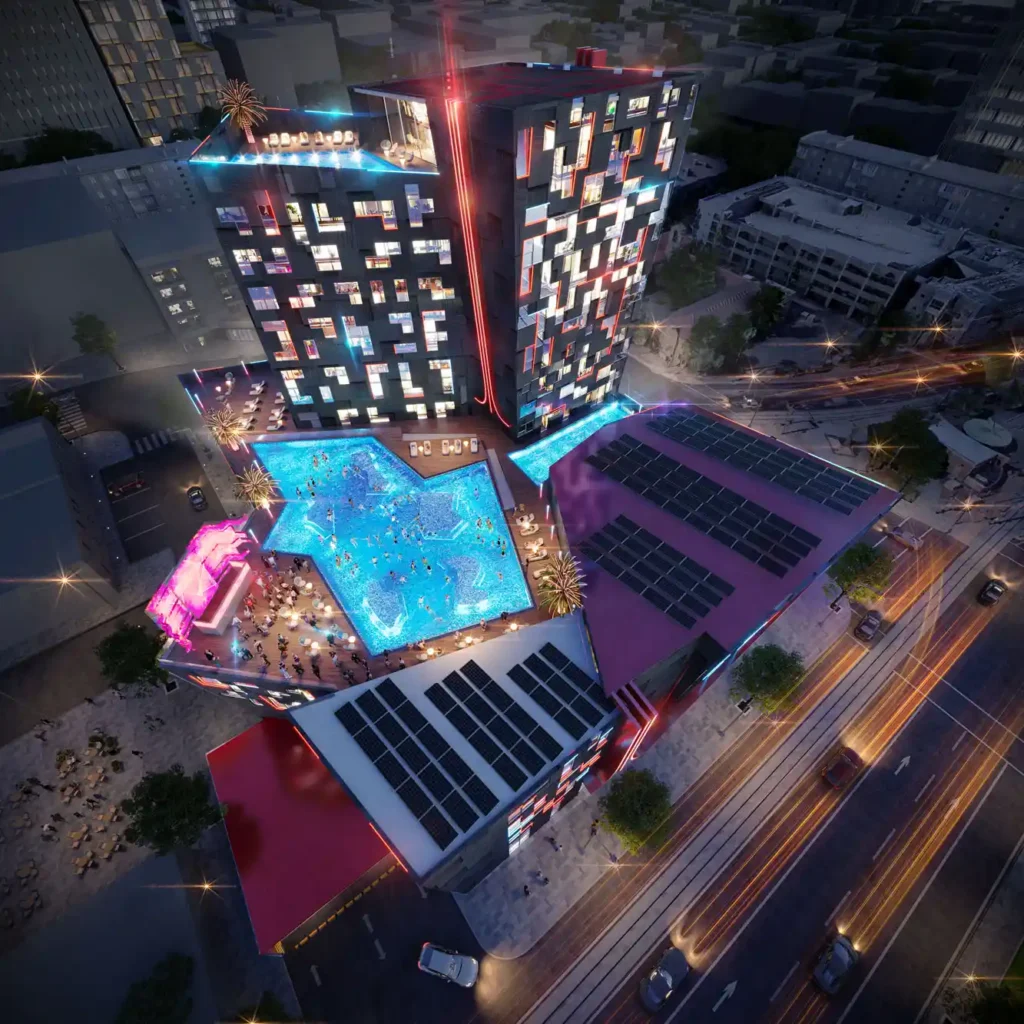
Räkkhaus describes the tower as a glowing monolith of light and motion. Its aesthetic draws from Tron and Blade Runner. Creative director Zac Cohen stated the goal was to fuse architecture with interaction not themed design, but pure spatial innovation. The Atari logo stretches vertically up the façade. An LED lit breezeway shifts color and rhythm based on time, season, or events. This reflects broader shifts in architectural design toward dynamic user experiences.
Materials & Construction
Exact materials are not yet public. However, the use of responsive lighting and digital surfaces implies glass, steel, and integrated electronics. The building will have 91 units 19 suites and 72 rooms symbolizing 1972, Atari’s founding year. It includes a 10,000 square foot esports venue and a 2,000 person event space. These features demand complex coordination of power and acoustics. Structural details and construction sequencing remain undisclosed.

Urban and City Impact
The Atari Hotel sits in Phoenix’s Arts and Entertainment District. It enters a growing debate about how cities adapt to experience based economies. Most floor area supports nightlife, gaming, and social gathering not lodging. This challenges norms for urban buildings. Zoning and infrastructure may need reevaluation as such hybrids multiply.

Sustainability Considerations
No official data confirms energy or water efficiency measures. The project relies on high-intensity lighting and climate-controlled party zones. In a desert climate, this raises concerns about resource use. Sustainable building materials or certifications like LEED have not been mentioned. Without third party review, its environmental claims remain unverified under current sustainability standards.
Construction is set to begin in late 2026. The Atari Hotel is expected to open by mid to late 2028 with $14 million already committed. As digital culture reshapes physical space, can architecture be both playable and enduring?
Architectural Snapshot: A 91 room tower in Phoenix uses vintage game logic to shape circulation and façade, testing hospitality as an interactive medium.
ArchUp Editorial Insight
The announcement of the Atari Hotel in Phoenix frames interactive entertainment as architecture, yet its reliance on branded nostalgia risks substituting spatial depth with visual gimmickry. While Räkkhaus’s kinetic façade and programmable breezeway signal an earnest attempt to merge digital logic with built form, the project remains tethered to commercial hospitality metrics 90,000 square feet of experience calibrated for maximum turnover, not resonance. Still, its refusal of literal theming offers a sliver of conceptual clarity. Whether such a model endures beyond the attention economy’s next cycle remains uncertain.


ArchUp: Technical Analysis of the Atari Interactive Hotel in Phoenix
This article provides a technical analysis of the Atari Hotel in Phoenix as a case study in experimental hospitality architecture based on interactive media and digital visual identity. To enhance archival value, we present the following key technical and design data:
The project spans a total area of 90,000 square feet (approximately 8,360 square meters) and includes 91 accommodation units (19 suites and 72 rooms), symbolizing the year 1972—the founding year of Atari. The central feature is a dynamic interactive facade incorporating a programmable LED lighting system that changes its color and patterns in response to time, season, or special events, aiming to create a “glowing, moving light monster.” Entertainment spaces constitute 40% of the total area, including a 10,000-square-foot esports arena and an event hall with a capacity for 2,000 people.
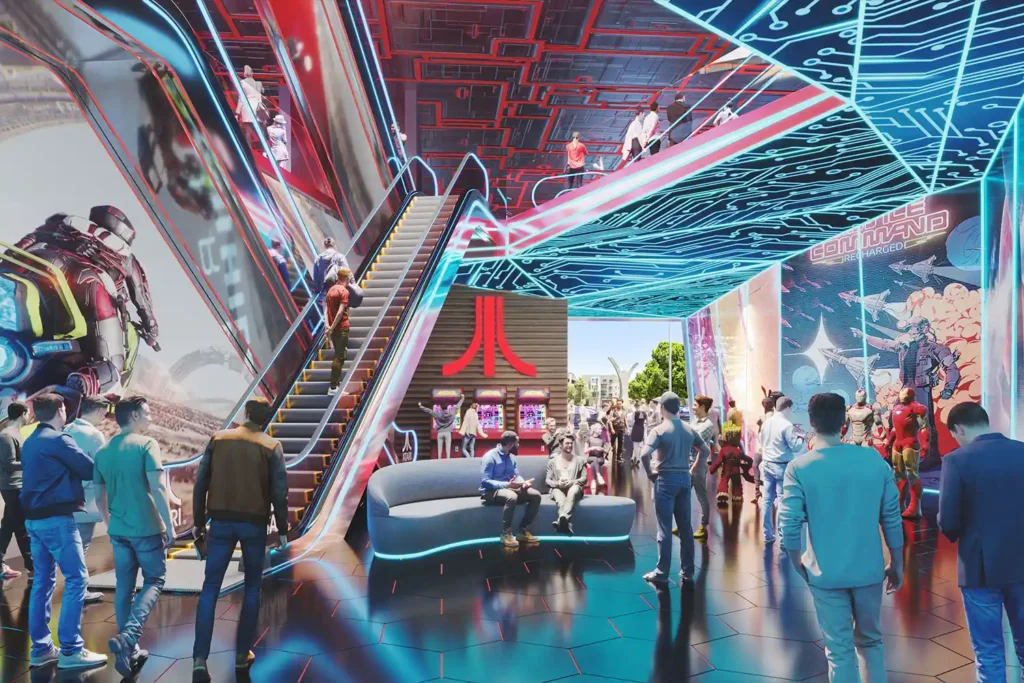
The interior design employs a visual language inspired by classic games (such as Pong and Asteroids) in its layout and finishes. This includes glowing moving staircases, circuit board-patterned ceilings, and digital murals. It is projected that the interactive lighting system and large display facade will consume up to 35% of the hotel’s total electricity consumption, posing a significant challenge in a desert environment like Phoenix, where temperatures can reach 45°C (113°F) and require intensive cooling systems.
In terms of sustainability and operation, the project lacks a declaration of specific environmental standards or certifications (such as LEED). Construction is planned to begin in late 2026, with an opening scheduled between mid and late 2028, backed by an initial investment estimated at $14 million. The hotel is located in Phoenix’s Arts and Entertainment District, positioning it as part of an urban development strategy centered on the experiential economy and digital entertainment.
Related Link: Please refer to this article for a discussion of broader trends in hospitality architecture and sensory experience:
The Aura Effect: How Media Narratives Shape Taste, Emotion, and Architecture
https://archup.net/tiroler2-0-measuring-tool/