
Mass Timber Fire Station in Queensland Wins 2025 Award


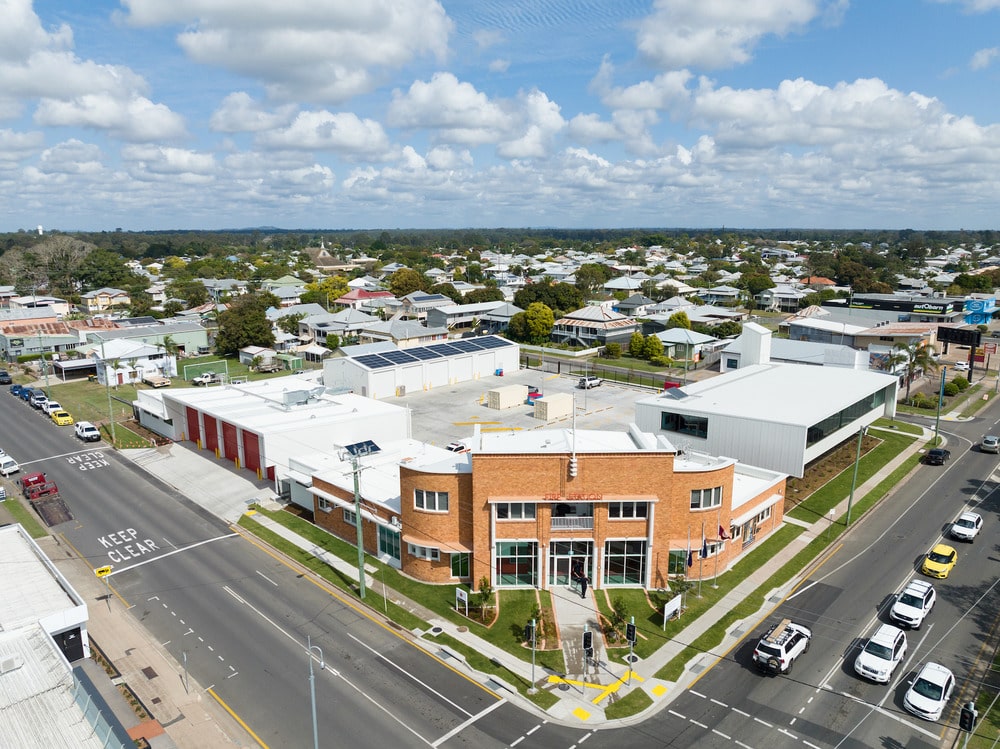
Mass timber fire station development has gained international attention after a public facility in Maryborough, Queensland, won recognition at the 2025 Built by Nature Awards. The project reactivates a 1951 Art Deco fire station while introducing contemporary architectural design strategies. It uses approximately 500 cubic meters of engineered wood, replacing conventional building materials like steel and concrete. The facility demonstrates how emergency infrastructure can align with sustainability benchmarks without compromising regulatory safety standards.
Functional Layout Within a Historic Footprint
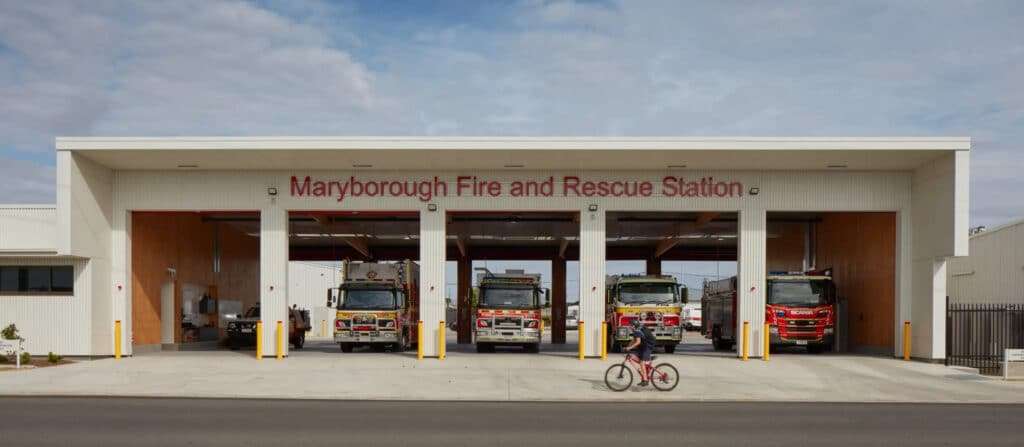
The facility serves as the North Coast Region Headquarters and Maryborough Fire and Rescue Station. It includes vehicle bays, offices, training rooms, and emergency response zones. Public and operational areas are clearly separated to support rapid deployment. The layout reflects established models for civic buildings. No demolition occurred. The project remains within its original urban footprint a principle reinforced in global cities planning discourse and documented in the archive of adaptive reuse projects.
Structural Performance and Material Strategy
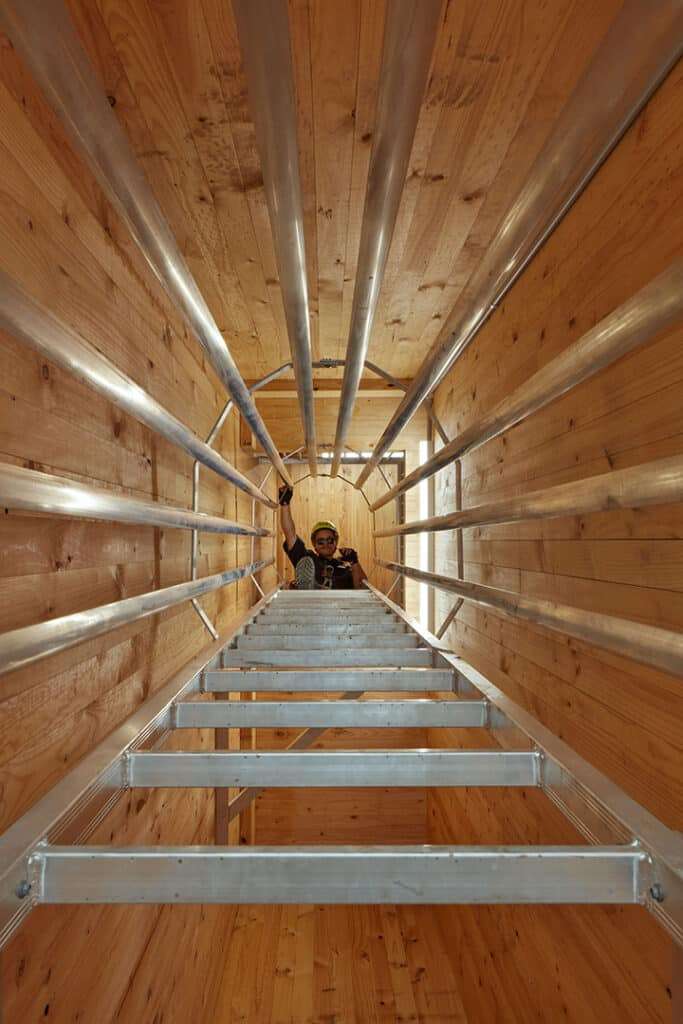
The mass timber fire station employs cross laminated timber panels and glue laminated beams. These meet Australian fire resistance and durability requirements. Prefabrication reduced on site waste and accelerated construction. Timber was sourced from managed forests with short regrowth cycles. Project data estimates a carbon offset of 1,742 tonnes aligning with current research on low carbon public works.

Urban Continuity and Regulatory Questions
By intensifying use of an existing civic plot, the project avoids relocation or expansion. This approach fits broader trends in sustainable cities policy. Yet it also tests whether engineered wood can satisfy long-term demands of high risk emergency buildings. Global events are beginning to address this technical threshold.
Could mass timber become standard for fire stations worldwide?
architectural Snapshot
A Queensland fire station repurposes a mid-century civic structure using mass timber to test carbon reduction, operational efficiency, and urban continuity in emergency infrastructure.
ArchUp Editorial Insight
The article documents a mass engineered timber fire station in Maryborough with technical precision, framing it as a model of low carbon civic infrastructure. It avoids overt promotion but leans on familiar sustainability tropes carbon offset metrics, managed forestry, prefabrication without interrogating regulatory compromises or long-term maintenance risks in high exposure public safety buildings. Still, its commitment to factual clarity and adaptive reuse within an existing urban footprint offers a rare anchor in a field saturated with speculative eco-claims. Whether such projects will shift codes or remain symbolic exceptions depends less on their merit than on institutional inertia.





ArchUp: Technical Analysis of the Massive Timber Fire Station in Maryborough
This article provides a technical analysis of the Maryborough Fire Station in Queensland as a case study in redeveloping civic infrastructure using low-carbon mass timber. To enhance archival value, we present the following key technical and design data:
The project involves the revitalization of an original Art Deco-style fire station built in 1951, preserving its historic facade. The new structure uses approximately 500 cubic meters of mass timber, including Cross-Laminated Timber (CLT) and Glued Laminated Timber (GLULAM), reducing the building’s embodied carbon footprint by an estimated 1,742 tons of CO₂ equivalent compared to using concrete and steel.
The structural performance meets the 90-minute fire resistance requirement mandated by Australian standards for high-risk public buildings. This was achieved through the thick dimensions of the timber, where the charred carbon layer that forms during combustion acts as a natural insulator, preserving structural integrity. Off-site prefabrication accounted for up to 80% of the building elements, reducing construction time and minimizing on-site disruption.
In terms of functional distribution, the building combines the regional headquarters for North Queensland with a local fire station. The design includes four vehicle bays, administrative offices, training rooms, and emergency response areas. Operational spaces are clearly separated from public ones to ensure vehicles can be deployed within 60 seconds. This design reflects a deep understanding of emergency infrastructure efficiency while integrating it into an existing urban fabric without requiring horizontal expansion.
Related Link: Please refer to this article for a comparison of other projects utilizing advanced timber construction techniques:
Kusatsu for Manufacturing: Redefining the Relationship Between Industrial Production and the Natural Environment
https://archup.net/high-end-wood-panels/