

Cabana 18 in Vaughan: A Backyard Sanctuary Redefining the Relationship with the Land

Immersed in Topography: A Story of Harmony with the Earth
The Backyard Sanctuary transformed a simple desire for a gathering place into an integrated architectural space that redefines the home’s relationship with its natural surroundings. This auxiliary building sits on a site with a gentle westward slope. The design deliberately embraced this grade rather than resisting it. It lowered the structure softly; the architects made it appear carved into place, not imposed upon it.
This intentional submersion firmly roots the structure horizontally. It lends the Backyard Sanctuary a sense of stillness and belonging to the landscape. When visitors view it from the main living room, they do not perceive it as an addition. Instead, it acts as a quiet, anchored part of the natural composition. This deep integration encourages viewers to consider the environment an active partner in the daily living experience. The Backyard Sanctuary is not just an add-on; it is an organic extension.

The Celestial Eye: The Illuminated Heart of the Backyard Sanctuary
Imagine yourself moving toward the center. Here, the essence of the design takes shape. The floorplan adopts a central functional shape. Yet, its visual focus rises toward a luminous circular oculus. This sculptural opening proves as crucial as any interior area. It serves as a vertical window to the sky.
When sitting beneath it for al fresco dining, you sense the movement of light and shadow. This kinetic quality makes the space feel constantly alive and shifting. The oculus functions as an efficient natural regulator. The opening provides both illumination and ventilation. It subtly reminds occupants of the passage of time and seasons. This feature represents the deepest point of interaction. External air blends seamlessly with daily activities within this Backyard Sanctuary.
![Modern residential [architectural project] façade integrating warm wood cladding with gray monolithic masses.](https://archup.net/wp-content/uploads/2025/12/2-45-1024x683.webp)
Paths of Living: Year-Round Program Flexibility
Designers created this Backyard Sanctuary to remain as flexible as its users’ lives. It adapts readily to dynamic hosting or quiet moments of retreat. The visitor’s experience unfolds across three clear functional zones:
- Open Cooking Suite: Upon entry, guests find a complete outdoor kitchen. It equips them for everything from quick meals to long celebrations. This kitchen platform expresses the clients’ passion for food.
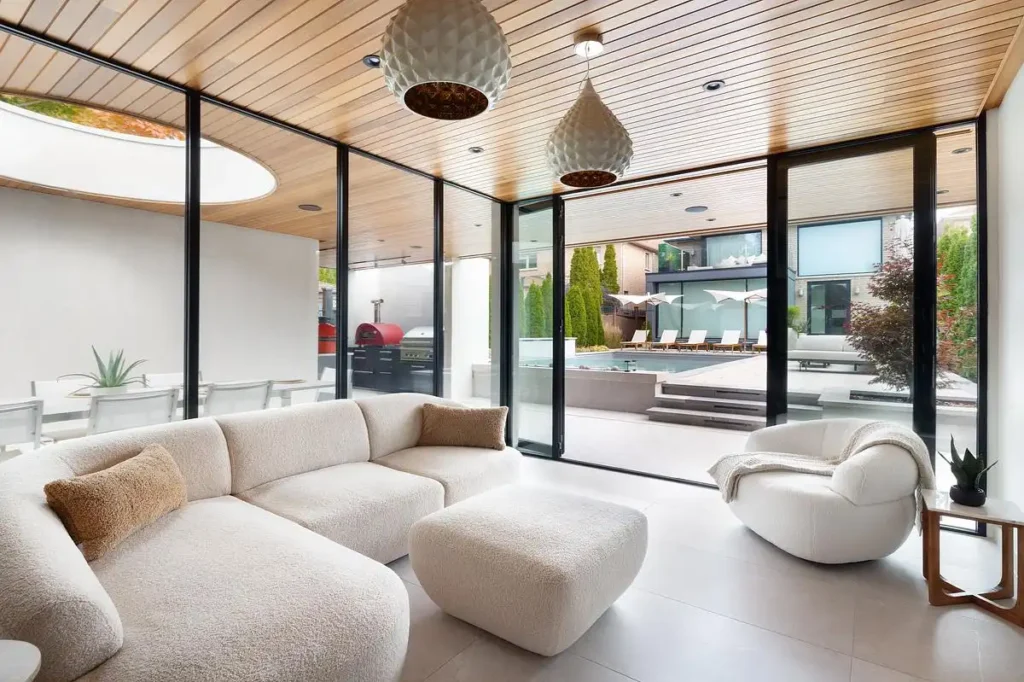
- Enclosed Living Room: On one side, a glass enclosed, climate controlled lounge offers comfort during colder months. This space easily converts for movie nights or extended conversations. It effectively eliminates the traditional boundary between indoors and outdoors.
- Support Services: Behind the central dining zone, necessary service spaces like restrooms and changing rooms are discreetly arranged. This ensures a fluid flow of movement and preserves the visual serenity of the location.
Key Materials and Technologies:
To achieve the desired sense of solidity and calm, the construction relied on a deliberate contrast between two primary materials:
- Floors and Walls: The team used Porcelain, making up approximately 60% to 70% of the visible exterior surface. This conveys a carved mass that subtly changes with the light.
- Soffit Ceiling: The exterior ceiling was clad in wood (primarily cedar), covering 30% to 40% of the upper plane. This material wraps the space in warmth and softness. It effectively balances the stone-like solidity below.
The entire process required meticulous regulatory planning, which lasted several months. A full year of construction followed this phase. The effort resulted in a Backyard Sanctuary that transcends its function. It elevates a standard outdoor area into an architectural location characterized by a quiet, profound presence.

✦ Editorial View from ArchUp
The discussion surrounding Cabana 18 must move beyond merely viewing it as a sophisticated recreational addition. The description eloquently highlights how FrankFranco Architects utilized the earth-sinking process as a powerful tool to achieve visual tranquility and contextual anchoring for the project. However, we must question the authenticity of this anchoring within a typical suburban environment. The regulatory costs and the full year of construction for a 1,000 sq ft facility raise concerns about the replicability of this model within a broader ethical context. This reminds us of the risk of architecture becoming a luxury commodity promoted by trade names like Ciot Vaughan . Nevertheless, the experiential clarity the circular oculus creates and the management of light deserve documentation as a lesson in enriching the residential experience. This model might set a new standard for auxiliary structures in the suburbs, compelling municipalities to re evaluate their regulations within the next decade.


ArchUp: Structural & Material Analysis of Cabana 18 (The Backyard Retreat) in Vancouver
This article examines the Cabana 18 residential addition in Vancouver as a case study in contextually integrated architecture that harmonizes with the terrain. To enhance its archival value, we present the following key technical and structural data:
The structural system employs a “sunken construction” approach to integrate the building horizontally with the site’s 15% slope. The structure rises only 3.5 meters above ground, featuring a central circular oculus 2.5 meters in diameter as a primary source of natural light and ventilation. The total area is 1,000 square feet (93 m²), organized into three distinct functional zones.
The material expression is characterized by extensive use of large-format porcelain slabs (60-70% of surfaces) measuring 120×240 cm for exterior walls and flooring, complemented by cedar wood cladding (30-40%) on the ceilings. The design achieves complete visual integration through full-height glass walls that separate the three functional areas while maintaining a sense of openness.
Regarding functional performance, the retreat provides a fully-equipped outdoor kitchen, a thermally insulated glass-enclosed living space (with a U-value of 1.2 W/m²K), and concealed support services. The construction phase lasted 12 months, following several months of meticulous planning. The design ensures seamless circulation between all areas via continuous porcelain flooring.
Related Link: Please refer to this article for a comparison of techniques integrating auxiliary buildings with terrain:
Terrain-Integrated Architecture: Horizontal Construction & Sunken Building Techniques
https://archup.net/casa-ouro-velho-architecture/