
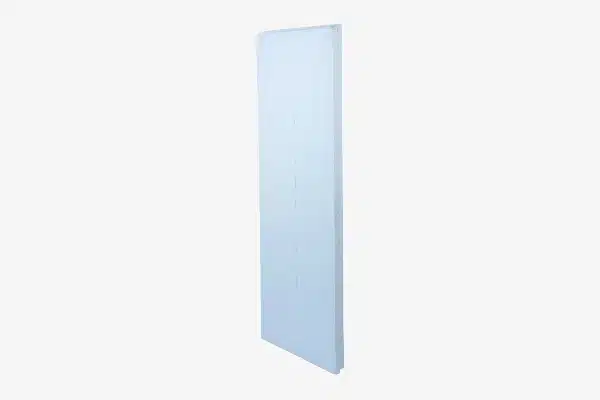
Blue Insulation Foam Board

Home » Building Materials » Material Datasheets » Blue Insulation Foam Board

Overview

Blue insulation foam board is a rigid, closed-cell extruded polystyrene (XPS) sheet used for thermal insulation in building and construction. Known for its high compressive strength and moisture resistance, it is widely applied in walls, roofs, foundations, and floor systems to enhance energy efficiency and control thermal bridging.


Main Uses

  • Thermal insulation for walls, roofs, and floors
  • Insulation for foundations and basements
  • Under-concrete slab insulation
  • Cold storage facilities and refrigerated rooms
  • Noise reduction in partitions and wall systems
  • Protection of waterproofing layers in foundations

Technical Specifications

PropertyValue
MaterialExtruded Polystyrene (XPS)
ColorBlue
Thickness Range2 cm to 10 cm
Standard Dimensions120 cm x 60 cm / 240 cm x 60 cm
Density30–38 kg/m³
Thermal Conductivity0.028–0.034 W/m·K
Compressive Strength250–500 kPa (varies by grade)
Water Absorption<0.5%
Fire ResistanceLimited (requires protection layer)
Temperature Resistance-50°C to +75°C

Advantages

  • Excellent thermal insulation performance
  • Lightweight and easy to handle
  • Low water absorption and high moisture resistance
  • High compressive strength for load-bearing applications
  • Resistant to mold, bacteria, and aging
  • Easy to cut and shape with tools

Application Cases

  • Used in exterior wall insulation systems (EIFS)
  • Installed beneath concrete floor slabs in residential buildings
  • Thermal envelope in prefab modular structures
  • Backfilling protection for foundation walls
  • Insulating industrial refrigeration panels

Installation Tips

  • Ensure surface is level and clean
  • Cut boards with a utility knife or hot wire tool
  • Fix with adhesive or mechanical fasteners as required
  • Seal gaps with foam sealant to eliminate thermal bridges
  • Cover with protective layers if exposed to sunlight or fire risk

Further Reading from ArchUp

  • RC1 Bituminous Waterproofing Primer

    Overview RC1 is a liquid bituminous waterproofing primer used as a preparatory coat before applying bituminous membranes or asphalt-based waterproofing systems. It enhances adhesion, seals porous surfaces, and ensures a more effective waterproofing application. Main Uses Technical Specifications Property Value…

  • Bahraini Ordinary Cement

    Overview Bahraini Ordinary Cement is a general-purpose cement widely used in construction projects. It is ideal for various applications, including residential, commercial, and industrial construction. Its properties make it suitable for general concrete production, and it ensures strength and durability…

  • Broken Marble Sole Tile

    General Description Broken marble sole tiles, or “نعله بلاط كسر رخام,” are flooring materials made by incorporating crushed marble particles into a base material like cement. These tiles offer a unique blend of durability and elegance, making them a popular…

  • Steel Flooring Mesh

    Overview Steel flooring mesh is a reinforcing material used in construction to enhance the strength and durability of concrete floors. It prevents cracking, improves load distribution, and increases structural integrity. Why Use Steel Flooring Mesh? Common Uses Specifications Property Value…

  • Waterproofing Primer

    Overview A waterproofing primer is a preparatory coating applied before the main waterproofing layer. It enhances adhesion between the surface (such as concrete or masonry) and the waterproofing membrane or coating. Primers ensure better penetration, sealing, and durability of the…

  • Aluminum Cover

    Overview An aluminum cover is a protective layer made from lightweight, corrosion-resistant aluminum. It is commonly used in construction, automotive, and industrial applications due to its durability, flexibility, and resistance to environmental factors. Why Use an Aluminum Cover? Common Uses…

Leave a Reply

Your email address will not be published. Required fields are marked *