
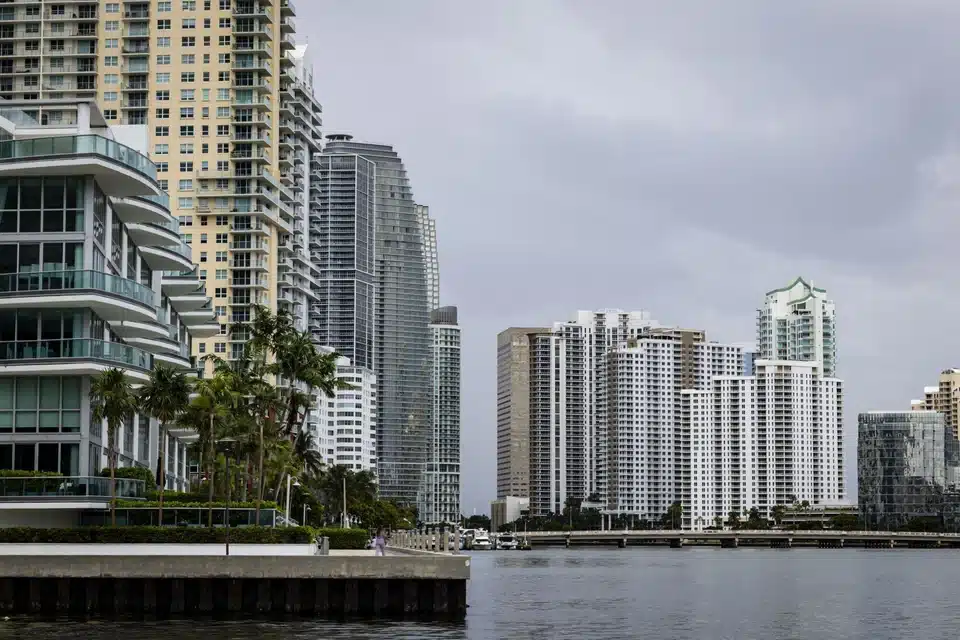
Record $520 Million Waterfront Deal in Miami Brickell District

Oak Row Equities and Vlad Doronin’s OKO Group have completed a record-breaking $520 million acquisition of an Aimco-owned waterfront assemblage in Brickell, Miami, according to a report by The Real Deal.
Property Overview
The deal covers a 4.24-acre site comprising the 32-story Brickell Bay Office Tower at 1001 Brickell Bay Drive and the adjacent 31-story, 357-unit Yacht Club Apartments at 1111 Brickell Bay Drive. Mariposa Real Estate partnered in the acquisition.
The transaction equates to approximately $122.4 million per acre, marking the most expensive development site sale in South Florida to date.
Financing Structure
Tyko Capital, a joint venture between debt broker Adi Chugh and Elliott Investment Management, founded by billionaire Paul Singer, provided a $464.5 million senior loan for the purchase and predevelopment. The financing was arranged by Walker & Dunlop, led by Dustin Stolly and Aaron Appel.
Development Plans
The buyers plan to develop a luxury hotel and branded residential condominiums in the project’s first phase, adding to the growing pipeline of branded residences across South Florida.

According to Knight Frank and Savills, the tri-county region is the epicenter of branded residential development in North America, with Miami hosting 48 completed and 55 planned branded projects, second only to Dubai globally.
Market Context
Denver-based Aimco had initially listed the properties last year with an asking price of around $650 million. The sale follows the company’s recent announcement of a voluntary liquidation, amid a slowdown in the multifamily housing market, as it continues to divest assets nationwide.
✦ ArchUp Editorial Insight
The record acquisition of a waterfront assemblage in Brickell underscores Miami’s position within Contemporary luxury development, blending large-scale urban redevelopment with elements of adaptive reuse. The existing office and residential towers are treated less as fixed architectural artifacts and more as strategic placeholders within a high-value urban fabric increasingly shaped by branded residences and hospitality-driven density. Material expression here is secondary to location and capital intensity, privileging skyline impact and waterfront proximity over contextual continuity. However, this model raises critical questions of contextual relevance and functional resilience, particularly as branded residential typologies risk prioritizing global investment appeal over local housing balance amid a slowing multifamily market. Yet, the transaction also reveals an architectural ambition rooted in repositioning Miami as a global node for luxury urban living, where financial structures and spatial dynamics increasingly define the city’s future form.





ArchUp: Technical Analysis of the Record-Breaking Brickell Waterfront Deal in Miami
This article provides a technical analysis of the Brickell waterfront acquisition deal as a case study in massive real estate investment and luxury waterfront development. To enhance archival value, we present the following key technical and design data:
The deal was valued at $520 million, making it the most expensive sale of a development site in South Florida’s history. The transaction included a 4.24-acre (approximately 17,160 square meter) plot containing the 32-story Brickell Bay Office Tower and the 31-story Yacht Club residential complex (357 units). The average land price reached $122.4 million per acre, reflecting the premium value of the prime waterfront location on Biscayne Bay.
The deal structure involved a $464.5 million senior loan provided through a partnership between Tyko Capital and Paul Singer’s Elliott Investment Management. The plan includes developing a luxury hotel and branded residential units in the initial phase, aligning with Miami’s trend as a leading hub for branded residences in North America, with the city currently home to 48 completed and 55 planned projects of this type.
In terms of market impact and urban development, this transaction sets a new benchmark for waterfront land value in Miami. The development occurs as part of a voluntary asset liquidation by the seller, Aimco, reflecting shifts in the multi-family property market. The deal contributes to further transforming Brickell into a mixed-use district combining luxury residences, offices, and hospitality, enhancing the area’s urban density and vibrancy.
Related Link: Please refer to this article for an analysis of investment trends in luxury real estate and hospitality:
Real Estate Transactions in Dubai Exceed 22 Billion Dirhams in a Week
https://archup.net/dubai-real-estate-boom-and-urban-expansion/