

Bumi Pakubuwono: When Earth Becomes Architecture – A New Vision for Adaptive Reuse

Introduction: Beyond Renovation to Re-Establishment
In a world of rapid urbanization, a fundamental question arises: how can we reimagine our existing buildings to become an organic part of the ecological and human fabric? The “Bumi Pakubuwono” project in Indonesia is not merely a renovation of an old office building but an ambitious answer to this question, transforming it into a creative lifestyle compound. This project redefines the relationship between the building, its users, and nature, based on a deep design philosophy that draws inspiration from the fundamental elements of the earth to create spaces where nature is not just a decoration, but an intrinsic component of the architecture itself.
Design Philosophy: Architecture in the Language of the Earth
The project’s creative vision is built on the concept of “Earth’s Elements,” where these elements are used not only as building materials but as a fundamental guide for the sensory experience and movement within the space.
· Water: Flow and Calm
The element of water is manifested in a design characterized by fluidity and continuity. The pathways are not designed as rigid straight lines but flow like a stream, directing the movement of visitors and occupants in a natural way that encourages exploration and transition. In contrast, reflective pools create intentional moments for meditation and calm, providing a dynamic balance between movement and stillness within the project.
· Plants: Life and Boundary Dissolution
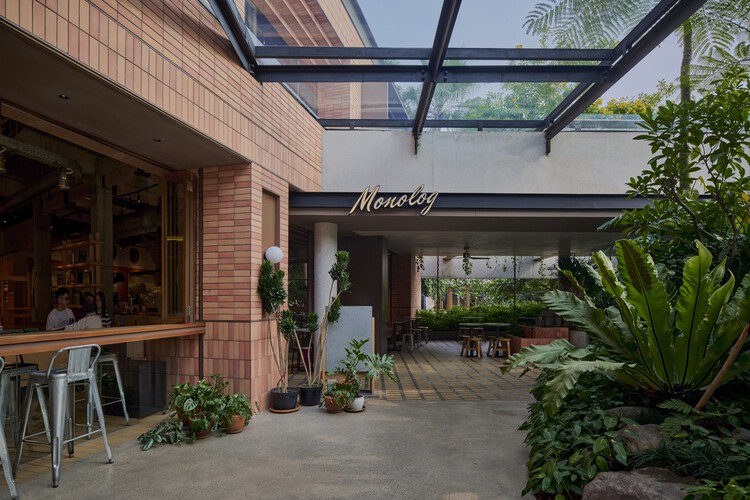
The element of plants acts as a soft design tool that dissolves traditional barriers. Green spaces are spread to function as soft thresholds between inside and outside, where plants hang and climb to soften the architectural mass. This integration not only enhances visual aesthetics but also contributes to creating a micro-ecosystem that improves air quality, regulates humidity, and provides a habitat for local biodiversity.
· Stone and Brick: Authenticity and Sensory Connection
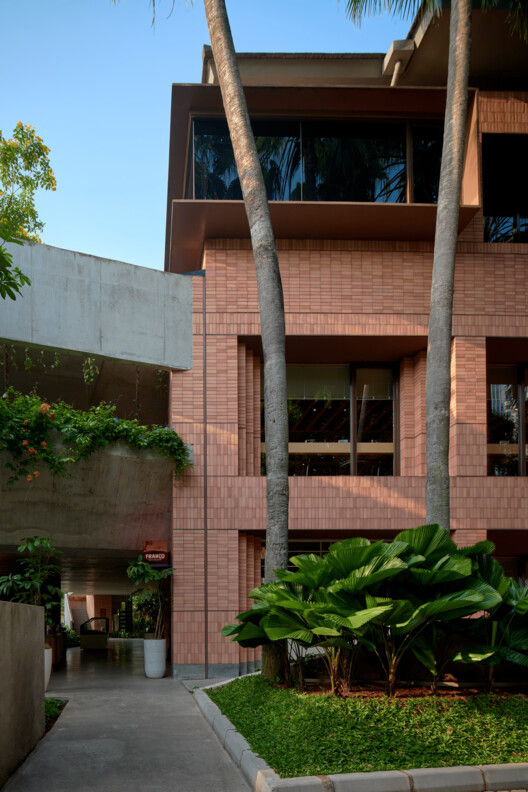
Stone and brick represent the project’s roots and authenticity. The stone provides a sense of permanence and grounding, visually connecting the structure to the earth it stands on. The brick, especially if handcrafted, adds a human warmth and celebrates the artisan’s touch, reminding us that architecture is a dialogue between nature and human, thereby enhancing users’ direct sensory connection with their built environment.
· Soil and Grass: Growth and Cooling
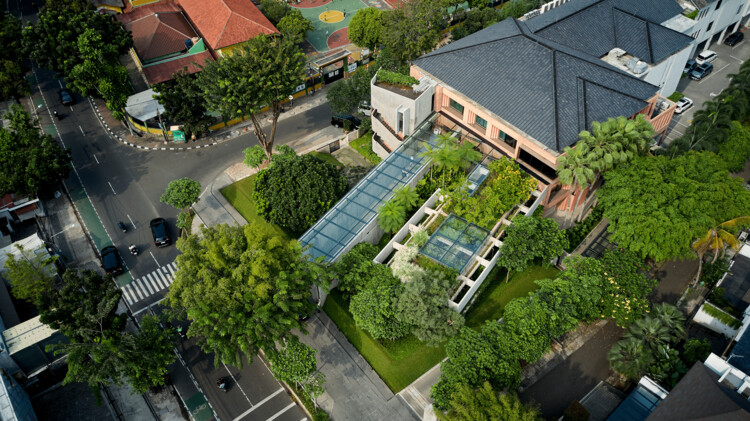
Soil is transformed from mere ground into a medium for life and growth. The building’s roofs and terraces become productive gardens that support plant life and enhance thermal insulation. Simultaneously, the grass acts as a living carpet covering outdoor common spaces, effectively contributing to lowering the ambient temperature through evaporative cooling and softening the project’s microclimate.
Architectural Solutions: Aligning Challenges with Opportunities
The design faced a key challenge: the original building’s low-lying location, set back about 35 meters from the main road. Instead of seeing this as an obstacle, it was turned into an opportunity to create a unique arrival experience.
· The Bridge-Promenade: An Immersive Reconnection with Nature
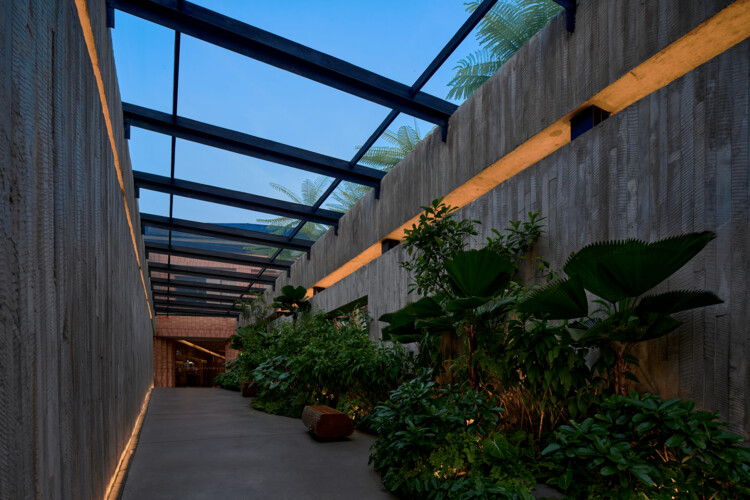
The solution was not a conventional bridge but a green elevated passageway four meters wide. This structure does not only serve as a circulation path; it is an immersive tropical walkway where plants and gardens surround pedestrians, transforming the journey of arrival from an ordinary action into a sensory experience that places the visitor in the heart of nature from the very first moment.
· Extending Activity Towards the Street
To enhance connection with the surrounding neighborhood, the design extended towards the main road by creating outdoor seating areas. The remarkable feature of these areas is that they are shaded by rooftop gardens, which provides significant thermal comfort for users and reduces heat gain for the building, all while encouraging community interaction and creating a vibrant, lively facade towards the city.
Sustainability: Architecture Enlightened by Nature
The project’s approach to sustainability goes beyond complex technologies to adopt intelligent passive solutions. By maximizing natural light and cross-ventilation, the design significantly reduces reliance on artificial systems for lighting and cooling. This not only creates a healthier indoor environment for occupants but also reduces the project’s carbon footprint, making it a model for environmentally enlightened architecture that respects our planet’s resources.
Conclusion: A Model for the Future
Bumi Pakubuwono is more than an architectural project; it is a statement. It proves that the future of urban development does not necessarily lie in new construction, but in the radical rethinking of what we already have. By embedding the language of the earth into its fabric, this project creates not only functional spaces but restorative places that ground people in their location, deepen their connection to nature, and meaningfully enrich the fabric of their daily lives, offering a lasting legacy of architecture that serves both humanity and the environment.
✦ ArchUp Editorial Insight
The article focuses on converting an existing office building into a creative compound through a design philosophy inspired by natural elements, aiming to reconnect architecture with humans and the environment. The evaluation reveals that the design concept, while theoretically coherent, sometimes appears applied as a set of prescribed metaphors rather than organically emerging from the site’s specific requirements and function, potentially creating a gap between the conceived and the felt experience. The project relies heavily on greenery and natural ventilation for thermal comfort, which may be insufficient in harsh climatic conditions, raising questions about its year-round effectiveness without intensive support from artificial cooling systems during peak times. However, the treatment of the building’s street isolation via a bridge-promenade dense with plants remains a practical and intelligent response, turning a site-specific disadvantage into an opportunity to create a unique and engaging arrival sequence.
Brought to you by the ArchUp Editorial Team
Inspiration starts here. Dive deeper into Architecture, Interior Design, Research, Cities, Design, and cutting-edge Projectson ArchUp.


