Canada Pavilion at Venice Architecture Biennale


Experimental structures that challenge the meaning of architecture
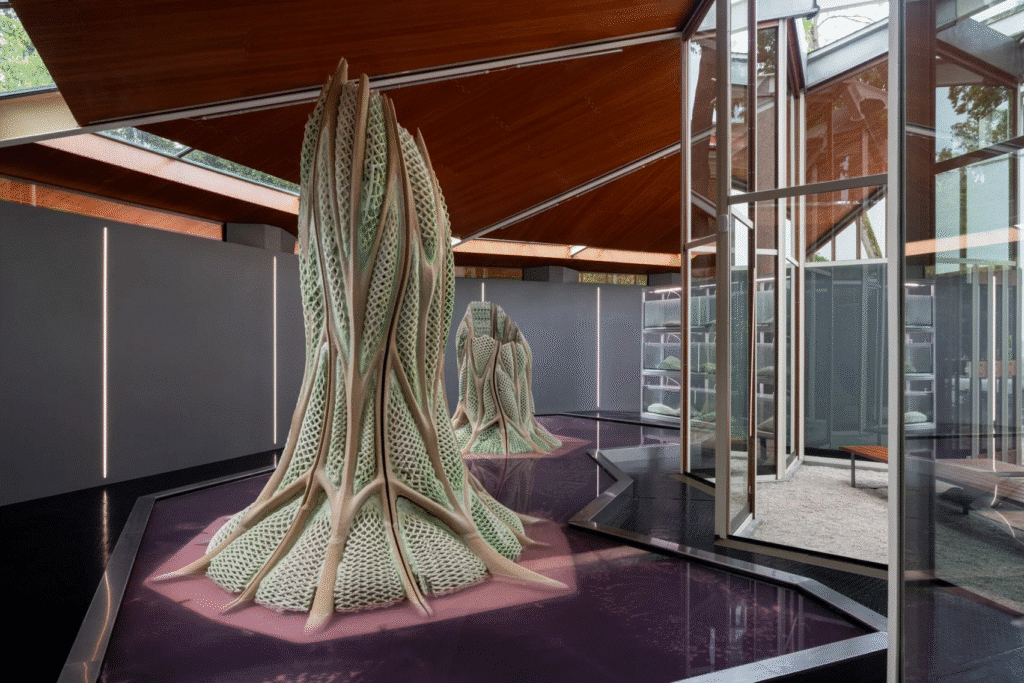
At this year’s Venice Architecture Biennale, the Canada Pavilion hosts a strikingly unorthodox installation titled Picoplanktonics, created by the interdisciplinary group Living Room Collective. These bizarre, alien-like towers emerge from shallow pools, coated in living cyanobacteria that actively sequester carbon from the atmosphere.
But beyond the novelty of bacterial skins and underwater aesthetics, Picoplanktonics raises a deeper question: What if architecture wasn’t built for us first? What if it served the planet instead?
Follow all bold ideas, trends, and updates from the world of architectural content on ArchUp.
Architecture That Grows… Slowly, and With Purpose
The bio-integrated forms—3D-printed using expanded glass and filled with a lattice to host the bacteria—were not designed to house people, but to nurture life and sequester carbon. By combining photosynthesis and biocementation, the cyanobacteria pull carbon from the air and transform it into stable mineral form.
The process is intentionally slow. As Clayton Lee from Living Room Collective notes, “the impact won’t be visible for decades, maybe centuries.” And that’s precisely the point: It’s architecture as a long-term planetary investment—not a consumer product.
An Architecture That Doesn’t Prioritize Humans
Picoplanktonics turns the logic of architecture upside down. It’s not about efficiency, cost-effectiveness, or speed—values typically prized in the construction industry. Instead, it’s a provocation, one that challenges the architectural profession to consider its responsibility toward the planet’s survival, not just human comfort.
The structures don’t respond to trends or aesthetics; they respond to climate conditions, to chemistry, to life cycles. This is architecture not as a static object, but as a living system, co-evolving with its environment.
Temporal Design: Across Decades, Not Months
When a tree dies, its carbon is eventually released back into the atmosphere. But the cyanobacteria used here mineralize carbon permanently—a key difference in climate-positive design. The structures are deliberately high-surface, to expose more bacteria to air and light, and they depend on specific levels of humidity and salt content to thrive.
What does this imply for the future of building? Perhaps façades that breathe, exteriors that shift color and texture with growth, and architecture that is as impermanent as it is regenerative.
More on ArchUp:
Beyond Sculpture: Toward a Radical Shift in Thinking
Despite their alien forms, these structures are not just installations. They are prototypes for how architecture could evolve to be both reactive and restorative. However, to become viable, this approach would demand a fundamental shift in urban living, from expectations of permanence and convenience to embracing fragility, slowness, and care.
Lee acknowledges that the current iteration isn’t “ready” for use—but insists the urgency is real. “It’s not fit for use for 10 years,” he jokes, “but actually, we feel urgent about this.”
Conclusion: The Death of Architecture-as-Object?
The Canada Pavilion doesn’t present buildings; it presents ecosystems in progress. In doing so, it critiques a profession obsessed with form, function, and spectacle. It dares to ask: Can we design for the planet’s timeline instead of our own?
With Picoplanktonics, Living Room Collective doesn’t just suggest new forms. They propose a new ethic, where human architecture no longer extracts, but contributes—slowly, humbly, and biologically.

Photos: Valentina Mori