

Coastal Skatepark in Qinhuangdao Redefines Public Safety

Coastal Skatepark structures public safety in the newly built 15,000 square meter facility at phase nine of Aranya, Qinhuangdao.
It operates as open civic infrastructure.
No perimeter fencing is used.
Spatial clarity replaces physical barriers.
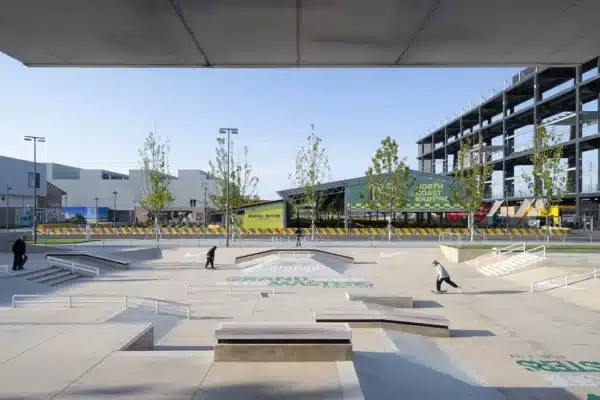
Oversight Through Layout
Skate zones radiate from a central lawn the Green Heart.
This radial plan eliminates blind spots.
Users see and are seen at all times.
The approach aligns with urban planning that embeds safety in form.
Good public space allows people to see and be seen safety emerges from presence, not walls.

Materials That Reduce Risk
Ramps use raw concrete shaped as landforms.
Earthy grays and muted coral tones echo the North Coast.
Tree canopies diffuse light without deep shadows.
These choices support Public Safety through visual legibility, drawing on regional building materials strategies.
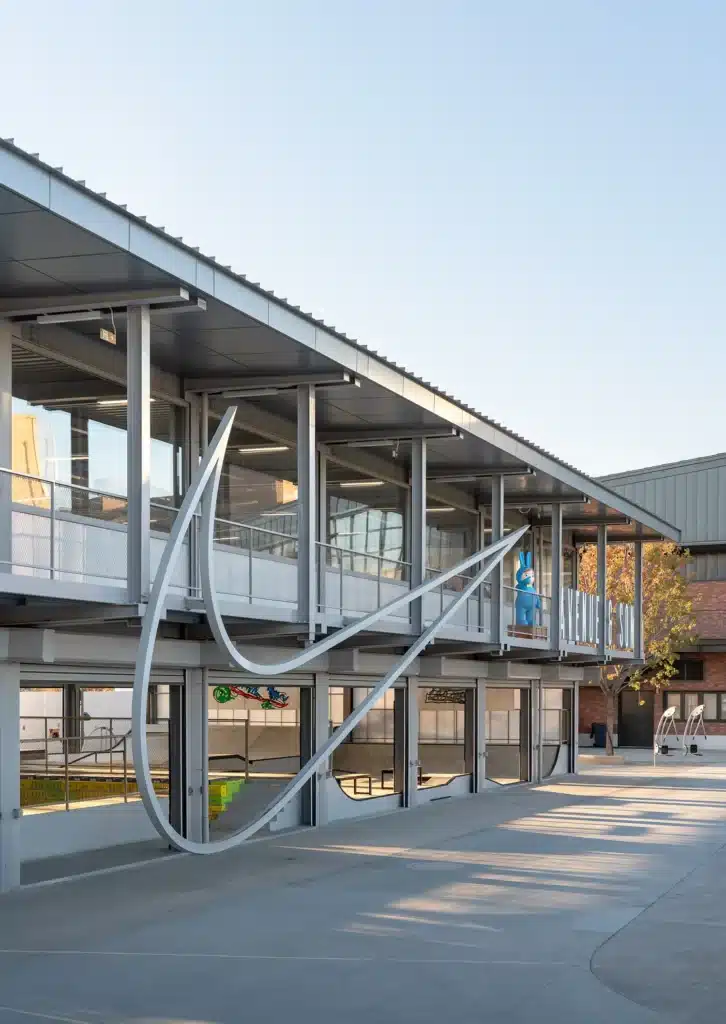
Operable Boundaries
Roll up fireproof shutters replace fixed walls indoors.
They open for ventilation and close securely at night.
A lightweight steel pavilion hosts training and events.
This shows how Public Safety integrates with flexible use.
Flexibility should never mean vulnerability. Design must anticipate both use and misuse.

Social Presence as Deterrence
Skaters, spectators, and neighbors share views of the Green Heart.
No activity occurs in isolation.
Continuous occupation deters misuse organically.
This frames Public Safety as a social outcome.
The project appears in the global archive as a model of inclusive recreation.
Operable thresholds manage high energy use without surveillance.
Interior design logic scales to the urban level.
Even construction details encode oversight through slope, surface, and sequence.
Design that invites people in rarely needs to lock others out.
Architectural Snapshot: The Aranya Coastal Skatepark in Qinhuangdao embeds Public Safety through radial planning, honest materials, and operable boundaries proving that openness and control can coexist without fences or cameras.
✦ ArchUp Editorial Insight
The article presents Qinhuangdao’s coastal skatepark as a model where public safety emerges from design, not surveillance.
It credits spatial clarity, social presence, and operable thresholds as substitutes for fences and cameras.
This is compelling in theory.
But it assumes steady use and upkeep rare in most public spaces.
Still, framing safety as a social outcome, not a technical fix, is a rare shift.
Most projects default to gates, guards, or cameras.
This one trusts layout and community.
That’s bold and possibly fragile.
In an era of over securitized urbanism, such restraint stands out.
It may not last everywhere.
But where it works, it could outlive reactive fortification.



