Drammen River Park: Rail Yard Redevelopment in Norway

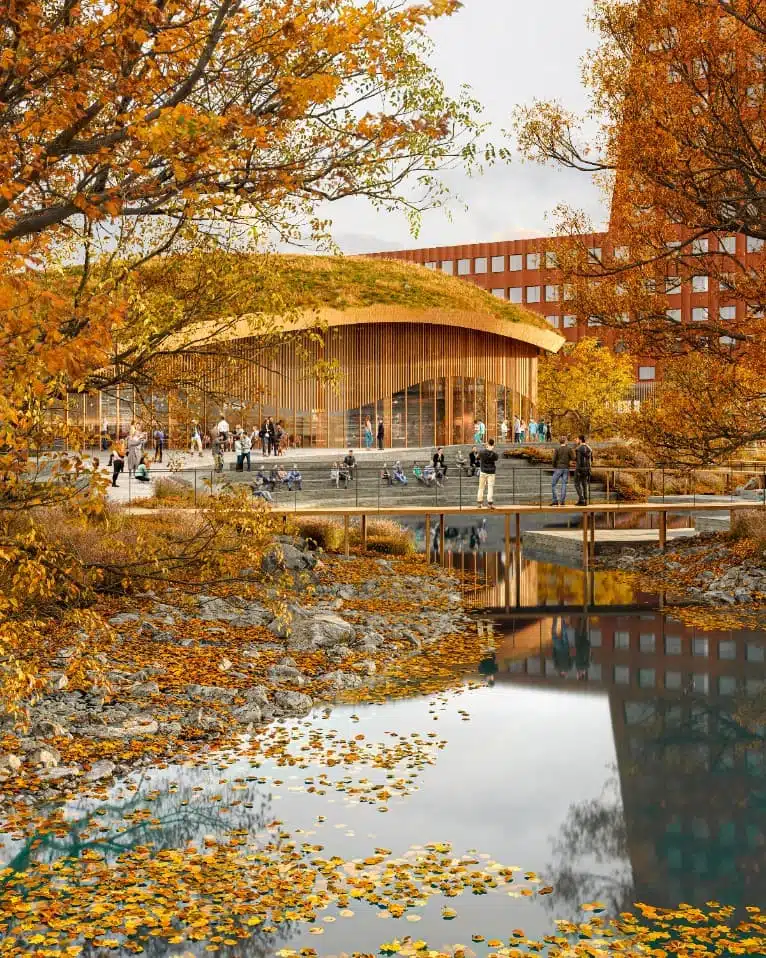
Drammen River Park converts a disused rail yard north of Drammen Station into public space that reconnects the city with the Drammenselva River.
The project won an international design competition and boosts green coverage from 4% to 70%.

Restoring Hydrological Memory
Industrialization straightened the river and replaced soft banks with hard edges.
The new design reintroduces islands and gradual transitions to support biodiversity.
It treats water as spatial infrastructure a core principle in resilient cities planning.
The river park reframes infrastructure not as a barrier, but as a living interface between city and nature.

Three Civic Functions
The brief demanded three urban contributions.
First: direct river access with room for bathing, saunas, kayaking, and an outdoor amphitheater.
Second: a flexible gathering place for all ages, shaped by informal seating and multiple entry points.
Third: a new landmark tower that minimizes ground use while maximizing spatial quality.
Drammen River Park integrates these through adaptive reuse.
Existing structures supply brick flooring, reconfigured windows, and repurposed metal panels demonstrating circular logic in building materials.

Climate-Responsive Infrastructure
Permeable surfaces, native plants, and organic landforms manage floods, heat, and wind.
Greywater and excess heat from performance spaces feed building systems.
This operational approach embeds sustainability into function, not form.
Unlike symbolic parks, Drammen River Park treats every surface as both ecological asset and social platform.
It avoids spectacle in favor of layered utility.
Post-industrial voids rarely become civic assets without historical erasure.
Post-industrial voids rarely become civic assets without historical erasure.
Drammen River Park proves they can by retaining memory, enabling access, and prioritizing resilience over image.
Architectural Snapshot
The river park reframes infrastructure not as a barrier, but as a living interface between city and nature.

✦ ArchUp Editorial Insight
Drammen River Park results from abandoned industrial land.
Civic demand drives multifunctional space.
Policies favor environmental resilience.
Mobility patterns show informal river access.
Financing prefers reuse over demolition.
Regulations enforce public access and flood management.
Operations focus on performance, bathing, and gatherings.
Existing structures guide material choices.
Watercourses shape landforms.
Architecture appears as layered surfaces.
Edges are restructured to match use.
Ecological function aligns with civic engagement.