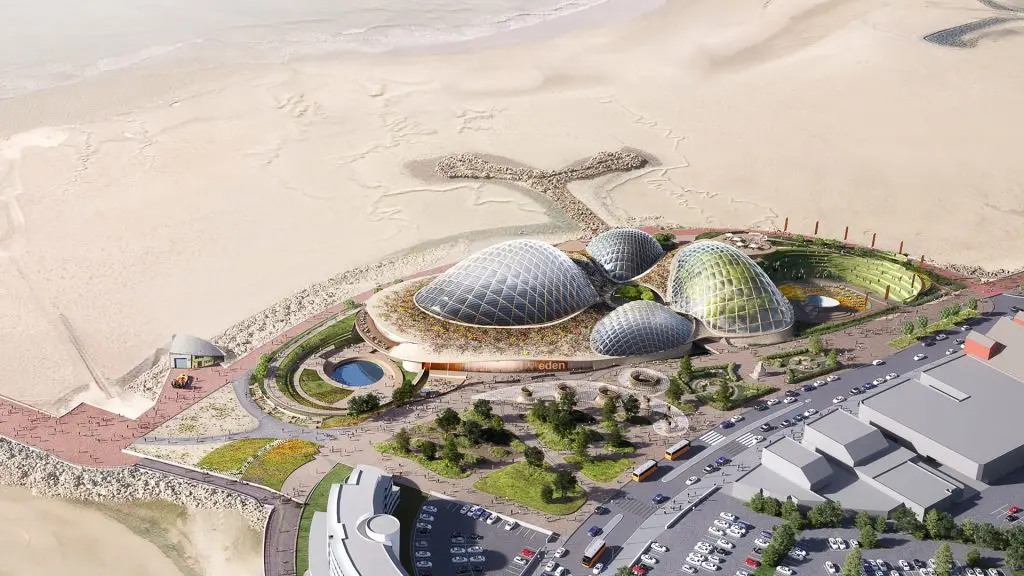
Scaled-Down Eden Project Morecambe Gets Green Light for 2028 Opening

A revised coastal attraction in Lancashire has received planning approval, marking a significant milestone for the seaside regeneration effort. The project now moves forward with a smaller footprint and updated timeline.
Planning Approval Confirms New Direction
Lancaster City Council approved the modified design on February 16, 2026. This follows an earlier approval in 2022 for a larger version. However, economic challenges and inflation prompted a strategic recalibration last year. Consequently, the total cost dropped to £100 million. Construction work should begin this year. Moreover, the anticipated opening is now set for late 2028.
Revised Design Reduces Scale Significantly
The architectural design now features two domes instead of four. The internal area decreased from 185,000 square feet to 91,500 square feet. Additionally, the main dome height dropped to 37.3 meters. The two remaining structures include Realm of the Sun at 41,700 square feet and Realm of the Moon at 18,300 square feet.

A connecting entrance space called the Metronome covers 7,750 square feet. Meanwhile, outdoor gardens expanded to accommodate events and seasonal activities. The Rhythm and All Seasons gardens will host various public gatherings.
Economic Impact and Visitor Projections
The Eden Project Morecambe expects 585,000 annual visitors. This represents a decrease from the original one million projection. Therefore, the infrastructure requirements are less demanding. The site will not need major transport upgrades.
The project previously secured £50 million in public funding. It aims to create employment opportunities and revitalize the Lancashire coast. Furthermore, a special garden will debut at a major flower exhibition this year.
Site History and Location
The 11-acre site previously housed a seaside entertainment center on the Morecambe waterfront. This news confirms the transformation of an underutilized coastal area. The Eden Project Morecambe represents a branch of the famous Cornwall attraction.

Project leaders addressed public concerns about the changes. They emphasized improved efficiency and environmental performance. The scaled-down approach prioritizes sustainability and long-term viability over ambitious sizing.
Looking Ahead
This approval opens a new chapter for coastal urban planning in northwest England. The Eden Project Morecambe could serve as a model for future seaside regeneration efforts.
What role should scaled attractions play in reviving coastal communities?
A Quick Architectural Snapshot
The Eden Project Morecambe sits on an 11-acre waterfront site in Lancashire, England. It features two biome domes reaching 37.3 meters in height. The total internal space covers 91,500 square feet. Outdoor gardens and a 7,750 square foot entrance pavilion complete the coastal attraction designed for late 2028 completion.
✦ ArchUp Editorial Insight
A public attraction originally scaled for one million visitors loses nearly half its program and 60% of its interior space before a single foundation is poured. The sequence is predictable. Public funding secures early political commitment. Inflation erodes feasibility. Strategic recalibration replaces ambition with survivability. The architectural outcome, two domes instead of four, is not a design revision. It is a fiscal correction expressed in built form.
The reduced visitor projection eliminates the need for transport upgrades. This is presented as an advantage. It is also an admission that regional infrastructure investment was never guaranteed. When attraction scale must conform to existing road capacity rather than drive new connectivity, the project serves the system rather than challenging it.
Coastal regeneration projects that shrink before construction begins reveal a recurring pattern: public aspiration outpacing institutional commitment.