Engineering Facts about Buggy Bridge


,Engineering Facts about Buggy Bridge
Buggy Bridge one of the most unusual bridges in Ontario and possibly beyond,
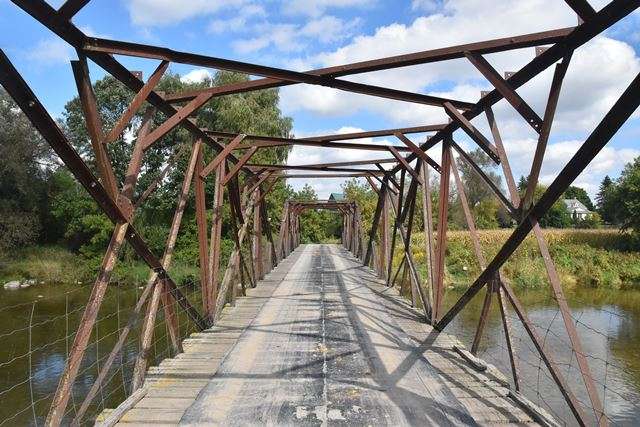
Buggy Bridge is a bridge grouped together, seemingly haphazardly without the need for engineering of any kind.
Made of steel extracted from riveted masonry, the bridge consists of two girders spanning at the southern end,
and two through truss spans at the northern end.
It’s hard to call this bridge a ‘heritage bridge‘, however it’s made of old materials and a truly unique structure,
it undoubtedly instills great fear into any architect.
The girder girders consisted of profiled girders with rivet connections to various girders,
most of which were removed when the girders were salvaged.
The bridge’s configuration is truly unusual, with each girder in the span itself consisting of two girders (of different size and design),
welded together in a chaotic manner from mid-span plate pits.
Moreover, in every period, the design and size of the crossbar does not always match the design on the other side of the road.
The span of the two beams is less important,
as the spans of the masonry trusses appear to consist of the salvaged roof trusses.
The roof trusses were made entirely of rivets, but were welded together to assemble the truss bridge,
so due to the random way in which these trusses were brought together to form the span of the bridge,
these trusses did not correspond to any known truss configuration.
Engineering Facts about Buggy Bridge
The origin and ownership of the bridge is also unknown, although there are no signs prohibiting use,
a “dead end” sign appears next to the last lane before the bridge.
This indicates that public or governmental ownership ends at this point,
and beyond the dead-end road sign, the road and bridge may not be owned by the government.
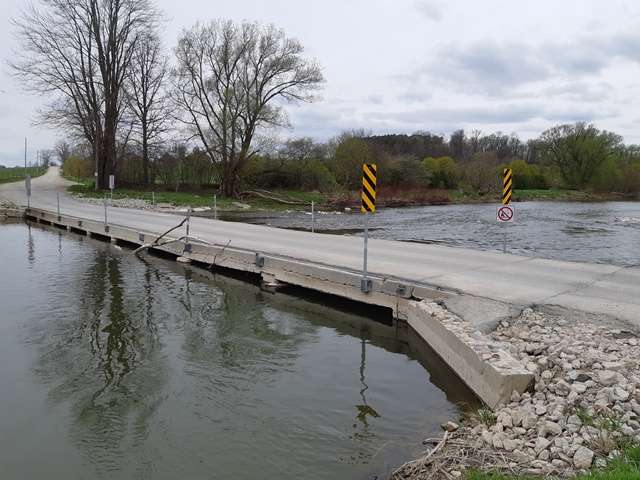
The local Mennonite community is known for building low-budget crossings
(the most famous of which is a low-water, near-concrete crossing called the Mennonite Bridge),
which may have been built and maintained by them.
This extremely rare example of a low-water crossing in Ontario is also unique in that it was designed and built by the local Mennonite community.
A low water crossing is a type of bridge located close to the water level and is designed to allow water to flow over the surface at times of high water.
As such, lower water crossings usually do not have handrails.
It seems that the entry of the heritage bridge stock for this bridge indicates that this bridge is shorter and spans fewer distances than what actually exists.