

- This event has passed.
Cao Fei: Dash
April 9 @ 8:00 am - September 28 @ 5:00 pm
Overview
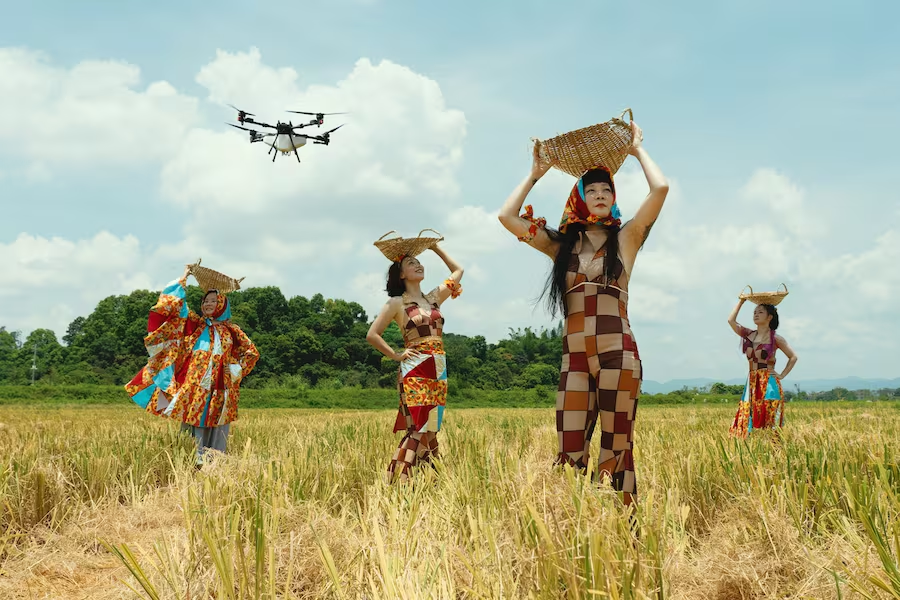
Fondazione Prada presents “Dash,” a new multimedia project by Chinese artist Cao Fei, at its Milan headquarters from April 9 to September 28, 2026. The exhibition occupies the ground floor and first floor of the Podium, Fondazione Prada’s central exhibition building designed by OMA. It is produced by Fondazione Prada in close collaboration with the artist and represents the culmination of three years of fieldwork across southern and northwestern China and Southeast Asia.
The title refers to the high-frequency sound of a drone in flight: that precise, autonomous buzz of a machine operating at the edge of human grasp. Cao Fei positions this sound as the sonic signature of a technological moment in which the tools of agriculture, and by extension of subsistence itself, are being fundamentally reorganised by automation, artificial intelligence, and remote sensing systems. The exhibition is accompanied by an illustrated catalogue published by Fondazione Prada, with a foreword by Miuccia Prada, a conversation between Cao Fei and Rem Koolhaas, a science fiction story by the artist, and essays by scholars, curators, and experts.
Focus
Dash examines smart agriculture not as a solution to planetary crisis but as a dense field of contradictions, where automation promises efficiency while quietly rewriting labour, memory, and the relationship between humans and land. The exhibition’s conceptual framework is organised around a diagram Cao Fei calls CHT Triad: Cosmos, Human, Technics, which proposes a non-hierarchical relationship in which technology is a co-author of human becoming rather than a tool in human hands.
The project builds on Cao Fei’s two-decade inquiry into technological modernity’s effects on Chinese society, moving from factories and logistics networks (as in “Whose Utopia,” 2006, and “Asia One,” 2018) to agriculture, the oldest and most foundational form of human relationship with land. The shift is not merely thematic. Smart farming is among the most consequential technological transformations of this century, affecting food security, land use, labour markets, ecological systems, and the cultural fabric of rural communities globally, yet it has been almost entirely absent from contemporary art discourse.
Cao Fei’s central provocation is drawn from an observation at a Chinese super farm in 2023: there were virtually no humans in the fields. In their place were drones, autonomous vehicles, and automated irrigation and harvesting systems. That condition, she notes, is not a future projection but an already existing present.
Here, satellite positioning systems converse with ritual geographies; artificial intelligence and traditional experience train one another; historical images and sensor signals generate visual resonance.
Cao Fei, Exhibition Statement, 2026
Exhibition Structure
Ground Floor: The Agricultural Environment
The ground floor constructs a full-scale rural environment inside the Podium. A grain warehouse functions as a cinema screening the eponymous two-channel video “Dash” (47 min.). A temple built from fertilizer sacks houses three-channel video “The Birth,” which documents the everyday reverence farmers across Southeast Asia extend to their agricultural drones, offering flowers, incense, and ceremonies once reserved for rain deities. A new farmer’s training station and a banana plantation surrounded by solar panels, smart agricultural machinery, and autonomous vehicles complete the floor. The installation structures were developed by Small Production; banners and cushions were designed by Xiang Gao.
The temple built from industrial waste packaging is the exhibition’s most precise formal decision: sacred and industrial occupy the same physical object. The videos inside show that this is not ironic or critical from a distance but an accurate description of lived agricultural reality in regions where harvests determine survival.
First Floor: Research and Archive
The first floor shifts from immersive environment to research archive. Documentary films, photographs, propaganda posters from the founding decades of the People’s Republic of China (1949 to 1980s), scientific and educational slides from the Reform and Opening-up era (1978 onwards), and Chinese folk records titled “Busy Farming” situate Cao Fei’s investigation within a broader historical and ideological context.
“Land Ceremony,” which greets visitors on this floor, makes the continuity between ancient ritual and technological present physical: constructed from local Lombard rice and traditional folk materials decorated with drone components, it draws directly on the ancient Chinese “rice dragon” ritual. The argument of the floor is that China’s current investment in agricultural technology is not a rupture from its history but a continuation of it.
Key Works
Catalogue and Conversations
The exhibition catalogue is designed by graphic artist Evi O and published by Fondazione Prada. It includes an introduction by Miuccia Prada; a conversation between Cao Fei and Rem Koolhaas, whose OMA has developed extensive research on countryside since 2012; a science fiction story by Cao Fei; and essays and interviews with scholars, curators, and experts. The Koolhaas conversation is a significant pairing: his countryside research and the broader OMA investigation of rural land transformation provide a direct intellectual counterpart to Cao Fei’s fieldwork methodology.
Audience
The exhibition is open to the general public at Fondazione Prada’s Milan venue. It addresses audiences spanning contemporary art, architecture, design research, technology studies, and agricultural policy. Its five-month run gives it an extended presence in Milan’s cultural calendar, overlapping with the city’s major design and architecture events in spring and summer 2026.
Event Details
| Exhibition Dates | April 9 – September 28, 2026 |
| Venue | Fondazione Prada, Podium (ground and first floors), Largo Isarco 2, Milan 20139, Italy |
| Admission / Fees | Standard Fondazione Prada admission applies — verify current pricing at fondazioneprada.org |
| Artist | Cao Fei (Beijing, China) |
| Represented by | Vitamin Creative Space; Sprüth Magers |
| Produced by | Fondazione Prada |
| Installation Design | Small Production |
| Catalogue Design | Evi O |
| Catalogue Includes | Introduction by Miuccia Prada; conversation between Cao Fei and Rem Koolhaas; science fiction story by Cao Fei; critical essays |
| Research Partner | XAG (agricultural robotics company, China) |
✦ ArchUp Editorial Insight
Dash is architecturally significant not as an exhibition about architecture but as one that takes the transformation of landscape, land use, and the built rural environment as its primary subject. The Podium at Fondazione Prada, itself an OMA building, hosts full-scale reproductions of grain warehouses, temples, and farming stations, creating a space where the built environment and its technological reconfiguration are examined from inside. The Rem Koolhaas catalogue conversation is the clearest signal of this framing: his OMA countryside research and Cao Fei’s agricultural fieldwork share a subject and a methodology, though they arrive from different disciplines. The exhibition’s most honest moment may be the temple built from fertilizer bags, which refuses the comfortable separation between the sacred and the industrial that most cultural institutions maintain. Smart farming is reshaping land at a global scale; the fact that it has taken this long to enter the exhibition space is itself a form of institutional blindness that Dash implicitly names.
Closing Note
Cao Fei has spent three years in fields across China and Southeast Asia to make this exhibition. That investment of time and direct research is visible in the specificity of the work and distinguishes Dash from exhibitions that take technology as a theme without engaging its actual material conditions. Running through September 2026, it is among the most substantively researched solo presentations of the year in Europe, and the most direct engagement with agricultural transformation as a subject for contemporary art practice.
Related Events


Event Data Review Notice: Event information is collected and edited by ArchUp’s human Events Desk. Since 10 September 2026, Archive Data Agent, an AI-assisted verification account operating under the ArchUp Events Desk, has provided a secondary review layer to identify and correct routine human data-entry inconsistencies, including dates, schedules, locations, and currency conversions. Final editorial responsibility remains with ArchUp.