
Architectural Hospitality: Herzog & de Meuron Breathe New Life into Les Trois Rois

Herzog & de Meuron: From Cultural Icons to the World of Hospitality
For over 45 years, Herzog & de Meuron have rarely ventured into hospitality projects, preferring to focus on cultural institutions that have helped shape global architectural consciousness. Among their most iconic works are the Tate Modern in London and the Elbphilharmonie in Hamburg, two projects that reflect the studio’s commitment to architecture deeply rooted in identity and place.
However, the Les Trois Rois hotel in Basel marks a striking exception. According to Jacques Herzog, the firm’s co-founder, this project held deeply personal significance. In an interview with Wallpaper, he shared that he chose to work on it because he lives nearby and enjoys visiting the hotel with his wife. He added:
“It’s a very personal project – and maybe a bit selfish.”
This personal dimension opens the door to a different understanding of the architect’s role when working on a project closely tied to their daily life, not just a distant design challenge.
Les Trois Rois: A History That Cannot Be Contained in a Building
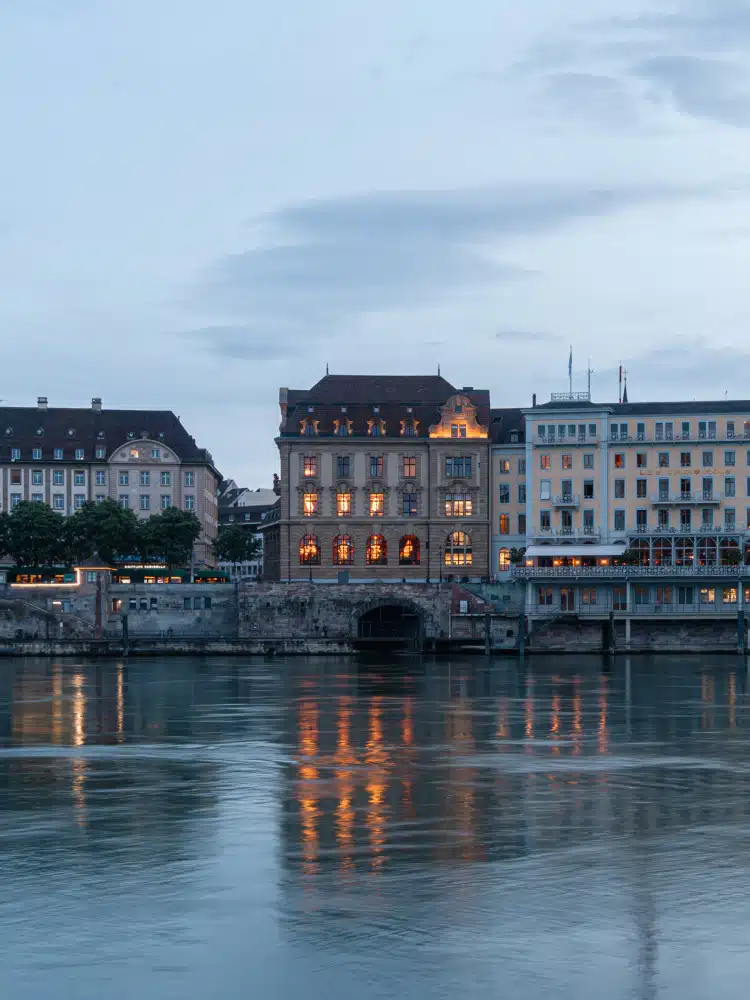
This hotel wasn’t merely a new architectural project for Herzog & de Meuron, it is also a vital part of Basel’s rich history. Established in 1681, Les Trois Rois has witnessed multiple turning points in European history. Notable guests include:
- Napoleon Bonaparte (late 18th century)
- Pablo Picasso
- Voltaire
- James Joyce
- Queen Elizabeth II
These historical associations make the building much more than a hotel, it becomes a living memory that fuses history, art, and architecture.
The City at the Project’s Service: Basel’s Cultural Context
Situated on the banks of the Rhine, the hotel enjoys a prime location that enhances the guest experience, especially in summer, when locals float in the river carrying their belongings in waterproof bags.
This location is also within walking distance of several of the city’s most important cultural landmarks, such as:
- Messe Basel (the convention center), which hosts events like Art Basel and Design Miami Basel
- The Natural History Museum
- The Museum of Cultures
- Kunstmuseum Basel, which houses works by Holbein, Picasso, Rothko, and more. The museum also features a wing designed by Herzog & de Meuron specifically for Rothko’s works.
This geographic proximity reflects the hotel’s harmony with the city’s cultural landscape, giving it a unique character that would be difficult to replicate elsewhere.
Who’s Behind the Design?
Herzog & de Meuron’s Return to Their Roots
In a departure from the large-scale projects that Herzog & de Meuron are typically known for, such as tech headquarters or Olympic stadiums, the Les Trois Rois hotel offered the architects a chance to work on a more intimate and detail-oriented scale.
The hotel is located just a short distance from the firm’s office in Basel, a geographic closeness that allowed the architects to carefully oversee every stage of execution.
Jacques Herzog comments:
“Usually, an architect doesn’t get the chance to develop the entire space down to the smallest details.”
This project went far beyond general planning and evolved into a fully immersive design experience, even extending to minute elements like the handcrafted ceramic tiles, which Herzog personally made for the fireplace in the ground-floor cigar lounge.
Total Design: From Workshop to Site
A striking feature of this project is that all elements were designed and developed in-house at the firm’s own workshops. This included finishes, materials, and both visual and functional solutions, reflecting a design philosophy rooted in craftsmanship and specificity.
Yet, as Herzog points out, this kind of experience is not easily replicable:
“You can’t do this kind of project all the time, it takes an enormous amount of time.”
This statement highlights the challenge architects face when striving to deliver precise, personal work in a world dominated by speed and deadlines. Here, the project reflects a rare balance between aesthetic ambition and executional depth.

Reviving an Old Building: An Extension with a New Spirit
From Bank to Luxury Architectural Wing
As part of its effort to expand Les Trois Rois, Herzog & de Meuron undertook the task of rehabilitating a neighboring building on the left bank of the Rhine. This structure came with a layered past, previously serving as a bank, then later as a tourist office, before undergoing a complete reimagining as part of the hotel project.
The building’s transformation was more than just an interior redesign; it was a redefinition of its urban function. The new extension was seamlessly integrated with the original hotel, all while maintaining its architectural identity and historical value.
Flexible Functional Layout: Five Floors, Multiple Uses
The architects redesigned all five floors to meet contemporary hospitality needs while preserving the classical spirit of the space:
- Ground Floor: Dedicated to a new restaurant and bar that open up to the riverfront, adding a sensory and social layer to the hospitality experience.
- First Floor: Home to a flexible event hall with retractable walls, allowing for various configurations depending on the occasion, be it a formal meeting or a private celebration.
- Second and Third Floors: Host a series of new suites, including the expansive presidential “Les Trois Rois” suite, designed to offer the highest levels of privacy and comfort.
- Rooftop: Reserved for a luxurious spa experience, offering relaxation at a height with panoramic views over the city and the river.
This spatial distribution is not merely about increasing the hotel’s capacity, it’s about enriching the experience. Each floor serves a distinct purpose, giving guests the feeling that every level carries its own identity and added value.

The Room Worth Booking
An Architectural Experience Beyond Traditional Luxury
Located on the second floor of the new extension, the “Les Trois Rois” suite stands out as one of the hotel’s most architecturally compelling experiences. Spanning 240 square meters and featuring two master bedrooms, the suite doesn’t rely solely on generous space to convey luxury, it redefines it through the lens of design.
Flowing Design: An Alternative to Walls
What sets this suite apart is its deliberate move away from rigid walls in favor of a more open and flexible configuration. The architects used curtains and sliding doors as spatial tools, defining zones without enforcing strict separations. This created a sense of fluidity and spatial continuity throughout the suite.
“We wanted the façade to be free,” says Herzog, referring to the design philosophy of breaking down traditional barriers.
Light Architecture and Chromatic Gradients
At the heart of the suite is a circular living and dining room that serves as the central hub. It is naturally illuminated from three directions, thanks to large openings that fully merge with the façade when opened.
The color palette blends icy white with deep crimson, creating a calm yet distinctive visual tone in the bedrooms and bathrooms.
“It’s a hybrid between something enclosed and something very open,” Herzog adds, underscoring the dual nature of the space.
This design approach doesn’t aim to display conventional opulence; rather, it rethinks the relationship between privacy and openness, offering guests not a predetermined way of living, but the freedom to shape their own experience.


Planning to Stay for Drinks and Dinner?
When Indoors and Outdoors Intertwine
On the ground floor of the new extension, Herzog and his team envisioned the bar and restaurant as more than just interior décor. Instead, they created a visual and emotional extension of the surrounding natural landscape.
The goal was clear:
“We wanted guests to feel directly connected to the river and the city from the very first moment,” Herzog explains.
A Calculated View: Design in Service of the Scene
To foster this sense of immersion in the outside world, the design team elevated the dining tables to align with the window level. This was achieved through a U-shaped platform that wraps around the restaurant’s interior perimeter, allowing guests to enjoy unobstructed views of the river in a seamless flow.
Interior Composition: Materials and Contrasts
At the heart of the space stands a gleaming chrome bar, its reflective surface producing ever-changing visual effects based on light and movement. Surrounding the bar are seats upholstered in bubblegum-pink velvet, offering a bold chromatic contrast to the surrounding hard materials.
This juxtaposition, between shimmer and softness, geometric lines and fluid curves, imbues the space with an experimental spirit that also feels deeply sensual.
Through this composition, the venue transforms from a conventional restaurant into an interactive architectural experience, reimagining how we dine and connect with the environment around us.

The River Doesn’t End at the Shore
Reflections of Water in Architecture and Imagination
The presence of the Rhine River isn’t confined to the view, it extends upward into the higher floors through a clever design strategy. On the ceiling, reflective panels were installed to echo the movement of water, mirroring the blue-green currents of the Rhine against a backdrop of intricate geometric patterns. This creates a continuous sense of connection with the surrounding landscape, even from the top levels of the building.
Artistic Intervention: Between Surrealism and Pop Art
Suspended above the bar is a vibrant installation by Swiss artists Gerda Steiner and Jörg Lenzlinger. Rather than following a singular aesthetic, the artwork combines contrasting elements:
- Artificial flowers
- Crystals grown by hand in the studio
- Small animal figurines
All of this comes together in a rainbow-like color composition that infuses the space with an unexpectedly festive atmosphere.
“It’s like a surreal garden,” says Herzog, emphasizing the deliberate contrast between the hotel’s classical French character and this pop-art-inspired touch.
Through this fusion, the space becomes one open to interpretation, where architecture meets art, interior meets exterior, and classical meets contemporary.

The Dining Experience: Between the Present and What’s to Come
A Multi-Layered Culinary Scene
Although the new restaurant in the extension building has yet to officially open, its launch is scheduled for this fall, the outlines of its culinary vision are already taking shape. The concept leans toward a fusion of Asian-inspired cuisine paired with an expanded beverage selection.
Until this experience is fully realized, guests can still enjoy existing options within the hotel, including:
- The Brasserie, which serves traditional European classics in a timeless setting
- Cheval Blanc, the pinnacle of the hotel’s dining experience, proudly holding three Michelin stars
This range of dining tiers within a single establishment reflects a deliberate diversity, allowing guests to explore various culinary styles without ever leaving the property.

Where Do You Disconnect from the World?
A Retreat Beneath the Roof
At the top of the historic building, tucked beneath the sloping mansard roof, Herzog & de Meuron have created a spa that breaks away from the conventional. Inspired by Japanese onsen hot springs, the space offers a sanctuary that fuses isolation with architectural warmth.
“There were wooden beams in the space, and they were rather ugly… so we decided to integrate them rather than hide them,” Herzog explains.
The architects drew upon Japanese structural logic, where the framework itself becomes the aesthetic element, not merely something to be concealed.
Materials and Texture: A Return to Nature
Surrounded by deep brown beams reminiscent of dark chocolate, the walls are clad in aromatic cedar wood, enhanced with clay-like finishes to evoke a calm, natural ambiance. The private treatment rooms feature traditional sliding paper doors, reinforcing the Japanese identity of the space.
Relaxation on Two Levels
The spa unfolds across two levels, offering a curated range of wellness spaces:
- Sauna
- Steam Room
- Cold plunge pool located on the rooftop terrace, with a direct view of the Rhine and the historic rooftops of Basel
With this composition, the spa transcends the notion of a typical hotel amenity. It becomes an intimate architectural retreat, connecting interior and exterior, and redefining the aesthetic meaning of solitude.


✦ ArchUp Editorial Insight
While the Les Trois Rois hotel project delivers a captivating architectural experience rooted in craftsmanship and personal connection, the question remains: Can this model be replicated in broader contexts?
On one hand, the project showcases a rare ability to blend architecture with sensory experience in ways that transcend conventional hospitality standards. This stands as a testament to Herzog & de Meuron’s contribution to the architectural hospitality landscape.
On the other hand, the success of this experience relies heavily on factors that are difficult to generalize: personal proximity to the site, the availability of time and resources, and an exceptional level of control over every detail.
This “intimate local” character is both the project’s strength and its potential limitation. So, can what has been achieved here serve as a model for other contexts, or is it a one-off exception?
There may be no definitive answer, but what is clear is that the project reopens fundamental questions:
What is the architect’s role?
Where are the limits of personal design?
And how can one balance individual vision with the demands of contemporary function?
Prepared by the ArchUp Editorial Team
Don’t miss the chance to explore more from Architecture in fields like Design and Architectural News on the ArchUp website.


