House of Translation: Where Japanese Culture Meets Modern California

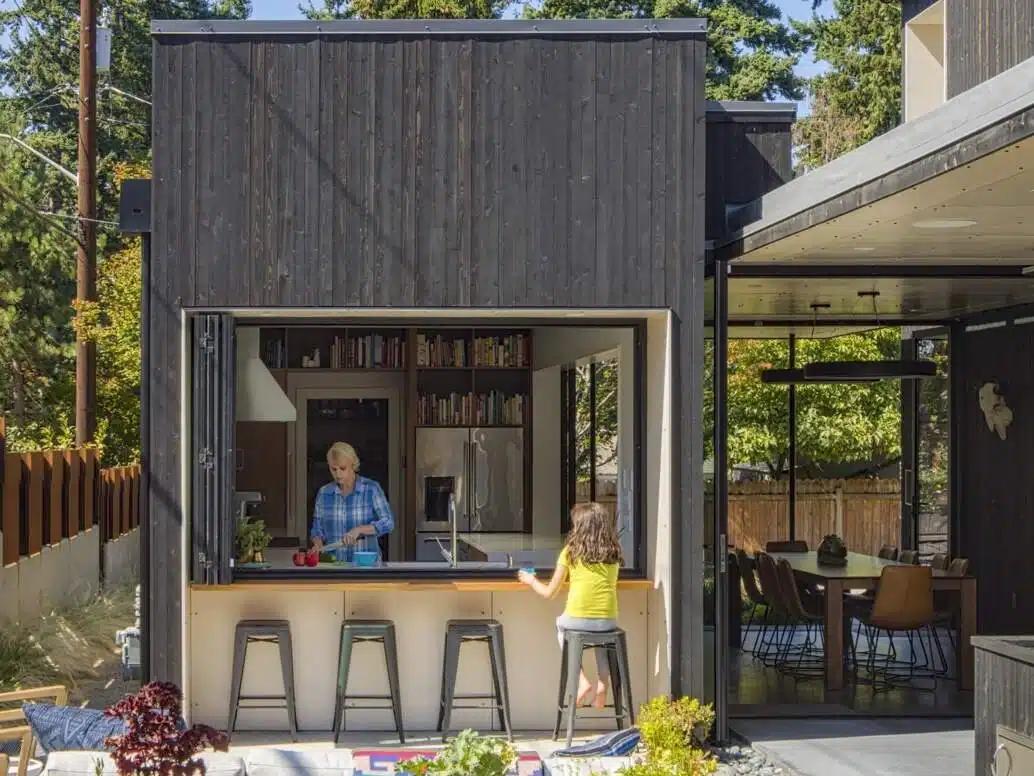
Amidst California’s rustic cottages, the Translators’ House in Culver City quietly evokes a certain poetry through a refined architectural translation. Stepping stones wind to its entrance through a small “meadow” of tall grasses. Its modern facade, with a large concrete plane marked by the ghostly imprints of woodwork, plays against the vertical grains of charred black Japanese timber (Shou Sugi Ban).
Here, Jacobschang Architecture (JCA) has partially translated a Japanese narrative into Southern California with precise intention, not mere imitation. The homeowners, both scholars of Japanese literature, wanted a warm, family-friendly home with an interesting design. The indoor-outdoor flow and use of wood in JCA’s work resonated with them, especially principal Mike Jacobs’s affinity for Japanese design culture.

The couple requested a two-story house that would feel open to the street yet private, including a low entry space (like a Japanese genkan) for removing shoes. The challenge was balancing openness with privacy on a relatively narrow urban lot. In response, the architects created a 3,885-square-foot home punctuated by north and south courtyards and screens of foliage.
From the street, the stone path curves around the front door, handmade in Japan using the ancient naguri-saib technique. This threshold is the project’s first physical translation: preserving a threatened craft, much as the owners preserve threatened literary forms.

One enters a “swimming pool” of coarse gravel, reminiscent of Japanese gardens where gravel evokes the metaphor of water. A platform of white oak provides low seating for removing shoes. An L-shaped concrete wall acts as an organizational spine on the ground floor, its raw materiality playing against soft, charcoal-gray cabinets.
Before reaching the main living areas, the hallway opens to a library overlooking a small courtyard with a Japanese basalt rock. Here, a low, traditional-style dining table sits over a well that comfortably accommodates legs; with a modern twist, this furniture disappears when a wooden lid is lowered, sinking it flush with the floor. The proportions hint at tatami mats, but the goal was never to recreate a traditional Japanese room.

“We never intended to transplant a Japanese house to Southern California—we weren’t interested in replication or fake Zen,” says the wife. Instead, the approach was to integrate elements of Japanese culture—or mere hints of them—in ways closer to literary translations, where two languages intersect to create new meaning.
The concrete spine ends in bright, open-plan common spaces: a clean kitchen, a Western-style dining area, and a high-ceilinged living room. Sliding doors—their frames in Douglas fir, as throughout the house—open these spaces to the courtyard. Upstairs, the bathrooms integrate bright tiles whose bold, playful patterns echo the cultures of both modern Japan and Los Angeles. The basement, lit by a large light scoop, is lined in sleek concrete.

Throughout, the varied interior and exterior spaces create serene atmospheres without losing connection to the street. The distinctive charred cladding, resistant to fire and moisture, is the ultimate expression of this translation: not a copy, but a bold and confident adaptation that belongs entirely to its new context.

✦ ArchUp Editorial Insight
This article explores the “Translators’ House,” a residential project that masterfully translates Japanese architectural principles and cultural elements into a distinct Southern Californian context, moving beyond mere imitation to create a new, hybrid language of design. The core idea is that architecture, like literature, can perform an act of cultural translation, respecting the source material while adapting it for a new environment and function. A minor critique is that the article occasionally gets lost in architectural jargon, which might obscure the elegant simplicity of its central “translation” metaphor for a general reader. However, it ultimately succeeds by showcasing specific, brilliant features—like the disappearing sunken table—that make the theoretical concept physically tangible and deeply resonant, proving the design’s profound success.
Brought to you by the ArchUp Editorial Team
Inspiration starts here. Dive deeper into Architecture, Interior Design, Research, Cities, Design, and cutting-edge Projectson ArchUp.