How to strengthen the longitudinal skin in the beam

Longitudinal skin stiffeners are deformed bars,
wires or prestressed stiffeners uniformly placed on both sides of the vertical face of the tension zone in relatively deep beams to control the width of the cracks.
If the deep girder is not equipped with such reinforcement,
the width of the cracks in its web will be greater than the cracks developed at the level of the longitudinal tension reinforcement.
When the depth of unstressed C-class beam is greater than 900mm,
Lacing reinforcement shall be provided for a depth distance from the tensile side of the beam, in accordance with ACI 318-19.
However, the British Standard for the Design and Construction of Prestressed and Reinforced Concrete Structures (BS8110),
It states that a skin reinforcement shall be provided for a distance measured at a depth of 2/3 of the tension face of the beam if the depth of the element is greater than 750 mm.
In addition, Eurocode 2 Part 1-1 specifies that this reinforcement must be provided for beams of 1000 mm or more in height.
This article introduces the purpose and detail of leather reinforcement based on ACI 318-19.
The purpose is to strengthen the skin
- Reduces the slit width in the beam web.
- Increases the maximum carrying capacity of the beam.
Leather reinforcement detail
tape size
The diameter of the skin reinforcement ranges from No. 10 to No. 16.
Alternatively, welded wire reinforcement shall be made with an area of at least 210 mm2 per meter of depth.
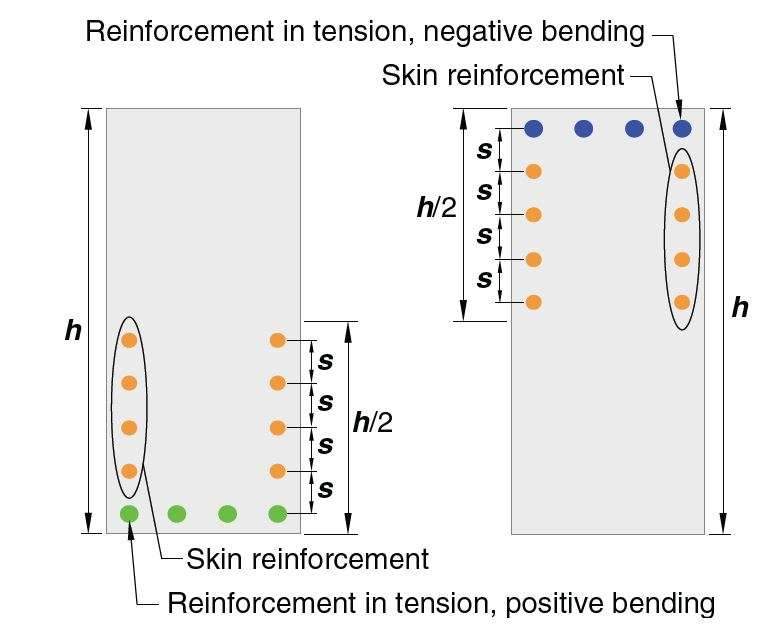
Skin strengthening mode
The position of the skin reinforcement for positive and negative moments is shown in the following figure.
For more architectural news
https://archup.net/how-to-distinguish-between-shear-wall-and-column/